- Coaching & Consulting
- Collaboration
- Training
- Events
- Leadership Simplified
- Sales Simplified
- Leadership Perspectives
- Manufacturers’ Leadership Development Program: Phase II
- Leading a Hybrid Workforce
- Leading in the Time of Covid-19
- Manufacturers Leadership Development Program
- Speaking Simplified
- Leadership Starts Young
- Leadership Accelerator
- Leadership Development Program
- e-Learning
- Company
- Media
- Store
 My Cart


Newsletters
Creating Followership
Volume: May 2026Raymond admires Ivan’s leadership abilities. The two leaders have worked for the same company for eight years and have collaborated on a number of projects and initiatives. During that time Raymond, a capable leader, has struggled with creating buy-in and enthusiasm with his team during turbulent times and regarding tougher projects. Ivan on the other hand, has seemingly experienced no problems with leading his team through troubled waters or engaging their efforts during tough projects. The end results are acknowledged kudos that Ivan’s team is consistently more productive than Raymond’s. In addition, the positive impact of Ivan’s team on the organization has netted Ivan several promotions that have distanced him from Raymond’s level of management – a level they once shared. What magic touch does Ivan possess that Raymond somehow lacks? The answer, my friends is not magic. The answer lies in Ivan’s ability to create followership.
Google defines followership as “the ability or willingness to follow a leader.” Those leaders who enjoy followership can savor something more valuable than gold. In fact, in his search for gold, Raymond dissected Ivan’s ability to create followership. Along the way, he learned about six qualities that Ivan possesses.
1. Consistency. Ivan is as steady as they come. When team members have excelled, Ivan consistently rewards them – and the act of rewarding is very public. When team members make costly errors, they have come to expect a private conversation with Ivan. The conversation focuses on facts, and the desired corrective actions are always specific. In fact, Ivan is so consistent with his leadership that when things happen (good or bad) when he is away, his team members joke about how he will react. Sure enough, when Ivan returns, he always reacts as predicted, much to the delight of his team. An important note: What Ivan’s consistency has led I call leadership in absence. What I mean by this is that even when he is away, Ivan’s values and his leadership culture, still govern his team’s behavior.
2. Coaching. Ivan’s team members tease him that he has a coaching problem. He seems to always be coaching. He notices the little things and frequently complements team members on things they are doing right. Even on the items that they are supposed to be doing right in the first place! When he notices results or behaviors that are not up to his standard, he is quick to privately mention the unsatisfactory outcomes to the team member. He also consistently cites the impact of the results on the team, as well as the specific outcomes he expects in the future. He is exuberant when praising, and calm when correcting. In other words, Ivan is a master at delivering effective feedback.
3. Courage. Six years ago, Ivan experienced some unfortunate health issues stemming from a non-work accident. Many people in similar circumstances do not recover from what Ivan faced. His team visited him in the hospital and they were very concerned about his condition at the time. From the time he saw his team, his family, his friends, Ivan was consistent with his message: I am going to work again; I am going to get my life back. What courage. Ivan sent a focused, consistent message to everyone he knew that nothing could keep him down. And nothing has. It should be noted that he did not need a catastrophic event to display his courage; he exhibits that same courageous behavior when times are tough at work. And you know what? His people follow his lead. They heed his words and direction because they believe in him.
4. Combativeness. Ivan is a very nice person. But those who know him are not lulled into a false sense of Kumbaya by Ivan. He is not afraid to mix it up for things he believes are needed or are right. What separates Ivan from many leaders who are perceived as combative is the fact that Ivan possesses good judgment. He knows how to pick his battles. And when he chooses a battle, he goes about resolving conflict in a strategic way – he seeks to have every side win.
5. Compassion. Empathy flows from Ivan. He has the ability to place himself in the other person’s position and to therefore, look at situations from different perspectives. He makes some unusual decisions as a result. But ultimately, his consistent sense of fairness plays out as the right path to have taken. Ivan has not always been so compassionate. It is an emotional intelligence trait that he has worked on a great deal over the years. He is a leader seeking to constantly improve himself, as well as his team and their results.
6. Creativity. Long ago Ivan embraced the fact that the business world changes quickly and you are either on the bus for change or you are off it. He seeks to not only be on the bus, but he likes to drive. As such, he constantly searches for fun, innovative ways to reward his team members. He participates in formal brainstorming sessions with his team and their clients in order to glean fresh ideas that can yield competitive advantage. Because he is consistently creative, Ivan’s team is consistently energized. They do not know what new things he will come up with, they just know he will consistently surprise them – pleasantly so.
Bottom Line: Creating followership is a process. It calls for leaders to be creative, yet consistent. Creating followership also challenges leaders to coach team members and to not be shy about resolving difficult situations. Outstanding leaders are intentional about creating followership. They value the productivity it enables, and savor the outstanding results it delivers for their teams.
Until next time, be well!
Doug Van Dyke is an executive coach, leadership development expert, teambuilder, and strategic planner. To learn more or have Doug speak at your event contact .(JavaScript must be enabled to view this email address).
Enjoy this post? Share it with others.
 del.icio.us
 Digg
Digg
 Email
Email
 Facebook
 Google
 LinkedIn
 Live
Live
 Mixx
Mixx
 StumbleUpon
 Technorati
 TwitThis
Leading Through Noise: Decision Clarity in a High-Change Year
Volume: January 2026 If 2025 taught leaders anything, it’s that information does not equal clarity. Leaders can access dashboards, AI summaries, customer feedback, and market headlines – and still feel stuck. In high-change environments like most of your organizations, the bottleneck often is not effort, rather, it’s decision clarity. In other words, the sticking point is frequently the analysis paralysis caused by “what are we doing”, “what are we not doing”, “who decides,” and “how will we know this is working?”
If you can relate, the good news is clarity is not complicated. It’s a set of repeatable habits that reduce “decision drag,” speed execution, and improve morale. The following is a simple framework that you can implement immediately.
The 2026 Clarity Reset: 4 Moves That Cut Through Noise
- Name the Noise (so it stops reordering your priorities)
Do this today:
Ask: “What are the top three sources of noise for us right now?”
Examples: unclear priorities, overlapping ownership, too many meetings, reactive customer escalations, shifting targets, AI outputs with no accountability.
Why this matters: When you name the noise, you can design around it. If you don’t, it designs your week for you.
- Choose a “One-Page True North”
One-page True North (complete in 10 minutes):
- Win Theme (Q1): The one sentence that defines success this quarter
- Top 3 Outcomes: measurable outcomes you will protect
- Not Doing List: 3–5 things you will pause, stop, or decline
- Key Constraints: budget, capacity, risk, deadlines
- Success Signals: how you will know your team is on track (weekly indicators)
- Clarify Decision Rights (to ensure speed and team member accountability)
Use a simple Decision Rights grid:
For each critical area (hiring, pricing, customer escalations, scheduling, quality, technology changes), define:
- D (Decides): one owner who makes the call
- I (Input): who is consulted
- E (Executes): who carries it out
- V (Veto/Review): only if required (legal, compliance, safety)
- Install a Weekly Decision Cadence
The 30-minute weekly cadence:
- Priorities: What are the top 3 priorities this week?
- Risks: What could derail them?
- Decisions Needed: What decisions must be made by Friday?
- Owners & Dates: Who owns each decision, and by when?
Immediately Implementable Takeaways
For Executives: “Fewer, Clearer, Faster”
Executives create clarity by choosing, communicating, and protecting focus.
- Publish three enterprise decisions for Q1
- “We will prioritize retention over new logo growth this quarter.”
- “We will pause non-essential projects to stabilize delivery quality.”
- “We will adopt a single customer escalation pathway.”
- Create an explicit ‘Not Doing’ list
- Standardize your decision language
- “Here is the decision.”
- “Here is what stays the same.”
- “Here is what changes.”
- “Here is who owns execution.”
- “Here is how we’ll measure progress.”
Executive 10-minute action to consider:
Send a short note to your organization: Q1 Win Theme; Top 3 Outcomes; and Not Doing It List. Invite questions, not negotiations.
Immediately Implementable Takeaways
For People Leaders: Turn Priorities into Team Momentum
Middle leaders are where clarity becomes action – where strategies translate into schedules, coaching, and tradeoffs.
- Use the “Tradeoff Question” in every meeting
Ask: “If we say yes to this, what are we saying no to?”
This single question prevents overload and forces real prioritization.
- Run a 15-minute “Decision Backlog” review weekly
Make a list of stuck items. Then categorize each:
- Needs a decision
- Needs more data
- Needs escalation
- Needs to be dropped
- Make ownership visible
Ambiguity loves silence. Post a simple tracker:
Decision / Owner / Due date / Status
People leader script for clarity (consider this immediately):
- “To reduce rework, let’s confirm the decision we’re making today.”
- “Let’s share input for 10-minutes, then I’ll call it.”
- “If you disagree, tell me what risk you see and what you recommend instead.”
Immediately Implementable Takeaways
For Frontline Supervisors: Clarity at the Point of Work
Supervisors win when the team knows “what good looks like” today – not in theory.
- Start shifts with one sentence & three bullets
- One sentence: “Today we win by…”
- Three bullets: the 3 must-do priorities (safety/quality/customer speed, etc.)
- Make escalation rules simple
- When does a team member stop and call you?
- When do you escalate upward?
- Write it down. Train it. Repeat it.
- Reduce “decision ping-pong”
If people keep asking the same questions, you don’t need more reminders – you need a clearer rule.
Frontline clarity phrases:
- “Pause. Here’s the standard.”
- “If X happens, do Y – every time.”
- “If you are unsure, choose the option that protects safety/quality/customer.”
Supervisor 10-minute action to consider:
Create a “Top 5 Decisions You Can Make Without Me” list. It builds confidence and speeds work.
Bottom Line: The Leadership Standard for 2026
In a high-change year, your team does not need perfect answers. They need you to create clarity they can act on. When priorities are visible, decision rights are clear, and the cadence is consistent, people move with confidence – even when conditions are uncertain.
Until next time, be well!
Doug Van Dyke is an executive coach, leadership development expert, teambuilder, and strategic planner. To learn more or have Doug speak at your event contact .(JavaScript must be enabled to view this email address).
Enjoy this post? Share it with others.
del.icio.us
Digg
Email
Facebook
Google
LinkedIn
Live
Mixx
StumbleUpon
Technorati
TwitThis
AI Literacy Leadership: Navigating and Leveraging the AI Frontier
Volume: August 2025
In today’s rapidly evolving business environment, the most effective leaders are not simply visionaries — they are AI-literate visionaries. Artificial Intelligence has shifted from being a niche technology to a foundational driver of productivity, competitiveness, and innovation across industries. Whether in healthcare, finance, manufacturing, education, or creative industries, AI’s influence is expanding at a velocity that challenges even the most agile executives.
For leaders, AI literacy is not about becoming a data scientist or programmer. Rather, it’s about cultivating a strategic fluency in AI: understanding its capabilities, limitations, ethical implications, and potential to reshape markets, customer expectations, and internal operations.
Why Leaders Must Continually Educate Themselves
- The AI Landscape Is Not Static
AI models are evolving from narrow, task-specific tools to multimodal, interconnected systems that can process text, images, voice, and video simultaneously. What’s cutting-edge today can be outdated in 12 months. Leaders who pause their AI learning risk making decisions with obsolete assumptions. - Competitive Advantage Depends on Applied Knowledge
AI-literate leaders can identify the right AI tools that align with their organizational goals — whether it’s automating repetitive workflows, enhancing customer personalization, or predicting supply chain disruptions. - Ethics, Risk, and Governance Are Board-Level Issues
With AI comes regulatory scrutiny, ethical dilemmas, and potential reputational risks. Leaders who understand these nuances can set guardrails that foster innovation while protecting the organization.
- Integrate AI Learning into Internal Learning
Regularly schedule AI briefings, internal workshops, and cross-functional roundtables with both internal IT teams, executive coaches, and external AI experts. - Participate in AI Pilots
Leaders should personally join at least one AI-driven project per year to experience firsthand how the technology is deployed and the challenges encountered. - Leverage AI Curators and Translators
Designate an AI “translator” within the organization — someone who can bridge technical and strategic perspectives for the leadership team. - Adopt a “Microlearning” Mindset
Dedicate 15 minutes a day to AI reading or hands-on experimentation. Even small, consistent engagement keeps leaders conversant with AI’s evolution.
While the AI universe is vast, a handful of categories and tools are particularly transformative for organizations today:
- Generative AI Platforms
- OpenAI’s GPT-5; and Google’s Gemini Pro: Advanced language models for knowledge synthesis, content creation, and decision support.
- Anthropic Claude: Known for safer, more interpretable conversational AI.
- AI-Driven Analytics & Forecasting
- Google Cloud Vertex AI: For custom model building, predictive analytics, and operational forecasting.
- Microsoft Azure AI: Deep integration with enterprise tools like Excel, Power BI, and Teams.
- Process Automation & Intelligent Workflows
- UiPath and Automation Anywhere: Robotic Process Automation (RPA) integrated with AI decision-making.
- Industry-Specific AI Applications
- PathAI (healthcare diagnostics), SambaNova (AI infrastructure for scale), Jasper (marketing content optimization).
- Multimodal AI Systems
- AI capable of simultaneously processing text, audio, and imagery, opening new opportunities in training, security, and customer experience.
AI Literacy in Hiring: Raising the Bar
Forward-thinking organizations are incorporating AI literacy into recruitment and promotion criteria. Candidates — regardless of role — should demonstrate a foundational understanding of AI’s role in their industry.
Why?
- Employees with AI literacy can independently identify use cases.
- Teams with distributed AI fluency accelerate adoption and minimize resistance.
- AI-fluent hires reduce the burden on technical teams by contributing to cross-functional implementation.
Behavioral-Based Interview Questions for AI Literacy
- "Tell me about a time you used an AI tool to improve a work process or solve a problem. What tool did you use, and what was the measurable result?"
Purpose: Assesses real-world application and comfort with AI tools. - "Describe a situation where you identified a potential risk or ethical concern in using AI. How did you address it?"
Purpose: Evaluates awareness of AI governance and ethical considerations. - "Give an example of how you stayed current with AI developments in your field over the last year. How did this knowledge impact your work?"
Purpose: Measures commitment to continuous AI learning and strategic awareness.
The Bottom Line
AI Literacy Leadership is no longer optional. Leaders who intentionally develop their AI fluency — and who embed that expectation into their organizational DNA — will not just keep pace with change, they will shape it. The future belongs to organizations where AI is not a distant concept managed by a few specialists, but a shared competency that informs every strategic move.
Until next time, be well!
Doug Van Dyke is an executive coach, leadership development expert, teambuilder, and strategic planner. To learn more or have Doug speak at your event contact .(JavaScript must be enabled to view this email address).
© 2025 Leadership Simplified. All rights reserved.
Enjoy this post? Share it with others.
del.icio.us
Digg
Email
Facebook
Google
LinkedIn
Live
Mixx
StumbleUpon
Technorati
TwitThis
Leadership & A.I. Policy
Volume: June 2025
It’s hard to believe that it has been two years since I published a series of newsletters focusing on artificial intelligence. In one of the newsletters, I shared a sample AI policy. It was my hope that leaders would work with their HR and legal departments to subsequently create their organization’s customized AI policy. Surprisingly, their remains a large number of organizations that have yet to create and deploy an AI policy.
Well, and I am going to sound a little bit like Woody from the original Toy Story here (he spoke about finding a “moving buddy”), but I will put it this way: “AI Policy; don’t have one? Get one!” I truly am serious here folks. If your organization does not have a policy in place that clearly states artificial intelligence usage guidelines, please (please!) use your influence to get one created and communicated asap. Below is a sample AI Usage Policy that I created, ironically, via AI.
Some of you may be curious as to the AI that I leveraged, as well as the Prompt I entered to create the policy that appears below. It was ChatGPT and here the exact Prompt used: “Please create a comprehensive Artificial Intelligence policy that could be inserted into a process and procedure manual. Seek to maximize safety protocols while also offering AI usage guidelines that could provide maximum benefit to the organization.”
For further context, here is ChatGPT’s message to me as it delivered (within seconds mind you) the below policy. “Here is a comprehensive Artificial Intelligence (AI) Policy that can be inserted into a Process and Procedure Manual. It is structured to maximize safety, ensure compliance, and encourage productive and ethical use of AI within an organization.”
With all that out of the way, on to a necessary disclaimer and then an informational AI policy that will hopefully spur many of you into action.
DISCLAIMER: We here at Leadership Simplified are NOT attorneys. The following is provided for information only and is designed to spur leaders into action regarding the creation of their own AI policies and procedures. Leaders are advised to always consult their human resources and legal departments before putting company policies into place.
Artificial Intelligence (AI) Usage Policy
Effective Date: [Insert Date]
Last Reviewed: [Insert Date]
Next Review Date: [Insert Date]
1. Purpose
This policy establishes standards and protocols for the safe, ethical, and effective use of Artificial Intelligence (AI) technologies across the organization. The intent is to safeguard organizational integrity, protect stakeholder data, and maximize the benefits AI can provide in enhancing decision-making, productivity, and innovation.
2. Scope
This policy applies to:
- All employees, contractors, consultants, interns, and third-party vendors.
- All AI tools, systems, and platforms used for data analysis, automation, communication, decision support, or customer interaction.
- Both proprietary and third-party AI systems used in operations.
3. Definitions
- AI (Artificial Intelligence): Systems or tools that simulate human intelligence processes including learning, reasoning, and self-correction.
- Generative AI: Tools that produce new content such as text, images, audio, or code based on input prompts.
- Automated Decision-Making: Decisions made by AI without human intervention.
- Responsible AI Use: Ethical and lawful deployment and monitoring of AI that aligns with human values and organizational goals.
4. Guiding Principles
- Transparency: AI operations and decisions must be explainable and traceable.
- Accountability: Human oversight is required in all AI-influenced decisions, especially those impacting individuals or critical business outcomes.
- Privacy & Security: AI usage must comply with all applicable data privacy laws (e.g., GDPR, HIPAA) and internal cybersecurity standards.
- Equity & Inclusion: AI tools must be regularly reviewed for bias and fairness to prevent discrimination.
- Compliance: All AI use must adhere to relevant laws, regulations, and industry best practices.
5. Acceptable Use Guidelines
Approved uses of AI include, but are not limited to:
- Data analysis and visualization to support decision-making.
- Business process automation (e.g., invoice processing, customer service chatbots).
- Predictive modeling for customer behavior, inventory, or risk assessment.
- Content generation for internal communications, reports, and training materials, with appropriate human review.
- Language translation or accessibility enhancements.
6. Prohibited Uses
The following AI use cases are strictly forbidden:
- Making employment, legal, medical, or financial decisions without human oversight.
- Deploying AI tools that process or infer sensitive personal information without consent.
- Using generative AI to fabricate data, impersonate individuals, or manipulate public opinion.
- Integrating unvetted or unauthorized AI tools into core business systems.
- Relying solely on AI for regulatory compliance or legal interpretation.
7. Risk Management & Safety Protocols
- Risk Assessments: AI tools must undergo a risk and impact assessment prior to deployment.
- Bias Testing: AI systems must be evaluated periodically for accuracy, fairness, and unintended biases.
- Audit Trails: All AI-based decisions should be logged and reviewable for audit purposes.
- Incident Response: Any AI-related anomaly, breach, or ethical concern must be reported immediately to the Data Protection Officer (DPO) or AI Governance Committee.
8. Oversight and Governance
- AI Governance Committee: A cross-functional team responsible for reviewing AI use cases, setting standards, and monitoring compliance.
- Ownership & Accountability: Each department using AI must designate an AI Use Steward to ensure adherence to this policy.
- Training & Awareness: All staff must complete mandatory training on responsible AI usage annually.
9. Third-Party AI Tools
- Third-party AI vendors must be vetted for data protection, reliability, and ethical practices.
- Contracts with AI vendors must include clauses on data security, ownership, explainability, and liability.
10. Review and Revision
- This policy will be reviewed at least annually or as needed in response to significant legal, technological, or operational changes.
11. Policy Violations
Non-compliance may result in:
- Suspension of access to AI tools.
- Disciplinary action up to and including termination.
- Legal consequences where applicable.
12. Contacts
For questions or reporting concerns, please contact:
- AI Governance Committee – [Insert Contact Info]
- Data Protection Officer (DPO) – [Insert Contact Info]
Bottom Line: Please help to reduce Doug Van Dyke’s stomach acid and stress levels by creating/updating your organization’s AI Usage Policy. Father’s Day is this month people, throw me a bone here (and drastically reduce risks within your organization in the process).
Until next time, be well.
Doug Van Dyke is a leadership development expert, executive coach, strategic planner, and Certified Speaking Professional. He is AI Literate and strongly desires for you to be as well. Contact him at .(JavaScript must be enabled to view this email address), www.leadershipsimplified.com, 941-776-1121.
Enjoy this post? Share it with others.
del.icio.us
Digg
Email
Facebook
Google
LinkedIn
Live
Mixx
StumbleUpon
Technorati
TwitThis
Leadership Resilience
Volume: February 2025
Hurricanes battering the Southeast, epic cold pummeling the North, and fires ravaging the West, it seems that calamity is everywhere. And with calamity comes the need for resilience. As leaders, we don’t often think about resilience as a skill. Yet, it most assuredly is. With the accelerating pace of work, constant change, and evolving technology, the skill of resilience is of paramount importance.
Resilience is defined as the capacity to withstand or to recover quickly from difficulties; psychological resilience is the ability to cope mentally and emotionally with a crisis, and to return to pre-crisis status quickly
Here are the nine (9) core elements of resilience that are pertinent to leadership.
1. Build & Leverage Strong Professional Relationships
2. Foster a Positive Environment
3. Innovate Through Critical Thinking
4. Decide with Confidence
1. Build & Leverage Strong Professional Relationships
- Strengthen Support Networks: Put into play the strong support networks that you have built over the years. This includes outside resources, peers, and mentors. In times that call for resilience, these networks provide essential emotional support, as well as practical advice.
- Communicate Effectively: Open and honest communication is essential when demonstrating resilience. Trust that has been built, coupled with established followership makes a leader’s communication impactful. Communication should also be channeled based on what the situation necessitates or via your preferred methods. Sometimes, picking up the phone or having a quick face-to-face avoids unnecessary frustration, preserving trust.
2. Foster a Positive Environment
- Encourage Pragmatic Optimism: Leaders who maintain a positive and grounded outlook help others stay motivated during difficult times.
- Celebrate Success: Voraciously look for small wins and recognize them along the way. This will boost morale and build momentum.
3. Innovate Through Critical Thinking
- Practice Problem-Solving Skills: Resilient leaders are nimble as they solve short-term, medium-term, and long-term issues. They also anticipate further challenges and plan to the best of their ability.
- Be Resourceful: A hallmark of a resilient leader is to leverage limited resources and find creative solutions to problems. Frequently, the resulting solutions become permanent features of the organization.
4. Decide with Confidence
- Hone Your Decision-Making Skills: Mistakes will be made. However, in times that call for resilience, selecting a direction is more important than perfection. While making the most informed decision possible, don’t forget to listen to your gut. Your instincts will often lead to sensible decisions being realized.
- Adapt Quickly: Resilient leaders are flexible and open to change, which enables them to pivot as necessary.
5. Maintain a Long-Term Perspective
- Commit to Your Vision and Purpose: Keeping sight of the organization’s vision, mission, and values help leaders and teams stay focused during turbulent times.
- Practice Patience: Leaders understand that resilience often requires patience and persistence. This self-discipline helps leaders avoid making hasty decisions.
6. Help Others Be Resilient
- Delegate: Effective delegation not only helps manage workload but also empowers team members, creating a more resilient organization.
- Develop Talent by Doing: Leading by example is in investment in the development of others. In the process, leaders build a stronger, more capable team that can weather challenges together.
7. Maximize Self-Awareness
- Understand Your Stress Triggers: Identify what creates stress in you and develop methods to compensate or minimize the negative impact of your stressors. Professional burnout is frequently caused by leaders being overly stressed.
- Develop Emotional Intelligence: This trait allows leaders to manage their emotions and to better deal with the emotions of others. There are four broad areas of EI: self-awareness, self-management, social-awareness, and social-skill. Understanding these major areas can help leaders triage issues quicker and determine if an issue is about a person or the group dynamic.
8. Maintain a Life-Long Learning Mindset
- Embrace Challenges: View challenges as opportunities. Using proven and learned problem-solving skills to overcome challenges can lead to resilience and help leaders to stay motivated.
- Grow from Failures: Instead of seeing failures as setbacks, resilient leaders see them as learning opportunities.
- Focus on Education: Leaders should commit to lifelong learning to stay ahead of industry trends and develop new skills.
- Seek Feedback: Receiving regular feedback helps leaders grow and adapt to changing circumstances. Whether from an executive coach, internal roundtables, or the Peer 360 process, gain information from professionals you respect and trust.
9. Prioritize Self-Care
- Exercise to Win: Don’t just engage in “regular” exercise that meets the minimum for health. Leaders excel. Seek to have an exercise program that is rigorous and challenging. That vigor and drive carries over to the workplace. Often it can inspire others. Plus, your body will be able to weather the long-game, whatever that holds for your career.
- Get Sleep: The mind and body of a leader is rejuvenated during sleep. Depriving yourself of sleep deprives your team of excellence.
- Monitor Nutrition: Good health requires organic food that has been minimally processed. Supplements are not a substitute for real nutrition. A balanced diet is crucial for maintaining the energy and focus needed to be resilient.
- Protect Your Mental Health: Practices such as yoga, meditation, and relaxation techniques help to manage stress. The better you have a handle on stress, the more superior are the decisions you will make.
The Bottom Line
The skill of resilience enables leaders to navigate challenges quicker, drive changes easier, and maintain effectiveness under pressure. By focusing on key areas, leaders can enhance their response times, bounce back from adversity, create an advantageous path forward, and inspire resilience in others. In the process, they set the stage for their organization’s future success. When faced with seemingly insurmountable obstacles, resilient leaders think of three simple words: “Bring it on.”
Be resilient my friends, and continue to make this year filled with success and meaning.
Until next time, be well.
Doug Van Dyke is an executive coach, leadership development expert, teambuilder, and strategic planner. He extends his deepest condolences to those who have recently experienced loss due to extreme circumstances. To learn more about Leadership Simplified or have Doug Van Dyke speak at your upcoming event contact .(JavaScript must be enabled to view this email address).
Enjoy this post? Share it with others.
del.icio.us
Digg
Email
Facebook
Google
LinkedIn
Live
Mixx
StumbleUpon
Technorati
TwitThis
Being a Transformational Organization
Volume: August 2024
At a recent leadership conference, I had the honor of delivering a keynote on the ever-evolving workforce and how to lead transformational organizations in today’s gig-shifting economy. If this topic resonates with you, here are some takeaways to help you navigate a changing workforce.
Understanding the Gig Economy
The “gig economy” is a labor market characterized by the prevalence of short-term, freelance work engagements often facilitated through online platforms or apps. In this type of economy, individuals perform tasks, projects, or assignments on a flexible basis, usually for multiple employers or clients.
Today’s workforce is evolving faster than ever, and leading younger workers in today’s gig economy require a fresh approach. A full understanding of the gig economy is imperative to successfully navigating the evolving marketplace. Consider this, according to the U.S Bureau of Labor Statistics, as of 2022 the U.S. workforce consists of 164 million people, with 36% identifying as independent workers. The percentage of independent workers has increased by 27% since 2016, showing a significant shift towards freelance and gig work.
A 2023 United States Chamber of Commerce study projected that by 2028, the number of U.S. contract employees is expected to grow to more than 90 million, making up approximately 50% of the workforce.
Attracting Talented Young Workers
With this shifting employment landscape in process, the question now becomes “How do we attract talented young workers into our firms, companies, and organizations?” Here are some strategies to consider:
- High-Tech Interfaces: Based on surveys and interviews I have conducted, young professionals are drawn to organizations with cutting-edge technology. Ensure your systems are up-to-date and user-friendly.
- Web-Based Platforms: Flexibility is the key here. Make sure your interfaces are web-based and accessible from anywhere.
- Engaging and Easy Onboarding: Keep the onboarding process light, straightforward, and maybe even a little fun. Young professionals dread a boring, cumbersome first day!
- Minimum Contact with People: This might sound counterintuitive, but the younger generation prefers digital communication over face-to-face interactions. At least initially. Make it easy for younger professionals to get information without navigating complex human hierarchies.
Retaining Young Workers
Attracting talent is just the beginning. Retaining young, high-potentials is where the real challenge lies. Here are a few of my favorite retention approaches to positioning your organization for success:
- Tech-Savvy Environment: Create a technologically advanced workplaces with the latest tools and software. Keeping up with tech trends shows that you’re forward-thinking. In fact, younger workers will expect this type of environment and will leave if things appear to old school.
- Flexible Work Options: Offer remote work or flex hours to accommodate their work-life balance. The younger generation values flexibility immensely and expects a hybrid workplace.
- Career Development and Growth: Emphasize opportunities for learning and career advancement. They want to see a future with a learning-organization.
- Transparent Communication: Maintain open communication channels and regular updates. Everyone appreciates honesty and clarity.
- Strong Organizational Culture: (LINK to July 2024 newsletter) Showcase your organization’s mission, vision and values. Younger workers want to feel that their work has a purpose beyond just a paycheck.
Leading a Diverse Workforce
Leading a workforce that spans multiple generations and perspectives can be challenging but incredibly rewarding. Here’s how to excel:
- Leverage Paraphrasing in an Authentic Manner: It’s the great equalizer. Ensure that everyone feels heard and understood. When used elegantly and authentically, paraphrasing lets younger workers know that they have been heard and that you get it.
- Understand Generational Perspectives: Recognize the different motivations and work styles of each generation.
- Master Different Leadership Styles: Adapt your leadership style to suit the situation and the individuals involved. This flexibility can boost morale and performance.
- Be a Coach and Developer: Focus on nurturing talent and helping your team grow. Your role is not just to manage but to develop.
- Share Meaningful Feedback: Give feedback that is actually useful. Generic praise or criticism will not cut it. Be specific and share feedback that helps your people grow.
The Bottom Line
To succeed in today’s ever-changing marketplace, it is crucial for leaders and organizations to keep up-to-date on data and trends. Stand firm on your organization’s culture while customizing your approach to engaging with younger employees. Continually elevate your leadership skills and abilities. Remember, you are strong and a life-long learner. You have the tools and acumen to help your organization thrive in the evolving employee landscape.
Until next time, be well!
Doug Van Dyke is an executive coach, leadership development expert, teambuilder, and strategic planner. To learn more or have Doug speak at your event contact .(JavaScript must be enabled to view this email address).
Enjoy this post? Share it with others.
del.icio.us
Digg
Email
Facebook
Google
LinkedIn
Live
Mixx
StumbleUpon
Technorati
TwitThis
10 Best Practices for Leaders to Influence their Organization’s Culture
Volume: July 2024
“Culture eats strategy for breakfast.”
Peter Drucker
This well-known quote by Peter Drucker (the quintessential management guru of the 20th Century) emphasizes that no matter how well thought out an organization’s strategy might be, the execution thereof can only succeed if supported by their culture. In other words, a strong and positive culture is imperative to an organization achieving its strategic objectives.
My definition of leadership is, “Leaders Impact Culture.” This makes sense since leaders play such a critical role in shaping and influencing the culture of a company. Their decisions, interactions and behaviors set the tone for the entire organization. It is critically important that leaders have their organization’s culture and their ability to influence in the forefront of their minds. With this stated, I share 10 best practices for leaders to utilize as they shape and reinforce their organization’s culture.
- Setting a Vision and Values.
Leaders define and communicate the company's vision and core values. This provides a clear sense of purpose and direction for team members. Consistently reinforcing and upholding these values in decision-making helps embed them into the organization’s culture.
- Leading by Example.
The actions and behaviors of leaders serve as a model for team members. When leaders demonstrate the desired values of the organization such as integrity, collaboration, and innovation, team members are more likely to follow suit. Authenticity and transparency from leaders build trust, reinforce cultural norms, and help to make these qualities more pervasive throughout the organization.
- Communication.
Open, honest, and frequent communication helps foster a culture of transparency and trust. Leaders should actively listen to employees, encourage feedback, and be responsive to concerns and suggestions. The elegant and efficient use of a variety of communication channels is of paramount importance.
- Recognition and Rewards.
Recognizing and rewarding team member behavior that aligns with the desired organizational culture create a winning atmosphere. Leaders who implement recognition programs that celebrate individual achievement and team successes help codify a healthy culture that is action-oriented.
- Hiring and Onboarding.
Leaders also influence the culture through their recruitment, hiring and onboarding activities. Leaders who believe they are above these activities are missing a large opportunity to shape and perpetuate their organizations. Leaders should always be looking for talent. By hiring individuals whose values align with the organization’s, the overall team grows stronger. A thorough onboarding process helps to educate and immerse new hires into the organization’s culture. Effective onboarding also sends a message to new team members that they are valued and will be contributing to an already strong team.
- Training and Development.
Providing ongoing training and development opportunities aligned with the company’s values and culture encourages team members to grow in ways that support the organization’s goals. Executive coaching and leadership development programs ensure that future leaders are constantly learning and reinforcing cutting-edge practices. Developing and coaching team members also perpetuates the desired culture of the organization.
- Empowering Employees.
Encouraging employee autonomy and empowerment can foster a culture of trust and innovation. Leaders who appropriately delegate authority and encourage decision-making at all levels build a more engaged and proactive workforce.
- Creating a Positive Work Environment.
Leaders can influence the physical and emotional work environment, ensuring it is supportive, inclusive, and conducive to productivity. Policies and practices that promote work-life balance, mental health, and employee well-being contribute to a positive culture and reduce the incidence of burnout.
- Addressing Issues Promptly.
Effective leaders possess a high sense of urgency. Leaders must address cultural misalignments, conflicts, and unethical behavior promptly and efficiently. Consistent enforcement of policies and standards helps maintain the integrity of the organization’s culture.
- Building and Maintaining Strong Relationships.
Developing strong relationships with team members fosters a sense of community and belonging. Leaders who are approachable and empathetic can better understand and influence the cultural dynamics within the organization.
Bottom Line: By actively engaging in these practices, leaders can shape and sustain a strong, positive organizational culture. Strong cultures support an organization’s mission and maximize goal achievement. This leads to world class results. And, as Daniel Goleman once put it: “The leader’s singular job is to deliver results!”
Until next time, be well.
Doug Van Dyke is an executive coach, leadership development expert, teambuilder, and strategic planner, who works with organizations dedicated to a strong culture. To learn more or have Doug speak at your event contact .(JavaScript must be enabled to view this email address).
Bottom Line: By actively engaging in these practices, leaders can shape and sustain a strong, positive organizational culture. Strong cultures support an organization’s mission and maximize goal achievement. This leads to world class results. And, as Daniel Goleman once put it: “The leader’s singular job is to deliver results!”
Until next time, be well.
Doug Van Dyke is an executive coach, leadership development expert, teambuilder, and strategic planner, who works with organizations dedicated to a strong culture. To learn more or have Doug speak at your event contact .(JavaScript must be enabled to view this email address).
Enjoy this post? Share it with others.
del.icio.us
Digg
Email
Facebook
Google
LinkedIn
Live
Mixx
StumbleUpon
Technorati
TwitThis
Looking for Leadership? Look No Further Than Dawn Staley
Volume: April 2024
This past Sunday, the South Carolina Gamecocks women’s basketball team won this year’s NCAA Division I championship. It was their second title in three years, and third overall. ALL under the leadership of their coach, Dawn Staley. Now, I do not know coach Staley. However, I am a big fan of hers and a great observer of what I believe makes her and her team successful. The 2024 Lady Gamecocks were the 10th undefeated champion in D1 women’s basketball history. As a tribute, I share what I believe to be are Dawn Staley’s top 10 leadership attributes.
- Gratitude and a Belief in Abundance. After her team’s victory the first words out of Coach Staley’s mouth were an affirmation of her beliefs and a statement about how when one door closes, another opens. This leader believes in abundance and is grateful for what her team has achieved.
- Culture. When each of her players were interviewed about their individual and collective success, without exception they referenced the team culture and lack of selfishness that Coach Staley has created. Each player expressed gratitude for the unselfish sense of team.
- Balance. No player on the South Carolina team averaged playing more than 28 minutes per game. Each game is 40 minutes. This is a remarkable achievement considering most teams in the country play their starters 37 minutes or more per game. Balance leads to consistency, results, and a lack of burnout.
- Involvement. Coach Staley is known to commonly involve parents in her players’ progress, hurdles and opportunities. The parents are not decision-makers, but they are informed and, in a way, are a part of the team.
- Sacrifice and Discipline. During her halftime interview, Coach Staley referenced that in the second half of the game her team needed to stay disciplined so they would execute to their best and remain in sync with their game plan. They did just that.
- Goes With the Shot. Because of the balance and unselfishness of the South Carolina team, they can feed the ball to whichever teammate is playing the best. In the case of Sunday’s game, that happened to be a freshman player. The ability to have a team that can “go with the shot,” removes pressure from “star” players to always having to carry the load.
- Strategy. You don’t build an incredible culture, strike a winning balance, and create broad swaths of engagement without being strategic. Even when her team was down by 10 points in the opening minutes, Coach Staley was calm and poised. She had a plan and knew that her team would execute.
- Talent. Without question, Coach Staley is a gifted and talented leader. She also seeks to surround herself with the best. She recruits and attracts some of the best female basketball talent in the world. Coach Staley also acknowledged that one of her freshman players is a “generational talent” that may continue to take the women’s game to new heights.
- Recognition. Along with acknowledging hard work and dedication of her players, Coach Staley verbalized special recognition of a generational player on the opposing team (Iowa), Caitlin Clark. She personally thanked Caitlin for taking the game of women’s basketball to a new height. It was a classy and authentic moment from Coach Staley.
- Celebration. What is not lost by Coach Staley is the need to celebrate victories. When asked by a reporter what is next for her after such a milestone victory, Coach Staley exuberantly exclaimed “I’m goin’ to Disney World!” A nice way to celebrate indeed.
My admiration for Dawn Staley runs deep. She seeks to build great things – from the inside out. Noble. And worthy of notice and emulation.
Until next time, be well.
Until next time, be well.
Doug Van Dyke is an executive coach, leadership development expert, teambuilder, strategic planner, and hoops fan. To learn more or have Doug speak at your event contact .(JavaScript must be enabled to view this email address).
© 2024 Leadership Simplified. All rights reserved.
Enjoy this post? Share it with others.
del.icio.us
Digg
Email
Facebook
Google
LinkedIn
Live
Mixx
StumbleUpon
Technorati
TwitThis
Dynamic Leadership During Business Disruption
Volume: June 2023 If your organization is facing disruption as a result of the ascendence of artificial intelligence (AI), it is important for leadership to adapt and develop strategies that leverage AI technologies and benefit customers in the process. Here are 10 strategies to consider if your business is facing possible disruption due to AI.
- Embrace Artificial Intelligence as a tool: Instead of viewing AI solely as a threat, businesses should examine AI as a powerful tool for innovation and improvement. Guide your organization to identify areas and processes where AI can be implemented to enhance efficiency, reduce costs, increase revenues, and/or improve customer experiences.
- Invest in AI talent: Improving your team’s expertise in artificial intelligence may be crucial for your business to navigate potential disruption. Consider investing in training that provides your people with AI skills. An alternative is to hire new team members who understand and can implement artificial intelligence technologies.
- Adapt business models: For those of you that have engaged in our strategic planning programs/sessions, you have experienced tools to create and enhance your business model. Evaluate your current business model and identify areas where AI can disrupt or improve existing processes. Consider how AI can streamline operations, enhance product offerings, or enable new revenue streams. Adapt your business model accordingly to take advantage of AI's capabilities.
- Blank it out. On the heels of updating your business model, it may make sense to engage in our blank org chart exercise. If you believe your organization or industry will experience even minor disruption, you will want to ensure that your structure and organizational alignment is sound.
- Mind the metrics. Artificial intelligence relies heavily on data for its content creation and positioning. Update the metrics that your organization is tracking and leveraging so that you are cutting-edge in your industry. Collect and analyze relevant data to feed AI algorithms. This will enable more accurate predictions, relevant shared content, customized recommendations, and data-driven insights.
- Enhance customer/client/patient experiences: Artificial intelligence may be able to significantly improve customer experiences by providing personalized recommendations, real-time support, and/or predictive insights. Leverage AI technologies such as virtual assistants, chatbots, or recommendation engines to deliver tailored experiences that meet or exceed your customers’ expectations.
- Continuous learning and adaptation: AI technologies are constantly evolving. So too should your organization. Encourage a culture of continuous learning within your organization to keep up with the latest advancements. Stay updated on AI trends, attend conferences, leverage your executive coach, and foster an environment that encourages experimentation and innovation.
- Monitor the competitive landscape: Keep a close eye on how your competitors are leveraging AI. Monitor their strategies, partnerships, and investments in AI technologies. Identify opportunities where you can gain a competitive advantage or differentiate your offerings through AI.
- Provide policies and guidelines: Whether you like it or not, your people are using newer AI offerings such as ChatGPT and Bard. Some of our recent newsletters addressed the pros and cons of AI, as well as sample policies to consider. In addition, prioritize ethical considerations. As artificial intelligence continues to evolve, organizations should prioritize the ethics surrounding its use.
- Prepare for workforce changes: Adoption of new artificial intelligence may require reskilling or upskilling your workforce. Anticipate the changes AI will bring to job roles and skill requirements within your organization. Invest in training programs and support employees in acquiring the necessary skills to leverage to positives of AI systems effectively.
Bottom Line: Dynamic leaders are life-long learners. As such, they lead savvy organizations that are striving to be relevant and forward-thinking. By embracing and executing the key strategies put forth in this newsletter, your organization can proactively address disruptions that are caused by artificial intelligence. Ultimately, you and your team will be positioned to thrive in an AI-influenced future.
Until next time, be well.
Doug Van Dyke is a leadership development expert, executive coach, strategic planner, and Certified Speaking Professional. Contact him today about exciting programs, meaningful coaching, action-oriented strategic planning, and speaking at your event. .(JavaScript must be enabled to view this email address), www.leadershipsimplified.com, 941-776-1121.
© 2023 Leadership Simplified®. All rights reserved.
Enjoy this post? Share it with others.
del.icio.us
Digg
Email
Facebook
Google
LinkedIn
Live
Mixx
StumbleUpon
Technorati
TwitThis
Effective Leadership in a World of Artificial Intelligence | AI Part II
Volume: June 2023 "If knowledge is power, a savvy leader must continually educate themself."
Doug Van Dyke, CEO of Leadership Simplified
Due to the positive responses from our most recent leadership newsletter, we offer a follow up that examines a broader perspective of Artificial Intelligence (AI). Yes, yes there is a sample AI policy for your consideration later in this piece. We begin in a moment with a look at Neural Language Models (NLLMs), then we do a deep-dive on AI, and we end with a quick comment on Artificial General Intelligence (AGI). Clearly, this is our geekiest newsletter ever.
Part I - NLLMs
NLLM stands for Neural Language Model, which is a type of statistical model that attempts to predict the likelihood of a sequence of words given a context. In other words, it estimates the probability of a word given its previous words in a sentence. One popular variant of the NLLM is the Generative Pre-trained Transformer model (think ChatGPT), which has achieved state-of-the-art results on a wide range of natural language processing tasks. NLLMs are one of many types of publicly and commercially available artificial intelligences.
Part II - AI
Artificial Intelligence refers to the development of computer systems that can perform tasks that typically require human intelligence, such as learning, reasoning, problem-solving, and decision-making. AI systems are designed to analyze data, recognize patterns, and make predictions or recommendations based on that analysis. AI can be divided into two main categories: narrow or weak AI and general or strong AI. Narrow or weak AI systems are designed to perform specific tasks, such as speech recognition or image classification. These systems are trained using large amounts of data and rely on algorithms to analyze that data and make decisions. On the other hand, general or strong AI refers to machines that can perform any intellectual task that a human can. More on this in Part III. AI is used in a wide range of applications, from virtual assistants and chatbots to self-driving cars and medical diagnosis. The development of AI has the potential to revolutionize many industries, but it also raises important ethical and social questions that must be addressed.
Part III - AGI
Artificial General Intelligence (AGI) is an advanced form of artificial intelligence (AI) that aims to create machines capable of performing a wide range of intellectual tasks that are typically associated with human beings. AGI is characterized by the ability to learn, reason, plan, understand natural language, and solve problems in a general and autonomous way. For many, AGI is where things get scary. The advance of AGI is what may very well bring forth a national debate about some type of AI regulation (such as what the FDA is to food).
For now, we will focus on the Part II (AI) segment of this newsletter. Without further ado, here is the good, the potentially bad, and some internal guidelines to consider regarding Artificial Intelligence.
The Pros & The Cons
Positives of using AI:
- Increased efficiency and productivity: AI systems can automate repetitive or tedious tasks, allowing humans to focus on more creative and strategic work. This can increase efficiency and productivity in many industries.
- Improved accuracy and precision: AI systems can analyze large amounts of data and make predictions or decisions with a high degree of accuracy and precision.
- Better decision-making: AI can help humans make better decisions by providing them with data-driven insights and recommendations.
- Personalization: AI can be used to personalize products and services for individual users based on their preferences and behaviors.
- Improved safety: AI can be used to detect and prevent accidents in industries such as transportation and manufacturing.
Negatives of using AI:
Negatives of using AI:
So now, on to a sample Artificial Intelligence policy. But first, a disclaimer.
NOTE: The Leadership Simplified team are NOT attorneys and you always want to consult your human resources and/or legal departments before putting company policies into place.
Generic Artificial Intelligence (AI) Policy
Bottom Line: Successful organizations are always looking for an edge. The ethical use of AI certainly will give savvy organizations a competitive advantage. AI will be best leveraged by taking a long view. Strategically ponder medium-term and long-term ramifications of AI implementation. Will your use of AI increase morale? If not, will its implementation be worth the short-term & long-term efficiencies, profits, etc.? Leaders and organizations that turn a blind eye to examining AI through the lens of impacting their own industry do so at their own peril. Luckily, most of you are savvy leaders that guide learning organizations. Educate yourself and your people. Guide them through this unfolding, foggy forest. Set guidelines, and provide a bold vision. Build guardrails, and execute.
Until next time, be well.
Negatives of using AI:
- Job displacement: AI can automate many jobs that were previously performed by humans, leading to job displacement and unemployment in some industries.
- Bias and discrimination: AI systems can perpetuate biases and discrimination if they are trained on biased data or if the algorithms themselves are biased.
- Lack of transparency: Some AI systems are complex and difficult to understand, which can make it challenging to identify errors or biases.
- Security risks: AI systems can be vulnerable to hacking and cyber-attacks, which can put sensitive data at risk.
- Dependence on technology: As we rely more on AI, there is a risk that we become overly dependent on technology and lose some of our ability to think and make decisions independently.
So now, on to a sample Artificial Intelligence policy. But first, a disclaimer.
NOTE: The Leadership Simplified team are NOT attorneys and you always want to consult your human resources and/or legal departments before putting company policies into place.
Generic Artificial Intelligence (AI) Policy
- Benefits & Risks: We should, at all times, ensure that AI is developed and deployed in a way that maximizes its benefits while minimizing its risks.
- Responsible AI Development: The development of AI systems should prioritize ethical considerations and respect for human rights. AI should be designed to enhance human welfare, and any negative consequences of AI should be identified and addressed. To ensure responsible AI development, our organization will adhere to best practices in AI ethics, such as the IEEE Global Initiative for Ethical Considerations in AI and Autonomous Systems.
- Transparency and Accountability: AI systems will be transparent and accountable, with clear documentation of how they make decisions and what data they use. Developers should make an effort to avoid biases and discrimination in their systems, and they should be held accountable for any negative outcomes resulting from the use of their systems.
- Data Privacy and Security: The use of personal data in AI systems should be governed by robust privacy and security policies. AI systems should be designed to protect personal data and ensure that it is used only for its intended purpose. Our organization will implement safeguards to prevent data breaches and ensure the security of our systems.
- Workforce and Employment: AI has the potential to create significant disruptions in the labor market. We will take steps to mitigate these disruptions and ensure that the benefits of AI are shared across our organization and the broader society. This may involve investing in education and training programs to prepare employees for the jobs of the future and supporting initiatives to promote social mobility.
- International Cooperation: The development and deployment of AI are global issues that require international cooperation. As prudent, our organization may work with other countries and international bodies to develop shared standards for the responsible use of AI, promote research collaboration, and support the development of AI in developing countries.
- Ethical Considerations: Ethical considerations such as fairness, accountability, and transparency should be prioritized in the development and deployment of AI systems. In order to ensure that AI is used for the benefit of humanity, it is important to recognize the potential negative consequences of AI, such as the amplification of existing biases, and work to mitigate them.
- Continuous Learning and Improvement: The development of AI will be an ongoing process of learning and improvement. Our organization will be open to feedback and willing to adapt our systems to address any issues that arise. Research into the ethical and social implications of AI is also supported and encouraged.
Bottom Line: Successful organizations are always looking for an edge. The ethical use of AI certainly will give savvy organizations a competitive advantage. AI will be best leveraged by taking a long view. Strategically ponder medium-term and long-term ramifications of AI implementation. Will your use of AI increase morale? If not, will its implementation be worth the short-term & long-term efficiencies, profits, etc.? Leaders and organizations that turn a blind eye to examining AI through the lens of impacting their own industry do so at their own peril. Luckily, most of you are savvy leaders that guide learning organizations. Educate yourself and your people. Guide them through this unfolding, foggy forest. Set guidelines, and provide a bold vision. Build guardrails, and execute.
Until next time, be well.
Enjoy this post? Share it with others.
del.icio.us
Digg
Email
Facebook
Google
LinkedIn
Live
Mixx
StumbleUpon
Technorati
TwitThis
Leadership and Artificial Intelligence
Volume: May 2023 Artificial Intelligence (AI) has been making sensational headlines of late. In particular, Open AI’s ChatGPT has hit a tipping point that may impact each of our organizations. In my opinion, the latest wave of ChatGPT and AI will be transformational. Just as transformational as the Internet, perhaps even more so. At a minimum, ChatGPT immediately enhances the efficiency of computer programming and offers the ability to streamline marketing departments and their related output. What befuddles me though is that so few leaders and organizations are communicating their viewpoints on AI via internal policies and usage guidelines. Head-scratching really. So, the remainder of this newsletter offers the good and the potentially bad of ChatGPT, as well as a policy for your organization to consider.
For the uninitiated, here is a description of ChatGPT:
ChatGPT, a cutting-edge language model that can revolutionize the way you interact with your customers, employees, and stakeholders. ChatGPT has been “trained” via a vast corpus of data, enabling it to generate human-like responses to a wide range of queries currently known as “prompts.” With ChatGPT, you can automate your customer support, streamline your HR processes, and even create personalized marketing campaigns. But while the potential benefits of ChatGPT are immense, it is important to be aware of the potential hazards of misusing this technology.
Yes, yes, ChatGPT generated about 90% of the above paragraph.
The Pros & The Cons of ChatGPT
Positives:
- Speed and Efficiency: ChatGPT can process and respond to large volumes of data or queries at a faster pace than human agents, thus increasing efficiency and reducing response times.
- Cost-Effective: ChatGPT can provide 24/7 customer service, which means that you don't have to pay human agents to be available round-the-clock.
- Scalability: ChatGPT can handle multiple conversations simultaneously, making it easier to scale customer service and support operations.
- Personalization: With the right data inputs, ChatGPT can provide personalized recommendations and responses that can improve customer satisfaction and loyalty.
- Versatility: ChatGPT can be used for a variety of applications, from customer support to content creation, making it a versatile tool for businesses.
Negatives:
- Limited Understanding: While ChatGPT can mimic human language, it does not have the same level of understanding or empathy as a human agent, which can lead to misunderstandings or unsatisfactory responses.
- Biased Responses: As ChatGPT is trained on existing data, it can inherit biases and prejudices from the training data, leading to biased or offensive responses.
- Misuse: ChatGPT can be misused to spread misinformation or generate false content, which can damage a business's reputation or cause harm to individuals or communities.
- Security and Privacy Risks: ChatGPT can be vulnerable to cyber-attacks and security breaches, leading to the theft or misuse of sensitive data.
- Dependence: Over-reliance on ChatGPT can lead to a reduction in the quality of human interaction and customer service, leading to a decrease in customer satisfaction and loyalty.
Needless to say, it is important to weigh these positives and negatives when considering the use of ChatGPT, and to take steps to mitigate any potential risks or negative consequences.
Now, on to guidelines and a sample ChatGPT policy for leaders to consider.
NOTE: We hear at Leadership Simplified are NOT attorneys and you always want to consult your human resources and/or legal departments before putting company policies into place.
Okay, with the disclaimer out of the way, here is a policy sample on which to ponder.
Generic ChatGPT Policy
NOTE: We hear at Leadership Simplified are NOT attorneys and you always want to consult your human resources and/or legal departments before putting company policies into place.
Okay, with the disclaimer out of the way, here is a policy sample on which to ponder.
Generic ChatGPT Policy
- Employees are encouraged to ask ChatGPT questions and engage in conversation, but should not upload any information to ChatGPT that could potentially compromise their own privacy or the privacy of others.
- Any misuse of ChatGPT, including attempts to upload or share sensitive information, may result in the employee being blocked or banned from using the service.
- Employees are reminded that ChatGPT is an AI language model and may not always provide accurate or reliable responses. Employees should use their own discretion when considering ChatGPT's output or suggestions.
- Use ChatGPT responsibly: ChatGPT is a powerful tool that can be used for a wide range of purposes, but it is important to use it responsibly. Do not use ChatGPT to generate false or misleading information or to spread misinformation.
- Train ChatGPT carefully: ChatGPT is only as good as the data it has been trained on. Be sure to provide it with high-quality data that is relevant to the task at hand. Also, be aware that ChatGPT can sometimes generate biased or offensive content, so it is important to monitor and correct its responses.
- Be transparent: If you are using ChatGPT to interact with customers or stakeholders, be transparent about the fact that they are interacting with a machine. This can help avoid confusion and build trust.
- Protect company data: If you are using ChatGPT to collect or process organizational data, be sure to take appropriate security measures to protect that data. Follow best practices for data security and privacy, and be transparent about your data practices.
Bottom Line: An important aspect of leadership is decisiveness. Is it too early in the game to create the perfect ChatGPT policy? In my opinion, the answer is “yes.” However, the absence of a ChatGPT policy and specific guidelines (do’s & don’ts) places your organization in a precarious position. Many of you reading this newsletter do not want your team members using ChatGPT in the workplace. Guess what? They are. Not maliciously. Some of your people are just curious. Others, and I guarantee you this, are using ChatGPT in a productive way to create work product. If you haven’t chimed in with your thoughts and preferences on ChatGPT, you are behind in the game. My advice: Educate yourself, think strategically, make a decision, and craft guidelines to help your team continue to thrive.
Until next time, be well.
Doug Van Dyke is a leadership development expert, executive coach, strategic planner, and Certified Speaking Professional. Contact him today about exciting programs, meaningful coaching, action-oriented strategic planning and speaking at your event. .(JavaScript must be enabled to view this email address), www.leadershipsimplified.com, 941-776-1121.
© 2023 Leadership Simplified®. All rights reserved.
Enjoy this post? Share it with others.
del.icio.us
Digg
Email
Facebook
Google
LinkedIn
Live
Mixx
StumbleUpon
Technorati
TwitThis
S3 - Systems, Structure & Scale
Volume: February 2023 In today’s highly competitive, technology driven marketplaces, adjusting and sustaining your organization’s business model is imperative. Any organization that has not deeply examined their business model in the past 12 months is already behind the competition. For purposes of simplifying the complicated, this narrative addresses three key areas for leaders to consider when maximizing their organization’s model.
- Systems. From an analysis standpoint this can address processes and procedures, as well as automated systems and technology protocols that make your organization efficient. When was the last time that your organization critically evaluated the top three “systems” that are essential to success? If a savvy competitor entered your marketplace today, would they be utilizing systems and protocols similar to what you have in place? If either of these questions make you a bit nervous, the odds are good your organization is due for some self-examination. Tip: Don’t go on a witch hunt if some of your procedures and systems are outdated. Just make certain you drive an analysis that keeps the internal workings of your organization competitive.
- Structure. It’s very easy for organizations to experience a problem and to throw additional staff at the issue. Concurrently, as people are longer tenured or show skills in mission-critical areas, they are often launched into leadership positions prematurely. Sometimes they are a terrific fit and thrive, other times they struggle and so does their team. Typically leaders move people around based on their perception of the person’s skills, personality, or the organization’s needs. Ultimately what occurs is an organizational structure that is not optimized for nimbleness in a changing marketplace. Tip: Step back and give yourself an opportunity to engage in a Blank Org Chart Exercise. In the process, you will create a structure that aligns five key areas:
Structure → Talent → Coaching & Development Plans → Career Paths → Succession
- Scale. Once systems have been examined/enhanced and a strategic structure is in place, you can think about scale. What type of scale does your organization need in the marketplace to compete effectively? What scale is necessary to maintain your independence? (If independence is desired). What scale and ease of acquiring other organizations is needed if what you lead is an aggregator? Tip: An organization that has proper systems, structure and scale in place is well prepared to engage in a robust, action-oriented, strategic-planning process. This allows your organization to expand, sustain or defend with maximum results.
Bottom Line: Get the right people in the right places in your organization. Provide training and development that will help everyone grow in their current capacity. Examine the systems and procedures in your organization and throw out the archaic. Streamline for efficiencies, while leveraging every technological breakthrough possible. Lastly, make certain your business model is scalable. Only mergeable, scalable organizations will be able to keep pace in a vibrant marketplace that constantly pushes boundaries and grays lines. Here is the good news, you are a savvy leader who is action-oriented. Bravo! Go forth and help your organization self-examine in a healthy, growthful way. Lead change. And help your people realize that nimbleness leads to sustained success.
Enjoy this post? Share it with others.
del.icio.us
Digg
Email
Facebook
Google
LinkedIn
Live
Mixx
StumbleUpon
Technorati
TwitThis
The Thankful Leader - 2023 Edition
Volume: November 2023 Happy Thanksgiving Leaders! It’s time for our annual thankful-leader newsletter. As we enter the home stretch of 2023, many organizations are focusing on daunting challenges they will face during 2024. Some of the challenges are personnel related, others are financial. Many organizations will be executing strategic pivots, as well as entering new markets. With a swirl of topics on a leader’s mind, it is easy to lose sight of some very important actions. These actions include giving thanks. With Thanksgiving next week, this is an excellent opportunity for all of us to take stock and reflect outwardly and inwardly on the many things for which we have to be thankful. There is a meaningful list when you truly focus on the important.
Family
If the Covid era did one thing, it has reinforced our appreciation and value for our family. Yes, yes, even those family members. Take time to have special moments with your significant other and close family members this week. My wife, Veronica, is incredible. I am thankful for her support, encouragement, and love. My sons are amazing. They are achieving, learning, growing, and contributing to the world. Bravo! Without family, leaders can easily become lost. Our families can serve as a compass for us, as well as a foundation. Savor. Give thanks for the many amazing people who are part of your family.
Friendships (including our Furry Friends)
Our closest friends bring richness to our world. Not only do I have the best clients in the world (and the coolest!), but I am blessed to have the most incredible friends on the planet. Take time this week to reach out to your best friends. Let them know specifically what makes them magical. They will probably share why you are magical to them. Doesn’t our world need a little more magic? Make it so. And don’t forget the love and comfort our pets and furry friends bring to us. Even if you are a cat-person, there is something special there.
Health, Spirituality & Your Ability to Thrive
We all have differing levels of health. Give thanks for what health you have. Strive to be healthier – in your mind, with your body, in your soul. Savor your spirituality and give thanks mightily during this holiday season. Cherish your ability to craft your future and to thrive. We must move forward in order to not fall behind. Strategize. Set a course. Execute!
Your Company/Organization
The Herculean work of your team members this year has been nothing less than inspiring. Whether you are part of a small shop, or work for a Fortune 500 company, odds are good there are many things for which to give thanks. Take a moment and make a list of the top five positives related to your organization. Give thanks for those five items. Be intentional about using your leadership influence to enhance your organization’s strengths going forward.
Your Customers/Clients/Patients
Be thankful for your customers or whatever moniker suits the people your organization serves. Heck, providing excellent service and products to customers is an organization’s reason for existing. This week, review your list of customers, clients, patients. Even though the client’s name may say ABC Corp, they are people and, of course, worthy of our thanks. This week, give thanks to the many people who are your customers and who deserve our best each day.
Your Team
Be thankful for the professionals that comprise your team. While some are frustrating, most are heroes. Savor them. Ponder the positives and the smiles that your team brings to the workplace. Share effective feedback with your people and help them feel valued. Place differences to the side. Give thanks for the difficult situations that seemingly drive co-workers or groups apart. Ultimately, we grow stronger from experiencing and overcoming workplace challenges. While the following phrase is trite, it is a true acronym for TEAM: “together everyone achieves more.” Share your thanks with others in your organization, directly and in-person, if possible. I will let you in on a secret, your team members are thankful for your leadership. Share a meaningful moment with them this week.
Your Thirst to Learn
The fact that you are reading this newsletter connotes that you are a life-long learner. Give thanks for the fact that you love to grow your skills and enhance your knowledge. It is a terrific trait, and certainly something worthy of giving thanks. Keep on learning. Keep on growing. In fact, I challenge you to make a list of the three areas in which you will learn and grow during 2024. Take time, ponder how you want to raise your bar of excellence. The rest becomes easy. It is merely a matter of execution. Learn, and be thankful for this desire.
Allies & Outside Resources
Every organization has people outside of it who provide value. Take time to give thanks for those who refer business to you. Appreciate service providers who help you when you are in a bind. Make a list of the top seven people outside of your organization who positively impact your work world. Give them a call or reach out in some way. Let them know you are thankful for their efforts and their acumen.
Your Country
While this newsletter is read by leaders in 17 countries, all of those countries are free and wonderful. Be thankful for your country and what it stands for. Give thanks to the men and women of your nation who sacrifice to keep it free. Realize that despite all challenges we live in a marvelous, exciting time. Be confident in the knowledge that good always triumphs over evil. Give thanks for your nation!
Be Thankful for Yourself
Some of you are funny, and all of you like to laugh. Some of you are great thinkers, and all of you contemplate each day. Some of you are creative, and some of you appreciate creativity. However, all of you are unique and talented. Take a moment and look in the mirror. Give thanks for who you are and what you have accomplished. You are a leader. You make positive differences in people’s lives. And you accomplish meaningful things each day. Give yourself a break, and give yourself some thanks.
Bottom Line: Be an incredible leader and give thanks often. There is much to appreciate. Look around. There is heroism everywhere. Peek through the foggy curtains that are created by stress and tasks, and simply gaze. Then, take pause. And, be thankful for your amazing world.
Happy Thanksgiving Everyone! Until next time, be well.
Doug Van Dyke is sincerely thankful for the incredible people and organizations in his world. He is an executive coach, leadership development expert, and strategic planner. To learn about upcoming Leadership Simplified events, feel free to click on any of these links: leadership development programs, 1-day leadership boot camps, executive coaching, strategic planning. To have Doug speak at your next event, visit www.leadershipsimplified.com or email .(JavaScript must be enabled to view this email address).
.
Enjoy this post? Share it with others.
del.icio.us
Digg
Email
Facebook
Google
LinkedIn
Live
Mixx
StumbleUpon
Technorati
TwitThis
Effectively Leading a Hybrid Workforce
Volume: June 2022 The hybrid work world is here. But, of course, you already know this. If there are any detractors who doubt that a distributed workforce is the new norm, consider this: A recent Wall Street Journal Article stated that less that 4% of organizations will be going back to work totally onsite. With this in mind, it becomes imperative that leaders are adept at leading a remote workforce that will be offsite a large percent of the time. Savvy leaders will be keeping the following areas in the forefront of their minds.
- Master the Basics. The blocking and tackling of leading hybrid workers is to ensure that while working remotely team members have the proper technology setup, security protocols, and professional atmosphere. Instrumental in maximizing their productivity is to make certain their offsite workspace is ergonomically terrific. If remote workers are sore by the end of the day or develop carpal tunnel, their productivity and job satisfaction will plummet.
- Minimize the Big Quit. Aside from a large pop in pay, two of the core reasons team members leave organizations has to do with not feeling valued or possessing a sense of belonging. Some questions to ask yourself are: 1. Do our people feel valued by our organization? If so, why? 2. Do our people feel valued by their direct leader? 3. Do our people feel like they belong here? Especially in young workers, a sense of belonging coupled with a strong community connection are the catalysts that keep them with your organization.
- Nurture the Culture. While conducting one-on-one interviews with CEOs on the topic of culture, something became very clear to me: Not once was co-location mentioned as essential to their culture. Based on my findings, it’s fair to say that a strong culture is not dependent upon every team member being onsite. Yet, a healthy culture is essential for an organization to thrive. For leaders to support and grow a healthy work culture, they should be laser focused on the following:
- Leading by values
- Sharing & reinforcing a meaningful vision
- Ensuring a positive work environment
- Recognition and awards programs
- Training & development
- Make Your Communication Sticky. Remember: Just because you speak or send an email does not mean that communication has taken place. A huge part of effective leadership is ensuring that two-way communication has occurred. If we send an email, it needs to be succinct and targeted. Using a long-tail subject line can make certain team members open your email more quickly. Also, be strategic about the frequency and the communication channels you leverage. Here are several items to consider.
- What channels of communication does your hybrid workforce prefer (i.e., email, text, Zoom, what about after-hours communication?)
- Quarterly Town Hall Meetings
- High quality videos and internal presentations for virtual employees (as well as in-person workers)
- Internal newsletters showcasing everyone’s life activities and work accomplishments
- Purposeful posts on favored social media (Instagram, LinkedIn, etc.)
- UpSkilling & ReSkilling. Effectively leading a remote workforce calls for leaders to be at the top of their game. It also calls for leaders to leverage winning skills in a different way. It is imperative that leaders are equally comfortable (and skilled) with leading onsite workers, offsite workers, and hybrid workers. Here is a cross-section of skill areas in which savvy leaders need to be elegantly effective.
- Priority management
- Action planning
- Time management (and teaching it to team members!)
- Leading multi-generational teams
- Leading DEIB (diversity, equity, inclusion and belonging)
- Building cross-functional collaboration
- Brainstorming
- Solving problems with a distributed workforce
- Elegantly talking up EAP
Bottom Line: The hybrid or distributed workforce is here, and it is not going away. High performing leaders are sharpening their skills and building new ones to keep pace with a changing workforce. Younger workers call for old skills used in a different way. They can also alter the cultural focus of the broader organization. The good news is that excellent leaders do what it takes to maintain excellence. Upskill and reskill your team as needed. Keep your fingers on the pulse of your culture. Communicate in a world-class manner. And make certain that your team members have the tools they need to succeed. Exciting times lay ahead. Luck favors the prepared.
Until next time, be well!
Doug Van Dyke is a leadership development expert, executive coach, strategic planner, and team builder. Contact him today about exciting programs, meaningful coaching and action-oriented strategic planning and facilitation services. .(JavaScript must be enabled to view this email address), www.leadershipsimplified.com, 941-776-1121.
Enjoy this post? Share it with others.
del.icio.us
Digg
Email
Facebook
Google
LinkedIn
Live
Mixx
StumbleUpon
Technorati
TwitThis
Decision Fatigue, Zoom Fatigue and the Leadership Decision Trap
Volume: May 2022
If you were in jail and found yourself scheduling a parole board hearing, what time of day would you choose? (If you are ever faced with this grim prospect you obviously missed reading our series of newsletters on ethics!) Back to the hearing, you probably would be so happy to have a parole hearing you would not care when it occurred, right? Well, various studies have concluded that inmates who appear at morning hearings are paroled with a much greater frequency than those who appear in the afternoon. It turns out that the reason for this odd occurrence is a syndrome known as decision fatigue. According to researchers, “Decision fatigue refers to the deteriorating quality of decisions made by an individual, after a long session of decision making.” Former President Obama was so aware of decision fatigue that he limited the number of different colored suits and ties he had to choose from. He did this to minimize the number and scope of decisions he made during a given day. Perhaps you have experienced this at the end of the day when faced with a simple dinner choice.
Loved One: “What do you want for dinner honey?”
You: “Anything. Surprise me. Don’t ask me any more questions.”
In an article that appeared in the New York Times, writer John Tierney stated that “No matter how rational and high-minded you try to be, you can’t make decision after decision without paying a biological price.” Mr. Tierney went on to say that decision fatigue is different from physical fatigue because you become low on mental energy as opposed to physical stamina. Further, Tierney stated that “The more choices you make throughout the day, the harder each one becomes for your brain…. eventually [your brain] looks for shortcuts.” The shortcuts come in the form of either making impulsive, often poor decisions, or in simply shutting down and making no decision. Either path can potentially create a problem. The potential problems, unfortunately, do not enter into our thinking once we experience the onset of decision fatigue. Yes, yes, Zoom fatigue falls right in line with this topic.
Minimizing The Decision Fatigue Trap
Often, leaders who are experiencing decision fatigue or Zoom fatigue become short-tempered or irritable. If you find yourself falling into the decision fatigue trap, consider embracing these steps to avoid or minimize potential problems.
- Morning Power Time. Set aside 60 minutes on selected mornings to accomplish mission-critical work and to make important decisions. If you consistently execute this you will find that your decisions will be more strategic and effective. Note: For a large percentage of leaders, the earlier in the morning they designate Power Time, the better their results.
- Energetic Lunch & Snack. Seek to rejuvenate during lunch by exercising for 20 minutes. A brisk walk will do the trick. This will build energy (not deplete it) and help to “reset” your decision-making clock. Also, eat a salad. This will minimize any carbohydrate induced crash that you may experience in the mid-afternoon. Note: Eat a snack (apples, hummus, etc.) around 2:30pm in order to stay energized. (Yes, you can do this!)
- Savvy Salesmanship. For sales leaders or those of you in the sales world, be strategic about planning your "get a decision" meetings. In other words, if an outcome from your meeting is to have your customer or prospect make a decision, seek to schedule the meeting for the early to mid-morning. The later in the day that your prospect is making a decision, the greater the probability that you will be put-off or disappointed.
- Create a Habit. Seek to repeat this routine for the next 16 workdays in order to create a habit. If you are unable to commit to 16 consecutive days, consider making this a twice a week ritual.
Bottom Line: Decision fatigue and Zoom fatigue are real. All leaders experience them to a greater or lesser extent. If you find yourself a bit irritable during the day, be wary of falling into the decision fatigue trap. Catch yourself and change a couple of your behaviors in order to minimize any ill effects. The positive results of minimizing decision fatigue and Zoom fatigue are many:
- Better decisions
- More timely decisions
- Additional time in your day to use for coaching others
- Increased team productivity
- Improved sales results
- Positioning yourself as a decisive leader who can help others to make sound decisions.
Until next time, be well!
Enjoy this post? Share it with others.
del.icio.us
Digg
Email
Facebook
Google
LinkedIn
Live
Mixx
StumbleUpon
Technorati
TwitThis
Leading in Times of Uncertainty
Volume: November 2021 “Times of uncertainly are filled with opportunity.”
-Doug Van Dyke
From a leadership perspective, uncertainty can manifest in the form of micromanaging direct reports and procrastinating on important tasks. Both are counterproductive and can crush workplace morale. The disruptions caused by uncertainty are rooted in the way we humans are wired. From a survival or flight-or-fight perspective, our brains hate uncertainty. Yet survive and thrive we must. If your work world is brimming with uncertainty and you want to drive your organization to success, you may want to consider the following three strategies.
From a leadership perspective, uncertainty can manifest in the form of micromanaging direct reports and procrastinating on important tasks. Both are counterproductive and can crush workplace morale. The disruptions caused by uncertainty are rooted in the way we humans are wired. From a survival or flight-or-fight perspective, our brains hate uncertainty. Yet survive and thrive we must. If your work world is brimming with uncertainty and you want to drive your organization to success, you may want to consider the following three strategies.
- Empower Others While Providing Guardrails. Leadership is a difficult balancing act of delegating and managing simultaneously. Yes, leaders need to provide appropriate direction. Leaders also need to be hands-off so that their team can accomplish necessary outcomes. In the process, the leader will free up valuable time that will allow them to focus on strategy and more complicated tasks.
- Use Priorities to Focus and Praise to Propel. Past studies have shown that fewer than 40% of Fortune 500 Board of Director members can accurately state the top priorities of their organizations. In other words, it is very difficult to have broad alignment and clarity of organizational priorities. Use priority communication tools to share goals and to get your team aligned with those goals. As your team executes goals, lavish praise on them. According to a Corporate Executive Board study, effective feedback can lead to a 35% increase in team member performance. Do not be too busy to share feedback. It is an integral skill for leaders to leverage while they inspire others.
- Encourage Others to Take Care of Themselves. One of the more frequent comments I am hearing from leaders is how burned out their people are. It’s understandable based on the stresses and strains of the Covid era. During stressful times it is easy to lose focus on the individual basic needs of sleep, hydration, nutrition and exercise. The number one contributor to good mental health is a restful night’s sleep. Demand that your team members get the number of hours of sleep they need, AND that it is restful. Encourage them to drink water, which helps with brain health. Exercise helps to reduce stress, and eating nutritious foods provides the right fuel for stamina. Satisfying these basic needs are the core elements that enable team members to best deal with stress, anxiety and uncertainty. Bottom Line: Out of chaos comes clarity. As Robert Louis Stevenson once said, “It is the mark of a good action that it appears inevitable in retrospect.” Years from now we will look back at these times and the best paths forward will shine quite clearly. Whether we lead our organizations down the optimal path is to be determined. However, by making decisions and taking action, you will keep your organization moving forward. The odds are good your team will emerge from uncertainty years ahead of the competition.
Until next time, be well.
Doug Van Dyke is an executive coach, leadership development expert, teambuilder, and strategic planner. To learn more about leadership development programs, coaching, strategic planning, or to have Doug speak at your next event, visit www.leadershipsimplified.com or email .(JavaScript must be enabled to view this email address).
© 2021 Leadership Simplified. All rights reserved.
Enjoy this post? Share it with others.
del.icio.us
Digg
Email
Facebook
Google
LinkedIn
Live
Mixx
StumbleUpon
Technorati
TwitThis
Invincible Leadership
Volume: June 2021 “In the midst of winter, I finally learned that there was in me an invincible summer.”
- Albert Camus
Pardon me as I wax poetic to begin this newsletter. Not only do I like Camus as an author (I am not alone, he won a Pulitzer way back when), but I really like the concept of invincibility. We are in the dog days, you know – in more ways than just summer. So how do we begin to even think in terms of invincibility? Well, take a peek at the following four areas and see what happens.
- Evaluate your leadership karma. It is easy to pick out ineffective leaders. They have little followership and are usually disguised as a worker-bee with a title. True leadership does not carry a title. Many of you know people who greatly impact their workgroups or organizations, yet do not possess a leadership moniker. Make certain that you are exhibiting real leadership – real guidance – and not just using title or authority to move people in a desired direction.
Lesson for Leaders: “Leaders impact culture”TM. Evaluate your influence and make certain it is universally positive. Due to the hybrid work world, ensure that you are connecting effectively virtually as well as in person.
- Accentuate the positive. No, no I will not break into the lyrics of an old Jimmy Durante song. How many of you have even heard of Jimmy Durante? Rather, my point here is to take stock of your positives. In other words, catch yourself doing things right. Make certain that you are aware of your strengths and the qualities that make you terrific. This may sound like an odd request, however, a lot of leaders second guess themselves and their decisions. Reflection is fine. Make certain you reflect properly on just what makes you valuable. Understand it. If necessary, ask other people you respect to give you their candid opinions. Have you ever received a personal testimonial that just blew you away? Right. You are really good. Don’t forget that.
Lesson for Leaders: Understand your shortfalls, but not at the expense of abandoning your strengths. Seek to subtly expand your core competencies and then hold on to your hat. Magic!
- Visualize invincibility. Somewhat difficult to do when faced with a myriad of leadership challenges, isn’t it? Yes, challenging situations may expose a few weaknesses and sometimes shake our confidence. If you have experienced this at all, now is the perfect time to take a deep breath and find a quiet place for five minutes. The core concept is this: “We can only change our circumstances by changing our state of mind.” Close your eyes. Take a few more deep breaths. Oxygen is good; it is a natural relaxant you know. Now put your mind in a place where you are ultra-successful. It does not have to be a business environment, just some real experience where you were great, and strong, and powerful, and felt invincible. Maybe it was yesterday. If so, bravo for you. Once in this mental place, examine your body language. Was it more positive than what you exhibit now? What about your manner and frequency of communication? How did others respond to you when you felt invincible? Keep asking yourself comparison questions. If there are disparities between that and how you currently behave, take it as a cue to initiate subtle tweaks in your leadership style and manner of communication.
Lesson for Leaders: If you can dream it, you can live it. Give yourself the luxury of a 15-minute mental exercise that may allow you to jettison negative head trash, while unlocking the notion of positive possibilities. - Reinvent your organization’s model. To be clear on this one, reviewing your staffing situation and tweaking or cutting to save expenses is NOT adjusting your business model. Well, okay, it does adjust your organization, but not in an elegant manner. What reinventing your organization’s model refers to is examining the market, taking stock of your resources, reflecting for a moment on past experience and trends, and creating a cohesive strategic model for your company or work unit. Your reinvented model should fit today’s environment, and be valuable for the next 18-24 months. No disrespect to anyone out there, but many of you (okay, almost all of you) are running as fast as you can with your heads down and making important decisions on the fly. These on-the-fly decisions may reduce your stress level when they are made, but in the medium run their impact often carries some uh-oh moments.
Lesson for Leaders: Be strategic about the structure of your organization, the direction in which you lead, and the actions in which you request your team members to engage.
Doug Van Dyke is an executive coach, leadership development expert, and strategic planner. To learn more about leadership development programs, coaching, strategic planning, or to have Doug speak at your next event, visit www.leadershipsimplified.com or email .(JavaScript must be enabled to view this email address).
© 2021 Leadership Simplified. All rights reserved.
Enjoy this post? Share it with others.
del.icio.us
Digg
Email
Facebook
Google
LinkedIn
Live
Mixx
StumbleUpon
Technorati
TwitThis
Leading in a Hybrid World
Volume: May 2021 “Do what you can, with what you have, where you are.”
-Theodore Roosevelt
According to the last Wall Street Journal poll I read, only 13% of organizations stated they will return to a totally onsite workforce. Contrast that with 20% - 30% of organizations that confidently said they were going to remain totally virtual. That leaves roughly 60% of businesses (like Leadership Simplified) that will operate in a hybrid space where some workers (or part of their time) will be onsite, and other workers (or part of their time) will be virtual. This hybrid situation is brimming with efficiencies and cost savings. It also holds the possibility of inefficiencies and disenfranchised employees. While there are a litany of topics to address, today we will focus on four areas: Policies, Leading Others, Minimizing Burnout and Delivering Results.
- Policies. The Covid Era has taught leaders that it is difficult to keep in front of the needs of employees. For the past 14 months most organizations have been playing defense as they have reacted to the variety of issues that their employees have faced. In the hybrid (onsite/virtual) work situation that has emerged, leaders will have to drive two broad areas regarding policy:
- What do our policies need to look like to best suit our organization and serve our marketplace?
- How can legal and operational risks associated with our policy-positioning be mitigated?
- Leading Team Members. To lead an in-person workforce seems easy these days. A luxury. Over the past 14 months many leaders have gotten quite comfortable leading virtual team members as well. Bravo! As we codify the onsite/virtual continuum going forward, it will be paramount for leaders to effortlessly manage virtual personnel needs as effectively as they handle onsite employee needs. Here is an important datapoint for all of us to keep in mind: It takes 50% more leadership time with virtual team members versus onsite team members in order for them to feel connected to the workplace (Dyer, Dyer & Dyer). This calls for leaders to be on point in two areas:
- Build more leadership time into our calendars for virtual employees.
- Gain clarity on the type of communication and the level of frequency that will help individual virtual workers feel connected to your team.
- Minimizing Burnout. This is a topic that seemingly all of our clients are dealing with these days. While two items for your consideration are shown below, I am definitely interested in hearing from you regarding some of the best practices your organization is putting into play. For now, here are two areas to strongly ponder:
- Focus on the physical. Make certain that team members are getting a good amount of sleep. Encourage the right type of hydration. Provide healthy snacks and encourage smart diets. Exercise. Yes, yes, real perspiration people!
- Revisit your organization’s commitment to wellness programs. In conjunction with physical needs, make-sense wellness programs offer employee assistance (EAP) and mental wellness checkups. Keep this statistic in mind: According to a University of Manchester study, “more than 42% of people surveyed by the US Census Bureau in December 2020 reported symptoms of anxiety or depression, compared with 11% in December 2019.” Many team members are hurting, and leaders need to be on alert and ready to help.
- Delivering Results. One of my favorite leadership quotes is by Daniel Goleman, who said: “The leader’s singular job is to deliver results!” Right. That’s what it is all about: Delivering results to our customers, to our team members, to our community. So how do we execute best in a hybrid world? Here are two important actions for all leaders to consider:
- Be extremely clear about your expectations in three areas: Mission critical work tasks, work results, and work behaviors. Bonus points for gaining clarity on your team members’ expectations of you.
- On a monthly basis communicate and realign the top priorities in your area of responsibility. Fyi, not everyone has the same top-of-mind priorities that you do. Communicate!
Bottom Line: You and your team are exceptional! Look at everything that you have been through. And, look at everything you have achieved along the way. Set clear policies that are a strategic fit for your organization. Lead your people more frequently and encourage them to truly take care of themselves. Clearly communicate your expectations and focus on ethical execution. Think of all that has been accomplished during turmoil. Now imagine how world-class your team will be when they have clear sailing!
Until next time, be well.
Doug Van Dyke is a virtual and onsite executive coach, leadership development expert, teambuilder, and strategic planner. To learn more about leadership development programs, coaching, strategic planning, or to have Doug speak at your next event, visit www.leadershipsimplified.com or email .(JavaScript must be enabled to view this email address).
© Leadership Simplified. All rights reserved.
Enjoy this post? Share it with others.
del.icio.us
Digg
Email
Facebook
Google
LinkedIn
Live
Mixx
StumbleUpon
Technorati
TwitThis
Bambino Leadership
Volume: February 2021 “It’s hard to beat a person who never gives up.”
Babe Ruth
My all-time favorite baseball player is Babe Ruth. In fact, he and I share a birthday, February 6, a nice time of year. Everybody remembers the Babe as an incredible hitter. He hit 714 home runs in an era when 300 career homers was outstanding. He was not a one-dimensional player, either. He was an incredible pitcher who won 94 major league games (94-46 lifetime – not bad!). It was his slugging, however, that made him a legend. So how do legends think? What actions lead to their success? “Never let the fear of striking out get in your way,” the Babe would say. His philosophy was simple: “Every strike brings me closer to the next home run.” He was also well known for taking pitchers on and not backing away from intimidating hurlers. The majority of his career he wore Yankee pinstripes, but during off hours he was known to be quite dapper. He could afford to look dapper, he negotiated the best paying contract in baseball. There are lessons for successful leaders in the words, actions, and achievements of Babe Ruth. Let’s take a look at five qualities to consider:
- Do not be afraid to make mistakes. If you are not making errors, you are not leading aggressively enough. Leaders cannot afford to make a lot of mistakes, but each mistake you experience helps you learn. This also brings you closer to breakthroughs that will make positive differences.
- Take people on. When you or your team is faced with a situation when you are being wronged, speak up and do not accept a raw deal. Babe Ruth faced down fastballs. Leaders get to face down adversarial personalities. When the timing is right, get gutsy, and be able to do so in a strategic manner and on a moment’s notice. Can this trait be learned? The answer is “you betcha.” Keep in mind though, it takes a lot of work to come across as a sharp person who is gaining clarity on a situation, as opposed to a combative jerk.
- Possess diverse talent. Just as the Babe could pitch and hit, leaders have to wield a variety of styles as they effectively lead their people. As you lead an array of different personalities, you will also be faced with challenging leadership situations. Do not be one-dimensional and just a home run hitter. Engage in leadership development initiatives that expand your leadership capabilities and assist you in operating effectively in complex situations.
- Negotiate. In 1927 Babe Ruth’s contract was more than 10 times greater than other top players. In fact, his compensation exceeded that of the president of the United States! When asked about the latter fact, the Babe quickly replied, “I had a better year than the President.” In short, the Babe was able to sell himself. Likewise, effective leaders are able to sell their ideas, their vision, and their team’s accomplishments. In the process, they negotiate terms and conditions that are favorable to their organization. If you are uncomfortable with negotiating, get comfortable! It is a necessary and admirable skill.
- Be polished. The Babe was a stylish guy with a persona that created followership. Let your sound leadership capabilities create followership for you. In addition, enhance your leadership image by dressing professionally, staying fit, and being well-groomed. Yes, yes, even if 90% of your professional interactions take place via Zoom! Your attire and style should match your organization’s culture. Let your manner blend in, while your professional skills stand out.
Bottom Line: The Bambino, as Babe Ruth was affectionately known, was a baseball legend. He possessed talent, grit, vision, and spirit. He was undaunted when faced with failure. He was confident in his abilities to achieve goals. He won, and he won big. As you lead your team, remember the good qualities of the Babe. Lead with confidence. Do not fear striking out – just do not do it too much. Take responsibility for the success of your team, and applaud them when they soar. Look professional, and boldly lead in tough situations. The next thing you know you will be hitting the long ball. There it goes, over the wall. Now round the bases and gives us a tip of your hat.
Until next time, be well.
Doug Van Dyke is a virtual executive coach, leadership development expert, and strategic planner. He has clients all over the world and is an aspiring virtual nomad. To learn more about leadership development programs, coaching, strategic planning, or to have Doug speak at your next event, visit www.leadershipsimplified.com or email .(JavaScript must be enabled to view this email address).
© Leadership Simplified. All rights reserved.
Enjoy this post? Share it with others.
del.icio.us
Digg
Email
Facebook
Google
LinkedIn
Live
Mixx
StumbleUpon
Technorati
TwitThis
The Thankful Leader: 2020
Volume: November 2020 This year has been the strangest and one of the toughest of my life. In fact, if this has not been the strangest year of your life you, my friend, have lived a wild one. Yet, with so many challenges still facing us, we have much to be thankful for. With Thanksgiving fast approaching, let us take stock and reflect outwardly and inwardly on the many things for which we have to be thankful.
Friendships
If ever there was a year that we needed friends and all the richness they bring to our world, it has been 2020. Not only do I have the best clients in the world (and the coolest!), but I am blessed to have the most incredible friends on the planet. On a daily basis, I’m in front of groups of people. It is not uncommon for me to be speaking in front of hundreds of people. I love people. However, sometimes I can be a very private person. And one-on-one time with my closet friends is some of the most cherished time of my life. I am blessed with the most amazing friends. Some, but certainly not all of them, are named Chris, Kevin, Joan, Michael, Risa, Jonathan, Jim, David, and of course, my buddy Lee. This year, however, I lost one of them to Covid-19.
Brian Claybaugh was one in-shape dude. When he was younger, he played competitive soccer on the world stage. Over the past weeks I have searched my memory banks, and for the life of me I do not have a memory of Brian when he was not smiling. Telling a story to Brian was such fun. As the story would unfold, Brian would be lasered in. There would be a glint in his eye and a growing smile. And when you hit the punchline he would laugh heartily, authentically. He was marvelous. When he would tell a story there was a boyish charm in his Oklahoma-twang. His stories just kept you smiling, even if they were about the weather. Brian’s wife, Tara, is one of my wife’s BFFs. The love affair of Brian and Tara is one of magic. Storybook. In August, Brian contracted Covid-19. He spent 19 days on a ventilator before he died. He was 46 years old. Brian’s memory haunts me every day. But in such a good way. I can’t quite get his laugh out of my head. And that smile. It is indelibly imprinted in my mind, Brian’s broad, wonderful, sincere, smile.

Brian Claybaugh 1974 - 2020
Your Organization
This year has stressed-tested every organization. And without fail, every organization I have seen has risen to the occasion. Frankly, I have been blown away by the incredible job our clients have done during the Covid era. Plus, the Herculean work of every team member this year has been nothing less than inspiring. Whether you are part of a small shop or work for a Fortune 500 company, odds are good there are many things for which to give thanks. Take a moment and make a list of the top five positives related to your organization. Give thanks for those five items. Be intentional about using your leadership influence to enhance your organization’s strengths going forward. All of this years’ challenges have not been overcome. However, there is a lovely light on the horizon. This too shall pass.
Your Customers/Clients/Patients
Be thankful for your customers or whatever moniker suits the people your organization serves. Heck, providing excellent service and products to customers is an organization’s reason for existing. This week, review your list of customers, clients, patients, internal colleagues. They are people, even though the client name may say ABC Corp. Give thanks for the many professionals who are your customers and who attempt to do their best each day. As you review your customer list, take pause by each name and think about the positives they bring to your organization.
Your Team
Be thankful for the professionals that comprise your team. Some are frustrating, but most are heroes. Savor them. Ponder the positives and the smiles that your co-workers bring to the workplace. Share effective feedback with your people and help them feel valued. Place differences to the side. Rather, give thanks for the sometimes difficult situations that seemingly drive co-workers or groups apart. Ultimately, we grow stronger from experiencing and overcoming workplace challenges. While it is a trite but true acronym for TEAM: “together everyone achieves more.” Share your thanks, directly and in-person, with others in your organization. I will let you in on a secret, your team members are thankful for your leadership. Share a meaningful moment with them this week.
Your Thirst to Learn
The fact that you are reading this newsletter connotes that you are a life-long learner. Give thanks for the fact that you love to grow your skills and enhance your knowledge. It is a terrific trait, and certainly something worthy of giving thanks. Keep on learning. Keep on growing. In fact, I challenge you to make a list of the three areas in which you will grow and learn during 2021. Take time, ponder how you want to raise your bar of excellence. The rest becomes easy. It is merely a matter of execution. Learn and be thankful for this desire.
Family
Take time to have special moments with your significant other and close family members this week. My wife, Veronica, is incredible. I am thankful for her support, encouragement, and love. Without family, leaders can easily become lost. Our family and friends can serve as a compass for us, as well as a foundation. Savor. Give thanks for the many amazing people who are part of your circle of friends and part of your family. Yes, even that family member.
Health, Spirituality & Your Ability to Endure
We all have differing levels of health. Give thanks for what health you have. Strive to be healthier – in your mind, with your body, in your soul. Savor your spirituality and give thanks mightily during this holiday season. Cherish your ability to endure. The amount of endurance I have witnessed this year is amazing. Stay the course leaders. Do not lose focus. We must stay healthy and strong to endure the challenges (and opportunities) that we will encounter in the next year.
Allies & Outside Resources
Every organization has people outside of it who provide value. Take time to give thanks for those who refer business to you. Appreciate service providers who help you when you are in a bind. Make a list of the top seven people outside of your organization who positively impact your work world. Give them a call or reach out in some way. Let them know you are thankful for their efforts and their acumen.
Your Country
While this newsletter is read by leaders in 17 countries, all of those countries are free and wonderful. Be thankful for your country and what it stands for. Give thanks to the men and women of your nation who sacrifice to keep it free. Realize that despite all challenges we live in a marvelous, exciting time. Be confident in the knowledge that good always triumphs over evil. Give thanks for your nation!
Be Thankful for Yourself
Some of you are funny, and all of you like to laugh. Some of you are great thinkers, and all of you contemplate each day. Some of you are creative, and some of you appreciate creativity. However, all of you are unique and talented. Take a moment and look in the mirror. Give thanks for who you are and what you have accomplished. You are a leader. You make positive differences in people’s lives. And you accomplish meaningful things each day. Give yourself a break, and give yourself some thanks.
Bottom Line: Be an incredible leader and give thanks this week. There is much to appreciate. Look around. There is heroism everywhere. Peek through the foggy curtains that are created by stress and tasks, and simply gaze. Then, take pause. And, be thankful for your amazing world.
Happy Thanksgiving Everyone! Until next time, be well.
Doug Van Dyke is sincerely thankful for the incredible people and organizations in his world. He is a Tampa Bay based executive coach, leadership development expert, and strategic planner. To learn more about leadership development programs, coaching, strategic planning, or to have Doug speak at your next event, visit www.leadershipsimplified.com or email .(JavaScript must be enabled to view this email address).
Take time to have special moments with your significant other and close family members this week. My wife, Veronica, is incredible. I am thankful for her support, encouragement, and love. Without family, leaders can easily become lost. Our family and friends can serve as a compass for us, as well as a foundation. Savor. Give thanks for the many amazing people who are part of your circle of friends and part of your family. Yes, even that family member.
Health, Spirituality & Your Ability to Endure
We all have differing levels of health. Give thanks for what health you have. Strive to be healthier – in your mind, with your body, in your soul. Savor your spirituality and give thanks mightily during this holiday season. Cherish your ability to endure. The amount of endurance I have witnessed this year is amazing. Stay the course leaders. Do not lose focus. We must stay healthy and strong to endure the challenges (and opportunities) that we will encounter in the next year.
Allies & Outside Resources
Every organization has people outside of it who provide value. Take time to give thanks for those who refer business to you. Appreciate service providers who help you when you are in a bind. Make a list of the top seven people outside of your organization who positively impact your work world. Give them a call or reach out in some way. Let them know you are thankful for their efforts and their acumen.
Your Country
While this newsletter is read by leaders in 17 countries, all of those countries are free and wonderful. Be thankful for your country and what it stands for. Give thanks to the men and women of your nation who sacrifice to keep it free. Realize that despite all challenges we live in a marvelous, exciting time. Be confident in the knowledge that good always triumphs over evil. Give thanks for your nation!
Be Thankful for Yourself
Some of you are funny, and all of you like to laugh. Some of you are great thinkers, and all of you contemplate each day. Some of you are creative, and some of you appreciate creativity. However, all of you are unique and talented. Take a moment and look in the mirror. Give thanks for who you are and what you have accomplished. You are a leader. You make positive differences in people’s lives. And you accomplish meaningful things each day. Give yourself a break, and give yourself some thanks.
Bottom Line: Be an incredible leader and give thanks this week. There is much to appreciate. Look around. There is heroism everywhere. Peek through the foggy curtains that are created by stress and tasks, and simply gaze. Then, take pause. And, be thankful for your amazing world.
Happy Thanksgiving Everyone! Until next time, be well.
Doug Van Dyke is sincerely thankful for the incredible people and organizations in his world. He is a Tampa Bay based executive coach, leadership development expert, and strategic planner. To learn more about leadership development programs, coaching, strategic planning, or to have Doug speak at your next event, visit www.leadershipsimplified.com or email .(JavaScript must be enabled to view this email address).
Enjoy this post? Share it with others.
del.icio.us
Digg
Email
Facebook
Google
LinkedIn
Live
Mixx
StumbleUpon
Technorati
TwitThis
The Leader’s Guide to a Work-From-Home Workforce
Volume: March 2020: Special Edition Studies have shown that people who can effectively work from home are 15% more productive than their onsite peers. There are a variety of factors leading to this including, less interruptions and office politics, as well as a stress-free commute. The challenge is, fewer than 25% of team members CAN effectively work from home. This is not surprising considering that less than 5% of the U.S. workforce are full-time, work-from-homers.
Currently, however, we are faced with a crisis that demands that ALL or at least a portion of our people work from home. Leaders, there is no playbook for this. We are improvising. And, we must do so strategically. Here is a guide for you to consider as you and your team “Do The Right Thing” and maximize results while doing so.
- Sense of Place. Everyone wants to start the work-from-home conversation by discussing technology. How are people going to connect? What access do they need? What about cybersecurity? These questions are important. However, one of the biggest challenges work-from-home team members face is the psychological hurdle of suddenly not having a work destination. In other words, not having a sense of place. As a result, many team members feel lost and even lonely. In fact, loneliness ranks very high when remote workers are asked to identify productivity killers while working from home. It is easy to feel lost. And team members who feel lost are painfully unproductive. Regarding the creation of a workspace at home, consider the following:
- Have a set room, table, or cordoned off space that is strictly used for work. Note: Their bed does not count. Believe it or not, more than 10% of people think that working from their bed is totally acceptable. It’s not! (See Expectations for more details about this one).
- Boundaries. The opposite of the loneliness-effect for the stay-at-home worker is the “I think I am going to kill my family” effect. Many work-from-homers are experiencing the chaotic fray of children running around, disturbing random noise, and the relentlessness of being asked mommy/daddy questions. After all, you are mom, or dad, or the adult in the house. Plus, it’s difficult to flip a switch in kids (or adults for that matter) and suddenly have them turn off being a kid. Duct tape is not the answer, although admittedly my wife has threatened our children with it multiple times. She is joking. I think. (I hope.) Establishing boundaries, however, IS the answer. And one thing that parents are pretty good at is establishing boundaries with their children. Let kids know that certain spaces or places or times are “off limits” with regard to interruptions. Also, share rewards with kids and family members who respect the boundaries that are established. Positive reinforcement goes a lot farther here than negative consequences when boundaries are broken.
- Ergonomic needs. It is much easier to meet the ergonomic needs of onsite workers. Makeshift workspaces at home are often ergonomic nightmares. Seek to provide guidance on how to ergonomicify (official consulting word) a work-from-home space. If people dare and are open to suggestions, they can also send photos of their workspace.
- Technology & Paving the Way for Success. Okay, now that we have created a sense of workplace within our home, we can address the necessary technology and connectivity tools. In the process, we can seek to minimize hurdles to productivity, and ease the burden of working from home.
- Determine the necessary technology tools. Your IT department or solution provider will nail this one.
- Recommit to cybersecurity. Regarding cybercrime, this is a dangerous time. Be vigilant and encourage your home workforce to do the same.
- Reach Out, Reach Out And …… This is an old AT&T tag line, but at its heart it’s all about connection. And let’s face it, if someone is out of sight they can easily become out of mind. As leaders we need to bridge the distance gap by using connectivity tools to ensure smart communication. In other words, Get Visual! Use tools such as Zoom, Skype, WebEx, et cetera for 10 minutes of social chat in the morning and 10 minutes of social chat in the afternoon to maintain social connectivity. Yes, even your workplace curmudgeons must participate. They can suck it up for 10 minutes of social fun, twice per day.
Make virtual workplace socializations fun and creative. Bonus, if people know they are going to be on video at least twice per day, they will tend to embrace their normal “get ready in the morning” routine. The reason many work-from-home team members are unproductive is because their regular “routine” has been disrupted. Many people may feel their morning get-ready routine is a grind, but that ritual is part of work winning formula. Regarding sociability, determine the method(s) and frequency by which individuals, small groups or the entire team will be connecting. - Stretch It Out. Many of us have home gyms. I know my home gym has been getting quite the workout. The vast number of people, however, do not have exercise alternatives readily lying about. What everybody has though is a little bit of open space. Perfect for stretching. Forward work-stretch exercises to your people and institute regular/required (i.e., every 2-hours) stretch breaks. Several of our clients have actually made this activity part of their morning and afternoon videoconferences. Whatever you decide, realize that a little exercise in the morning leads to greater energy during the workday and less fatigue from sitting for prolonged periods. Encourage or demand that work-from-home team members exercise in the morning to whatever level they believe is possible.
- Time Management Systems. Procrastination is a productivity killer. And there are hundreds of shiny objects at home that can lead to procrastination. Nothing reduces procrastination quite like a well-honed time management system. As many of you know, I am a big Day Plan fan. This structured approach can deliver maximum focus and productivity, while minimizing day-dreaming and procrastination. One client actually has his team members send him their day plans for the next day. He is very skilled and requests the Day Plans in a collaborative manner that his people support. Plus, they see the positive results that a structured day delivers. Nice!
- Sleep & Hydration. We live in a sleep-deprived society. On top of that, workers in the United States do not value sleep. Someone who only gets five hours of sleep and shows up to work is treated like a hero, while someone who got eight hours of sleep is viewed as a wimp. Huh? Sleep is how our bodies engage in renewal. It is also how our brains organize memory. Who wants to cut short activities like that? Encourage people working from home to get extra sleep since they will have no commute and have a shorter get-ready time.
Regarding hydration, keeping our brains properly hydrated allows for maximum thinking capacity. We tend to be a bit on the dehydrated side. Encourage people to have water handy while they are working from home. Afterall, they won’t have a line at the bathroom if they over-hydrate. - Humor. Goodness do we need humor now. It is pretty easy to get sullen. Yes, we are dealing with a crisis. But you know what, we ALL like to laugh. Leaders, find a way to help your work-from-home team members laugh a little bit each day. This is, of course, work-appropriate humor and does NOT involve turning on a Netflix comedy special and getting sucked into another dimension of procrastination.
- Share Best Practices. Your organization is a learning organization. During this work-from-home, crisis situation, we are going to learn a lot. Catalog that. Have team members share what is working for them regarding working from home. Also catalog what is not working well. Here are a couple of best practices to consider:
- Hold succinct teleconferences or Skype meetings. Ensure they are crisp and well-planned. Use an agenda that is distributed in advance. And make certain they begin and end on time.
- Virtual teambuilding. Often times, leaders think of teambuilding only when people are actually onsite. Realize that it is even more important to conduct workplace teambuilding with distance teams.
- Expectations. Studies reveal that 25% of the workforce are unclear about workplace expectations. And the vast majority of those workers have onsite jobs. Just imagine how fuzzy workplace expectations get when people are not connecting with their boss each day. There is an opportunity for leaders to be very clear about their expectations of team members. Also, leaders should strive to know what remote workers expect of them. Note: In order to effectively lead a remote worker it takes 50% more time investment than with an onsite team member (Dyer, Dyer, & Dyer). Leaders, help yourself and help your team members gain clarity on the following:
- Expectations on creating a designated workspace while working from home.
- Expect that people will NOT work from bed.
- Expectations on boundaries with family members while working from home.
- Expectations about technology needs, usage or ergonomically correct equipment.
- Expectations on the methodology, timing, and frequency of communication.
- Expectations to manage time well.
- Expectations regarding regular work hours and maintaining professional behavior.
- Expectations about being engaged during virtual meetings.
- Expectations regarding sleep, stretching, hydration and taking care of themselves.
- Expectations of sharing best practices (and worst practices).
- Expectations about sharing their expectations of their leader!
Bottom Line: No one is an island, even though many of us are by ourselves right now. We are still united. Frankly, more so than ever since we are all sacrificing for the same cause: each other. We have wonderful technology. And more means than ever to communicate. What we need is leadership. Luckily, we have you. Be strong and focused leaders. Help your people to organize their home workspace. Help them to control what they can control. Help them to deliver the results that are needed right now. I am sending positive energy your way, my friends.
Until next time, be well.
Doug Van Dyke, MBA, CSP has helped thousands of professionals find their way and skyrocket their skills. Take advantage of his Virtual Coaching services today!
© 2020 Leadership Simplified. All rights reserved.
Enjoy this post? Share it with others.
del.icio.us
Digg
Email
Facebook
Google
LinkedIn
Live
Mixx
StumbleUpon
Technorati
TwitThis
Leading Through a Crisis
Volume: March 2020 This century we have led through the chaos of 9/11. We have led through the confusion of the Great Recession. We are now faced with leading through a pandemic. No one you know has led their organization through a pandemic of this proportion. Yet, you are not alone. Further, you possess the skills necessary to successfully lead your organization through this very stressful time. In case you need to hit the reset button, I offer you the following seven items to embrace.
- Keep Calm & Carry On. If a team is facing a crisis and they throw themselves into chaos, it highlights a lack of leadership. The best leaders remain calm during times of emergency. In fact, their calm coupled with strong actions brings calm to their people. Remaining calm when facing a crisis is one of the Six Rules for Solving Workplace Problems.
- Strategy & Style. Another part of problem-solving is to be collaborative. As such, work with your fellow leaders and your advisors in order to craft a strategy that addresses the many alternatives that surround a crisis. Be clear about directions and seek to have narrow guardrails. This may call for you to exhibit a more direct or commanding style of leadership. Execute. People want confident, definitive direction during a crisis.
- (Then) Communicate. If we communicate before we have calmed our own nerves and established an intelligent roadmap, we may look like we spoke out of turn. Yes, we need to operate with a sense of urgency. However, do not communicate without a sense of calm and confidence.
Regarding the frequency and channels of communication, once you put forth messaging it needs to be frequently reiterated and updated. Also, identify what the main channel of communication will be for your organization. Don’t just assume that everyone will look for emails because you originally communicated via an org-wide email. State the official channel. Share how often team members can expect updates. Identify others in the organization that may also be providing official information and directions. The bottom line here: Leave Nothing to Chance. Clear communication is of paramount importance. - Training. Odds are good that most of the leaders in your organization have not led their team through a world-wide crisis. Due to the nature of a pandemic, in order to maintain some type of normal operations, most organizations will be resorting to having many employees work from home (or remotely). On the surface, this makes logical sense, and seems easy. The dark side, however, is that fewer than 50% of people can productively work from home. This is where you and your leadership team enter the equation. Make time to educate your leadership team and help them understand how to Lead Virtual Teams. In other words, your leadership team may need to take a crash course on how to effectively lead remote workers.
- Track. Your organization is a learning organization. While leading through a pandemic is an unfortunate learning experience, it nonetheless allows us to gain knowledge. Some of the experiences your organization may want to track along this journey are as follows:
- What actions are working, and why?
- What messaging is resonating, and why?
- What communication channels are proving effective?
- What is falling flat, and why?
- What mistakes have we made?
- Position Yourself as a Sherpa. Do NOT position yourself as a resource through this fog. Make it clear to everyone that you are an expert guide. Further, communicate that your C-Level team are experts as well (see Training above). Let everyone in your organization know that you are available 24/7 for any reason. Then, live this. Line up support that will allow you to live this. And, enlist help and up your game as needed to be able to walk the talk.
- Set a Vision for the Future. To whatever extent you can, help your team understand what lies ahead in the medium and long-run for your organization. This may sound sensationalistic, but humans are a very resilient species. We adapt quicker than any species the world has ever known. We will most assuredly gain a handle on this pandemic and emerge wiser and more knowledgeable. Frankly, the civility and cooperation that is being executed around the world is quite heart-warming. We are survivors. And we grow. The silver lining in this pandemic may be that we unite as a species and treat Mother Earth with more respect. We are One. It’s a shame that it is taking a pandemic to bring that message to light.
Enjoy this post? Share it with others.
del.icio.us
Digg
Email
Facebook
Google
LinkedIn
Live
Mixx
StumbleUpon
Technorati
TwitThis
Bambino Leadership
Volume: February 2020 My all-time favorite baseball player is Babe Ruth. In fact, he and I share a birthday, February 6th, a nice time of year. Everybody remembers the Babe as an incredible hitter. He hit 714 home runs in an era when 300 career homers was outstanding. He was not a one-dimensional player, either. He was an incredible pitcher who won 94 major league games (94-46 lifetime – not bad!). It was his slugging, however, that made him a legend. So how do legends think? What actions lead to their success? “Never let the fear of striking out get in your way,” the Babe would say. His philosophy was simple: “Every strike brings me closer to the next home run.” He was also well known for taking pitchers on and not backing away from intimidating hurlers. The majority of his career he wore Yankee pinstripes, but during off hours he was known to be quite dapper. He could afford to look dapper, he negotiated the best paying contract in baseball. There are lessons for successful leaders in the words, actions, and achievements of Babe Ruth. Let’s take a look at five qualities to consider:
- Do not be afraid to make mistakes. If you are not making errors, you are not leading aggressively enough. Leaders cannot afford to make a lot of mistakes, but each mistake you experience helps you learn. This also brings you closer to breakthroughs that will make positive differences.
- Take people on. When you or your team is faced with a situation when you are being wronged, speak up and do not accept a raw deal. Babe Ruth faced down fastballs. Leaders get to face down adversarial personalities. When the timing is right, get gutsy, and be able to do so in a strategic manner and on a moment’s notice. Can this trait be learned? The answer is “you betcha.” Keep in mind though, it takes a lot of work to come across as a sharp person who is gaining clarity on a situation, as opposed to a combative jerk.
- Possess diverse talent. Just as the Babe could pitch and hit, leaders have to wield a variety of styles as they effectively lead their people. As you lead an array of different personalities, you will also be faced with challenging leadership situations. Do not be one-dimensional and just a home run hitter. Engage in leadership development initiatives that expand your leadership capabilities and assist you in operating effectively in complex situations.
- Negotiate. In 1927 Babe Ruth’s contract was more than 10 times greater than other top players. In fact, his compensation exceeded that of the president of the United States! When asked about the latter fact, the Babe quickly replied, “I had a better year than the President.” In short, the Babe was able to sell himself. Likewise, effective leaders are able to sell their ideas, their vision, and their team’s accomplishments. In the process, they negotiate terms and conditions that are favorable to their organization. If you are uncomfortable with negotiating, get comfortable! It is a necessary and admirable skill.
- Be polished. The Babe was a dapper guy with a persona that created followership. Let your sound leadership capabilities create followership for you. In addition, enhance your leadership image by dressing professionally, staying fit, and being well-groomed. Your attire and style should match your organization’s culture. Also, nice shoes coupled with excellent table manners always help image and success.
Bottom Line: The Bambino, as Babe Ruth was affectionately known, was a baseball legend. He possessed talent, grit, vision, and spirit. He was undaunted when faced with failure. He was confident in his abilities to achieve goals. He won, and he won big. As you lead your team, remember the good qualities of the Babe. Lead with confidence. Do not fear striking out – just do not do it too much. Take responsibility for the success of your team, and applaud them when they soar. Look professional, and boldly lead in tough situations. The next thing you know you will be hitting the long ball. There it goes, over the wall. Now round the bases and gives us a tip of your hat.
Until next time, be well.
Doug Van Dyke is a Tampa Bay based executive coach, leadership development expert, and strategic planner. To learn more about leadership development programs, coaching, strategic planning, or to have Doug speak at your next event, visit www.leadershipsimplified.com or email .(JavaScript must be enabled to view this email address).
Enjoy this post? Share it with others.
del.icio.us
Digg
Email
Facebook
Google
LinkedIn
Live
Mixx
StumbleUpon
Technorati
TwitThis
Visionary Leadership
Volume: January 2020 “I can see clearly now, the rain is gone.” - Johnny Nash
Welcome to the New Year and a New Decade. Hopefully, whatever the “rain” is in your world has dissipated and 2020 looks like clear sailing. We are at an interesting crossroad in our work lives, personal lives, political lives, etc. From a work perspective, this crossroad holds great opportunity to affirm your organization’s current vision, or to set a new course. This is also an ideal time of year to ensure that your team has a clear vision for the future. Creating or restating the vision for your team holds a variety of benefits. Six of them, at least. So, let’s crystal ball together and make certain we are clear about the benefits of being a visionary leader.
- Leaders who provide a clear vision to their teams create a climate that can maximize performance. Note that I did not say “a rosy vision.” I simply said vision. Good, bad, or indifferent, people want to know where they are going: With their team, in their career, and in life. As such, it is the leader’s job to communicate a vision for the future to their team members. When you communicate your vision to your team, remember to do so in a succinct, understandable fashion.
- Smart leaders who articulate a clear vision of the future create greater followership with team members. Further, once team members know where they are headed it becomes easier to set priorities and agree on goals. Leaders can then assist team members with well-orchestrated action plans. All this culminates in meaningful results. Voila!
- Leaders who share a compelling vision with their teams tend to have a higher retention rate when it comes to key employees. We are pack animals and we want to know where the pack is going and where we fit into the pack. Thus, visionary leaders provide clarity regarding where the team is going and in what time frame. Second, visionary leaders share exactly why the team is moving in a prescribed direction. Third, visionary leaders provide a detailed roadmap on how each team member fits into the journey.
- Visionary leaders help key team members feel valued. Another terrific employee retention tool is to help your top performers feel that they are part of something significant. Being a part of something significant is inspirational. Help your people stay motivated and engaged by ensuring they are clear about the mission and results of your organization.
- Savvy leaders reinforce purpose. Since people desire to be a part of something, it is critically important that leaders share a clear vision of what your organization stands for – its purpose and positive contributions. In addition, solidifying a good vision has a lot to do with letting people know where the heck your organization is going, and why it should go there. This type of focused and visionary leadership has served organizations such as Apple very well.
- Sharing a vision that “sticks” calls for excellent communication skills. This means that leaders can effortlessly leverage a variety of communication tools and techniques. Beyond excellent public speakers, visionary leaders don’t just listen to respond, they truly listen to understand. This heightened awareness enables visionary leaders to articulate their message so that it has maximum stickability with their team.
Bottom Line: Visionary leaders are critical to the organization because they create and adjust corporate culture. A strong visionary leader will inspire breakout results and help team members feel a part of something important. The work that you and your team does is special, and it is stressful. Do not let the grind of the journey deflect your people from embracing the meaning in their work. What your team does and what your organization will do in the future is noble. Share that vision in a clear and frequent manner. Seek to enjoy the journey this year and in the process, make 2020 sizzle.
Until next time, be well.
Enjoy this post? Share it with others.
del.icio.us
Digg
Email
Facebook
Google
LinkedIn
Live
Mixx
StumbleUpon
Technorati
TwitThis
The Thankful Leader
Volume: November 2019 With Thanksgiving taking place this week, we believe it is a marvelous time for leaders to reflect outwardly and inwardly on the many things for which they have to be thankful.
First of all, be thankful for your organization. It may have faults - most do, however, whether you are a sole proprietor or work for a Fortune 500 company, odds are good there are many things for which to give thanks. Take a moment and make a list of the top five positives related to your organization. Give thanks for those five items. Be intentional about using your leadership influence to enhance your organization’s strengths going forward.
Be thankful for your customers. Heck, providing excellent service and products to customers is an organization’s reason for existing. This week, review your list of customers. They are people, even though the client name may say ABC Corp. Give thanks for the many professionals who are your customers and who attempt to do their best each day. As you review your customer list, take pause by each name and think about the positives they bring to your organization.
Be thankful for your team members. Some are frustrating, but most are heroes. Savor them. Ponder the positives and the smiles that your co-workers bring to the workplace. Share effective feedback with your people and help them feel valued. Place differences to the side. Rather, give thanks for the sometimes difficult situations that seemingly drive co-workers or groups apart. Ultimately, we grow stronger from experiencing and overcoming workplace challenges. While it is a trite but true acronym for TEAM: “together everyone achieves more.” Share your thanks, directly and in-person, with others in your organization. I will let you in on a secret, your team members are thankful for your leadership. Share a meaningful moment with them this week.
Be thankful for your thirst to learn. The fact that you are reading this newsletter connotes that you are a life-long learner. Give thanks for the fact that you love to grow your skills and enhance your knowledge. It is a terrific trait, and certainly something worthy of giving thanks. Keep on learning. Keep on growing. In fact, I challenge you to make a list of the three areas in which you will grow and learn during 2019. Take time, ponder how you want to raise your bar of excellence. The rest becomes easy. It is merely a matter of execution. Learn and be thankful for this desire.
Be thankful for strategic allies and outside resources. Every organization has people outside of it who provide value. Take time to give thanks for those who refer business to you. Appreciate service providers who help you when you are in a bind. Make a list of the top seven people outside of your organization who positively impact your work world. Give them a call or reach out in some way. Let them know you are thankful for their efforts and their acumen.
Be thankful for your family and friends. Take time to make special moments for your significant other this week. My wife, Veronica, is incredible. I am thankful for her support, encouragement, and love. Without wonderful friends and family, leaders can easily become lost. Our family and friends can serve as a compass for us, as well as a foundation. Savor. Give thanks for the many amazing people who are part of your circle of friends and part of your family. Yes, even that family member.
Be thankful for your health and spirituality. We all have differing levels of health. Give thanks for what health you have. Strive to be healthier – in your mind, with your body, in your soul. Savor your spirituality and give thanks mightily during this holiday season.
Be thankful for our/your country. While this newsletter is read by leaders in 17 countries, all of those countries are free and wonderful. Be thankful for your country and what it stands for. Give thanks to the men and women of your nation who sacrifice to keep it free. Realize that we live in a marvelous, exciting time. Be confident in the knowledge that good always triumphs over evil. Give thanks for your nation!
Be thankful for yourself. Some of you are funny, and all of you like to laugh. Some of you are great thinkers, and all of you contemplate each day. Some of you are creative, and some of you appreciate creativity. However, all of you are unique and talented. Take a moment and look in the mirror. Give thanks for who you are and what you have accomplished. You are a leader. You make positive differences in people’s lives. And you accomplish meaningful things each day. Give yourself a break, and give yourself some thanks.
Bottom Line: Be an incredible leader and give thanks this week. There is much to appreciate. Look around. There is heroism everywhere. Peek through the foggy curtains that are created by stress and tasks, and simply gaze. Then, take pause. And, be thankful for your amazing world.
Happy Thanksgiving Everyone! Until next time, be well.
Doug Van Dyke is sincerely thankful for the incredible people and organizations in his world. He is a Tampa Bay based executive coach, leadership development expert, and strategic planner. To learn more about leadership development programs, coaching, strategic planning, or to have Doug speak at your next event, visit www.leadershipsimplified.com or email .(JavaScript must be enabled to view this email address).
© Copyright 2019. Leadership Simplified. All rights reserved.
Enjoy this post? Share it with others.
del.icio.us
Digg
Email
Facebook
Google
LinkedIn
Live
Mixx
StumbleUpon
Technorati
TwitThis
Leadership Scorecard
Volume: October 2019 I play golf. Well, perhaps a more honest statement is “I own golf clubs.” Golf for me is more like a nature expedition: Walks in the woods, undersea exploration, discoveries at the beach. I can hook and slice with equal precision. Pool screens fear me. At the end of the day though, I have a scorecard that tallies just how well, or badly, I played during the round.
If only there was a scorecard pertaining to leadership! Well search no more, because here it is. Why attempt to keep a leadership scorecard? Well, as Peter Drucker put it: “We can only manage what we can measure.” Therefore, even if the measure is subjective, why not attempt to assess key leadership traits. Without further ado, here are nine nifty categories to consider for your leadership scorecard.
- Communicate Top Priorities. If you have one set of priorities and your team members have a different set, how can you maximize productivity? Worse yet, what if your priorities are not aligned with your boss or the overall organization? What to do? The answer is to use Leadership Simplified’s Priority Communication Tool or another priority system that helps you communicate in a manner that gets everyone rowing in the same direction.
- Delegate. Chances are good that you have a LOT on your plate right now. This is an indication that you need to delegate. How well are you utilizing internal and external resources to move smaller items off your plate so you can focus on the big rocks in your world? Squeamish about delegating? Take a leap of faith – delegate all you can and give your people a developmental opportunity that can help them soar.
- Negotiate. Whether it is the ability to de-escalate a heated verbal exchange or to communicate during a complex financial transaction, your ability to negotiate is critical to your team’s success. Make certain you continually expand your repertoire of verbal and non-verbal communication techniques in order to maximize your impact during negotiations.
- Courage. Often times the difference between success and mediocrity is ten seconds of guts. Courage comes in many forms: Making tough decisions, asking for business, choosing which sacrifices to make. Whatever the challenge, look it in the eyes and get gutsy.
- Move Groups of People. This means that you are comfortable addressing a group of people, and that you are confident in your ability to have them embrace your message. Many people are intimidated by public speaking. If you fall into that category, remember that most great speakers are made, not born. Given proper coaching on presentation skills and armed with proven best practices, anyone can become an impactful public speaker.
- Provide Feedback. Whether you are sharing positive or constructive feedback, seek to be consistent with your methodology and frequent with your praise. My favorite feedback mechanism is a technique called Plus/Deltas. Something else to consider is to be open to receiving constructive feedback. As leaders we often give constructive feedback, but our reaction to receiving constructive feedback sets the tone for the entire team.
- Conduct Effective Meetings. This means that the meetings you lead will be focused and efficient. In other words, you will only hold meetings that are necessary. You will start meetings on time, and at the end of your meetings, participants will think, “Wow, that was actually a good use of time!” Many leaders fall short here. Do not be one of them.
- Lead Change. The pace and array of change we are facing continues to escalate. This is challenging for all leaders because they must grasp change themselves, and they must lead a team populated with people who all embrace change differently. To make matters more challenging, leaders must appear consistent in their leadership approach while they lead change. All while adapting to new environments. Whew, leading change is tough. Only the savviest of leaders do it well. Realize that there is a strategy to driving change that will require you to be an excellent communicator.
- Celebrate. Many effective leaders take time to focus and celebrate team success. Furthermore, they recognize individuals who excel. Your organization probably has an array of top performing talent. Be positive, rejoice, have fun. It is the leader’s choice on how much or little to celebrate. Choose wisely and inspire in the process.
With these nine categories simply stated, let’s take a look at a sample scorecard. Keep in mind that in order to gather as much feedback as possible, your scorecard should be completed by you, your peers, your boss, and the team members you lead. In other words, the leadership scorecard can function as a quick Peer 360 Review. Warning: The scoring is cheesy – indulge me.
Leadership Scorecard
Scoring:
Eagle = Outstanding
Birdie = Very Good
Par = Good
Bogie = Improvement needed
Double-Bogie = Hit the showers and take up badminton
| Category | Eagle | Birdie | Par | Bogie | D-Bogie |
| 1. Communicates Top Priorities | |||||
| 2. Delegates | |||||
| 3. Negotiates Effectively | |||||
| 4. Strategically Courageous | |||||
| 5. Moves Groups of People | |||||
| 6. Provides Meaningful Feedback | |||||
| 7. Conducts Focused Meetings | |||||
| 8. Drives Change | |||||
| 9. Celebrates & Inspires |
So leaders, how do you score? Ready for the pro tour? If you would like a few tips on how to improve your game, pick up my favorite leadership book: Leadership Simplified or attend one of our leadership boot camps. They both contain an abundance of resources that will have you turning bogies into birdies in no time.
Now, where did I put those golf clubs? Oh, that’s right – the lake!
Doug Van Dyke is a Tampa Bay based executive coach, leadership expert, and strategic planner. He is also a tournament-winning racquetball player. To learn more about leadership development programs, coaching, strategic planning, and consulting services, visit www.leadershipsimplified.com or email .(JavaScript must be enabled to view this email address).
© Leadership Simplified. All rights reserved.
Enjoy this post? Share it with others.
del.icio.us
Digg
Email
Facebook
Google
LinkedIn
Live
Mixx
StumbleUpon
Technorati
TwitThis
5 Strategies on How to Lead While in Meetings all Day
Volume: July 2019Edgar is at wits end. He leads an important team for his organization. Well, he is supposed to be leading, unfortunately, he is in meetings all day. When I say all day, I only mean from 8am – 5pm, including working lunches. The rest of his day is wide open. At the end of some days, Edgar just shakes his head thinking about the myriad of emails, tasks, and paperwork that are waiting for him. He has a good history with his company and enjoys many aspects of his job, but the grind of long meetings and long days is taking its toll on Edgar’s morale. He feels trapped and inadequate - frustrated by his circumstances.
What a predicament for Edgar! In fact, many of you reading this may be empathizing with Edgar’s situation. If so, here are five strategies for you to consider.
- Delegate effectively. Let’s face it, you are not going to be able to complete many tasks yourself. Not if you are going to experience anything that resembles work-life balance. Thus, you are going to have to be an excellent delegator. This will call for you to be very specific with your team members regarding the tasks and duties that you delegate to them. Your directions, desired time frames, required updates, and resources available to the delgatee need to be crystal clear. In addition, you will need to empower your people because you will not be available to provide guidance to them while they complete delegated tasks.
- Get your priorities in order. You have limited time to spend with your team. Yet, you need everyone on your team to be rowing in the correct direction. This will call for you to get your prioritization act in order. Here at Leadership Simplified, one of the prioritization systems we recommend is called priority buckets. Regardless of the system you use, organize your team’s top priorities and communicate the daylights out of them. The more you have your priority management act in order, the better your team will be able to perform without your frequent guidance.
- Set ground rules for meetings. If you are booked back-to-back with meetings, it is difficult to arrive on time to each meeting. Consistently arriving late to meetings will eventually create integrity issues with colleagues. As such, communicate with your colleagues and meeting organizers regarding your situation. If they are in similar circumstances, implore them to begin meetings five minutes past the traditional start time. For example, rather than begin a meeting 10am, agree to start at 10:05am. In addition, consider requesting a five minute cell phone / text message segment during selected meetings during the day. For those of you who are truly passionate about leading effective meetings, you may be interested in the Death by Meetings chapter of Leadership Simplified.
- Fiendishly manage your email. We are taught that if you want to receive more, give more. And this is doubly true with regard to email: The more you send, the more you shall receive. Recently, a wise leader said to me, “I find that if I send less email, I receive less of the darn stuff.” This is a concept you may want to ponder. Also, if your team members use the A, B, C system in the subject line of their emails, it can help you triage your email when you are attempting to simultaneously digest the 100 or so unread emails in your inbox. For more tools and tips regarding email (including how to effectively use the Reply All function), you may find the following of interest: Leading the Changing Face of Email Strategy, Email Whisperer, and 11 Essential Email Habits.
- Create workplace expectations. If your day is filled with meetings and strategic commitments, establishing working agreements with your team members, important peers, and superiors is essential. Clearly communicate how all-day, everyday meetings will impact your duties and responsibilities. Likewise, clearly learn others’ viewpoints of your plight. Some may be empathetic, while others will simply expect you to devote your life to your job. Regardless, this is good information to have.
Bottom Line: Being expected to simultaneously participate in meetings all day and effectively lead people seems like a recipe for disaster. It does not, however, have to be such a slippery slope. Efficiently delegate, get your priority house in order, negotiate meeting rules of engagement, manage your email wisely, and drive clarity of expectations. You have more control over your situation than you imagine. Think strategically; communicate; and let your team members support you. The results you deliver will be broad contributions to your organization, a better cross-functional understanding of responsibilities, and team members who grow and develop despite your limited access to them.
Do you want to use this newsletter in print or online?
Please do so, as long as you do not alter the content or embedded links. Also, please include the following information: Doug Van Dyke is a Tampa Bay based leadership and collaboration consultant, executive coach, and strategic planner. To learn more about leadership development programs, coaching and consulting services, visit www.leadershipsimplified.com.
© 2019 Leadership Simplified. All rights reserved.
Enjoy this post? Share it with others.
del.icio.us
Digg
Email
Facebook
Google
LinkedIn
Live
Mixx
StumbleUpon
Technorati
TwitThis
Leading Baby Tigers
Volume: June 2019Meg Whitman, the former CEO of eBay once said “Every business has a baby tiger.” What she meant by this statement is that most businesses have at least one, ultra-talented employee who moves to the beat of their own drummer. These baby tigers are, in a business sense, wild. They crush the spirit of their peers because they do not even try to play nice in the sandbox. They feel that their talent and accomplishments overshadow others in the organization. Their viewpoint is “org chart be darned, I report to the president.” C’mon, you know someone like this, don’t you? Most of us have experienced the splendor of collaborating with a baby tiger at some point in our career.
Most leaders view their baby tiger as a rogue team member who needs to be tamed. Changing baby tigers is rarely successful and typically ends badly – they either leave the company which ends up hurting your bottom line, or they stay, pout, and stop being productive. So, what is a leader to do with these beasts? The answer lies with attempting to place your baby tiger in a position in which they can thrive. What I mean is this: think strategically about your baby tiger and seek to position them in one of three ways.
The first strategy is to make your baby tiger a sole-producer and isolate them from others in the organization. Surprisingly, baby tigers are passionate about the end game (i.e., the finished product, serving the customer, creating things, etc.). As such, you can have them interact with other people, just not the people within your organization. Oh, and be certain to have your baby tiger report to the president or someone who has authority in the organization. This will appeal to their highly developed sense of self-worth. The problems this creates with other team members will be covered in future newsletters.
The second strategy is to partner them with a team member who has off-the-charts good emotional intelligence. In other words, a baby tiger whisperer. You know, that high-flyer in your organization that seems to get along with everyone. While their amiability will be challenged by getting along with a baby tiger, they may end up serving as just the right buffer between the broader workgroup and your renegade. When this strategy is successful, everyone grows in the process and the bottom line is maximized.
The third strategy is to jettison your baby tiger. If your stomach or your team is turning sour due to the tumult caused by your baby tiger, relieve yourself of the discomfort, and the tiger of their duties. In sum, tell your baby tiger to find a different jungle in which to create chaos. What you lose in productivity, you will gain in solace, team harmony, and focus.
Bottom Line: Leaders impact culture®. In the process, leaders help to structure a workforce that delivers optimal results in a rapidly changing marketplace. If you can strategically position a baby tiger so that they enhance your organization, do so and be creative in the process. If they are just too wild and wooly for your corporate culture, recognize it early on and cut ties. And remember, when it comes to baby tigers doing nothing is not an option.
Until next time, be well.
Doug Van Dyke is a Tampa Bay based executive coach, leadership development expert, and strategic planner. To learn more about leadership development programs, coaching, strategic planning, and consulting services, visit www.leadershipsimplified.com or email .(JavaScript must be enabled to view this email address).
The third strategy is to jettison your baby tiger. If your stomach or your team is turning sour due to the tumult caused by your baby tiger, relieve yourself of the discomfort, and the tiger of their duties. In sum, tell your baby tiger to find a different jungle in which to create chaos. What you lose in productivity, you will gain in solace, team harmony, and focus.
Bottom Line: Leaders impact culture®. In the process, leaders help to structure a workforce that delivers optimal results in a rapidly changing marketplace. If you can strategically position a baby tiger so that they enhance your organization, do so and be creative in the process. If they are just too wild and wooly for your corporate culture, recognize it early on and cut ties. And remember, when it comes to baby tigers doing nothing is not an option.
Until next time, be well.
Doug Van Dyke is a Tampa Bay based executive coach, leadership development expert, and strategic planner. To learn more about leadership development programs, coaching, strategic planning, and consulting services, visit www.leadershipsimplified.com or email .(JavaScript must be enabled to view this email address).
© 2019 Leadership Simplified. All rights reserved.
Enjoy this post? Share it with others.
del.icio.us
Digg
Email
Facebook
Google
LinkedIn
Live
Mixx
StumbleUpon
Technorati
TwitThis
Facilitative Leadership
Volume: April 2019Harold is excited about brainstorming with his team to develop new sales strategies. He feels prepared to lead a meeting and decided that a facilitated approach was appropriate. Rather than ask a colleague or outside expert to facilitate the session, he decided that his expertise in sales would serve him just fine in leading his team.
He set up the room perfectly. The tables where his team was seated were positioned in a large U-shape. He had two flip-charts in the front of the room, the appropriate level of natural lighting was streaming in, and Harold, already looking triumphant, stood proudly in front of his fine team.
Ignoring any type of icebreaker, Harold began the meeting with a brief comment stating that we all know each other and know why we are here. Then he asked for ideas to boost sales. A bit dazed by his shotgun approach, the team members mumbled in confusion. Irritated by an initial lack of response, Harold began to answer his own questions with his ideas. Since the group was not in agreement with Harold’s ideas, they sat quietly so as not to anger him further. The meeting ended quickly and abruptly. Harold harbored animosity against his team, and team members felt as if they wasted time and had been attacked.
Have you ever been in a meeting such as this? Led by a leader with good intentions, but essentially delivered with combat tactics? The resulting atmosphere leading to pressure on the attendees, and awkward silences? You are, unfortunately, not alone.
So as not to emulate Harold’s performance, let us delve into this concept of facilitative leadership and compare it briefly with the topic of leading meetings. Similar to leading a meeting, yet subtly different in how it achieves solid results is the concept of facilitating. The two primary ways in which facilitating group discussion differs from leading meetings are as follows:
- When you lead a meeting, you drive the conversation. In addition, you freely express your thoughts, your direction, and your opinions. Typically, all participants, yourself included, are seated when the meeting commences.
- When you facilitate a meeting, however, it is important to remain as impartial as possible. When facilitating you act as a skilled invisible hand, while plucking informational jewels from an increasingly engaged audience. The people sharing thoughts and ideas are seated, while you, the impartial facilitator, stand or sit at the front of the room.
In a nutshell, leading a meeting takes good mechanics, while facilitating a group discussion is an art. A note of caution: when you, the leader, choose to facilitate a session with your team it is imperative that you keep your opinions to yourself. If you begin to direct the group, you will quickly hijack the session and maximized results will not be achieved. If you think that you will want to comment on topics, engage the services of an impartial professional to facilitate the meeting.
So, with all of this in mind, how can you perfect the art of facilitation? Here are a dozen of items to consider.
- Review presentation skills & non-verbal communication. You will need to be on top of your presentation game while facilitating. In addition, your use of proximity and non-verbal communication will be critical while subtly encouraging participation.
- State a clear purpose for the meeting. Let the attendees know if the meeting’s goal is to brainstorm, solve an issue , take sales strategy to a higher level, etc.
- Set up a parking lot. Have a flip chart page designated as a parking lot. Any items or topics that are off agenda may be placed on the parking lot for review at the end of the meeting or at a later time.
- Review the rules. If you plan on using time outs or special voting techniques, say so in the beginning of the meeting as to avoid confusion during the session.
- Break the ice. Even though you may have a group that has worked together for years, do some type of ice breaker or team building exercise. This action allows everyone to have fun, let their hair down, and relax. In other words, it sets the tone for a productive facilitation.
- Ask brilliant open-ended questions. A good facilitator asks awesome questions. The answers to well-timed, well-crafted questions typically yield an abundance of useful information and ideas.
- Lock-in on attendees. Focus on the dynamics of the audience. Stay attuned to body language and use techniques such as vocal variety and proximity to keep the group engaged.
- What else? This is perhaps the best question that an impartial facilitator can ask. When uttered with an empathetic tone, delivered with open body language, and coupled with a purposeful pause, the question “what else?” will mine golden nuggets of ideas and opinions from your team.
- Effectively use flipcharts and whiteboards. Visual aids assist in emphasizing important information. In addition, they make ideas come to life, and serve as a means for review.
- Protect and encourage. Facilitative Leadership calls for you to protect people who share “fringe” ideas, and to encourage team members who offer great input by saying: “Wow, that’s terrific, what else do you have to share?”
- Summarize. Intermittently throughout the session, as well as at the end, the facilitator should summarize what the group has offered. The intermittent verbal summary essentially gives the group an opportunity to digest and process. The verbal summary at the end validates that the deliverables were accomplished and provides a window to praise the group for their focus and achievement.
- Work Product. Send out a written report which summaries the session and highlights appropriate next steps or actions. The summary should also share additional praise to the group, as well as ask for feedback and enhancements from the participants.
Bottom Line: Effectively facilitating a meeting demonstrates a broad range of skills. Facilitative leadership is more subtle than the directive approach used when leading a meeting. In the end, the flexibility to direct or facilitate a meeting benefits team members and maximizes the time spent during group exchange.
Doug Van Dyke is a Tampa Bay based executive coach, leadership development expert, and strategic planner. To learn more about leadership development programs, coaching, strategic planning, and consulting services, visit www.leadershipsimplified.com or email .(JavaScript must be enabled to view this email address).
Enjoy this post? Share it with others.
del.icio.us
Digg
Email
Facebook
Google
LinkedIn
Live
Mixx
StumbleUpon
Technorati
TwitThis
Leaders - Go With The Shot!
Volume: February 2019Racquetball is one of my favorite sports. Four walls and a ceiling, two players armed with racquets, and a lively blue ball. It sounds so simple. On the surface, it is a simple game that can be learned in five minutes. Within fifteen minutes someone can be introduced to the game of racquetball and be playing and having fun. Nice. As one advances in the game, however, it becomes clear that the game is not so simple. The ball is meant to be hit low, and fast, and it frequently caroms off walls at confounding angles. Players must react quickly, while simultaneously attempting to hit a winner or keep the ball in play. The pace is rapid-fire, and if a player is not alert, the game can be over in a blink. The aforementioned is coupled with lots of running, effort and perspiration.
Sometimes due to the angle and velocity of the ball it makes more sense to hit a shot into the side wall, as opposed to the front wall. This angles the ball towards the opposite side wall before hitting the front wall for a winning shot. I call this “going with the shot.” It would be nice if every shot could be directed at the front wall in a nice linear fashion, but players must deal with non-linear situations and respond accordingly. Racquetball is a wicked game. A variety of shot options present themselves during each stroke. If this sounds complicated, it is. Especially considering that split-second decisions are being made in real-time with the game on the line. Tennis players can sometimes have a tough time with racquetball. Tennis is more of a linear game, so tennis players often attempt to hit every racquetball shot directly at the front wall. They do not go with the shot by using the side walls, the ceiling, and the back wall as shot options.
Leadership is lot like racquetball, non-linear. Leaders are continually presented with challenges that can be solved in many ways. It is the charge of the leader to consistently confront challenges and solve problems in the best way possible. Many managers think in a linear fashion. They develop a winning formula and ask for help when their formula does not work for a given situation. Leaders on the other hand go with the shot. They see the organization’s landscape in a less linear fashion. Leaders are continuously thinking strategically and often apply lessons from seemingly unrelated situations to deal with challenges.
Effective leaders, like good racquetball players, are constantly on their toes. They are alert. They pounce on opportunities. They continually influence the game. When they face hurdles, they let the game of work take shape – reacting as necessary. When there is chaos or rapid change, great leaders take over, put their team on their back, and lead them to where they need to go.
In my opinion, racquetball is one of the best games on the planet. And, effective leadership is a noble achievement. No matter what type of team you are leading, nor what type of industry you are in, go with the shot. Think in a non-linear fashion. Take stock of the many leadership tools and techniques you have amassed during your career. Apply those leadership weapons in strategic and creative ways. Be in the shadows when it is appropriate, and boldly step to the forefront when it matters. Go with the shot by ethically doing whatever it takes to win. Lead creatively when your team is presented with difficult situations. The journey on which you lead your team will never be the exact path you expected. It too will be non-linear. Use your skills to the best of your ability. Ensure that the results will be glorious. Make certain that the final result will be……victory!
Doug Van Dyke is a Tampa Bay based executive coach, leadership development expert, and strategic planner. To learn more about leadership development programs, coaching, strategic planning, and consulting services, visit www.leadershipsimplified.com or email .(JavaScript must be enabled to view this email address).
Doug Van Dyke is a Tampa Bay based executive coach, leadership development expert, and strategic planner. To learn more about leadership development programs, coaching, strategic planning, and consulting services, visit www.leadershipsimplified.com or email .(JavaScript must be enabled to view this email address).
Enjoy this post? Share it with others.
del.icio.us
Digg
Email
Facebook
Google
LinkedIn
Live
Mixx
StumbleUpon
Technorati
TwitThis
Leaders, 90% is NOT an “A”
Volume: October 2018Kevin leads a team that has a lot going on. They have projects, initiatives, new thoughts and ideas. All happening all the time. Plus, they have normal operations and customers to serve on a day-to-day basis. Kevin and his team are running hot all the time and they are getting a ton of things done. Or are they? Exasperated, Kevin steps back and takes stock of what his team has accomplished over the past quarter. He smiles as he tallies the amount of work they have done and the tasks they have accomplished on their litany of projects and initiatives. As his list grows to eight, then 12, then 16 items something strikes Kevin. “Everything is 90% done.” Scratching his head, he suddenly realizes why his stress level keeps mounting. Then the realization hits him: “Other than meeting our customers’ needs, we really did not finish anything this quarter.” This is a sad realization for Kevin. Perhaps many of you can relate to Kevin’s plight. There is a silver-lining in Kevin’s epiphany. The good news is Kevin has realized he and his team are caught in a trap. The 90% trap. Now, he must figure out what to do about this very stressful and surprisingly unproductive situation.
Many of you may believe I am writing about you. Relax, I am. Wait, no, this is a fictional tale. However, it is based on way too many real-world situations I encounter in my travels. So, like Kevin, you are probably wondering what to do about your challenge: many important initiatives, all moving forward, yet none realizing completion. If this is your pickle, here are seven strategies for you and your team to consider.
- Prioritize with Passion. Too few leaders truly prioritize well. There is an art to creating and effectively communicating priorities. The tool I recommend is our Priority Communication Tool. The details of this construct appear in Leadership Simplified and will be covered in one of our 2019 newsletters. Something for leaders to consider though is the number of priorities they create. Once a team is faced with more than six major initiatives, completion and execution greatly diminish. The reason is twofold. First, people and teams only have so much bandwidth. Successful delivery of important initiatives drains bandwidth, leaving less for other imperatives. Secondly, people have limited focus. The more balls that are in the air, the less focus on each ball. The result is an increase in errors and a reduction in completion percentage. In the process, frustration escalates, and morale suffers. All of these factors crush productivity. If you hope to experience decent completion rates that deliver quality results, a trimming down process needs to take place. If this is you, please continue reading.
- Force Rank. Trimming down the myriad of priorities that exist within a team can be challenging. One technique to consider is to list all of your team’s priorities and then seek agreement on which item is the number one priority, which is number two, and so forth. This process can create consternation and heated debate. Good. Once you have identified your top six, the hard work begins. While the remaining priorities are worthy endeavors, any focus on them will detract from the possibility of delivering on your team’s top six. Think about that. Long and hard.
- Negotiate & Be Decisive. Take a stand on just what can pragmatically be achieved by you and your team. This may call for tremendous negotiation skills. If you and your group choose to move certain priorities to a lesser status, you may encounter pushback from a variety of constituents (your boss, your peers, your allies, etc). In order to successfully navigate this potential minefield, you will have to be at the top of your negotiation and communication game. In the end, it is essential that you narrow your priorities. After all, what is better: Being involved in everything and delivering nothing, or selecting high-impact priorities and delivering results? I’ll take the latter all day long.
- Action Plan. Nothing brings priorities to life like a detailed action plan. And a solid action plan addresses specific actions, who owns them, when they are due, and how each action will be measured. Remember what management guru Peter Drucker said: “You can only manage what you measure.” Create an action plan for each of your top priorities. Each plan will serve as a roadmap that will help others visualize the importance and impact of the priority it supports.
- Revisit Action Plans. Action planning is not a stagnant event. Rather, it is a dynamic process that calls for regular updates and enhancements. If you want your priorities to be properly supported, review and update actions plans on a monthly or quarterly basis. Just the increased accountability associated with the action planning process is worth the time and effort involved.
- Focus on Daily Execution. Narrowed priorities and focused action plans allow professionals to focus on execution. Daniel Goleman put it this way: “The leader’s singular job is to deliver results.” A bunch of initiatives that are 90% complete is not results. Help your people execute and team results will soar.
- Celebrate Wins. There is nothing wrong with celebration. Odds are good that you and your team are putting forth Herculean effort. Make certain that effort is delivering completed initiatives and results. Then, celebrate the heck out of individual and team accomplishments.
Bottom Line: Leadership is about delivering results. Make certain your team is focused on the right results and priorities. And, ensure that salient action plans are built to support your mission-critical priorities. Then, support your people and lead toward execution. The results that are achieved should celebrated. Your skill in orchestrating results should be celebrated too!
Until next time, be well.
Until next time, be well.
Doug Van Dyke is a Tampa Bay based leadership development expert, executive coach, and strategic planner. He is fanatical about execution and results! To learn more about leadership development programs, coaching, strategic planning, or to have Doug speak at your next event, visit www.leadershipsimplified.com or email .(JavaScript must be enabled to view this email address).
© Copyright 2018. Leadership Simplified. All rights reserved.
Enjoy this post? Share it with others.
del.icio.us
Digg
Email
Facebook
Google
LinkedIn
Live
Mixx
StumbleUpon
Technorati
TwitThis
Are You a People Leader, a Thought Leader, or Both?
Volume: July 2018Many leaders are people leaders. They guide workflow, delegate, enhance collaboration and deliver important results. They do more than manage, they truly lead their team in a positive direction. There are also thought leaders. They consider the future and communicate a vision to their people. They coach and develop their people in unique and personalized ways. In sum, thought leaders challenge their people to think, to grow, and to be agile.
Most leaders who are reading this newsletter are both. You seek balance in all things and realize your organization needs a healthy mix of management that delivers pragmatic results, coupled with an eye to the future. You understand that leadership reinvention and re-thinking the structure of your organization are activities to engage in regularly. There is nothing wrong with a leader being skewed to one side (people leadership) or the other (thought leadership). However, if you are the big cheese (official consulting word), you better make certain that the C-Level of your organization contains both people leaders and thought leaders. Here are four reasons organizations need a healthy, balanced mix of both.
- Marketplaces are Changing. Technological advances and cultural change are altering the look and feel of products, as well as the delivery of services. Just look at the volume of groceries that Amazon delivers daily. It’s mind-numbing. Especially when compared with the minimal volume of home grocery delivery 10 years ago. In the coming years, your industry will undergo tremendous changes. Many of the changes will be sparked by advancements in the fields of artificial intelligence, health sciences, robotics, and globalization trends. If you don’t believe your market will change, ask yourself these questions, “Is our marketplace the same as it was 10 years ago? Five years ago? Heck, maybe even two years ago?” Stay ahead of changes in your marketplace by engaging in smart strategic planning and a regular reinvention process. Coming off of your strategic planning and reinvention process (i.e., thought leadership), you can execute meaningful action plans (i.e., people leadership).
- Competition is Getting Smarter. Not only are your competitors gaining in strength, but they are getting bolder. Odds are good that you have new competitors who were not even in your marketplace a few years ago. And they are not just dipping their toe into your space. They are hard-charging. Consider Amazon again. They have now entered the prescription distribution space. Established stalwarts such as Walgreen’s and CVS are not happy about this new, formidable competitor. It is okay if your organization is reacting to a changing competitive landscape. However, there is trouble if you are not anticipating what your marketplace will look like in two years. In this regard, thought leaders are ideating on how to shape or compete in what lies ahead. On the other hand, people leaders are retaining and searching for the right mix of team members to provide innovative future products and services to a dynamic customer base.
- Talent is Tougher. To find. To keep. To grow. Organizations need a healthy mix of people leadership and thought leadership to attract, retain and advance the available talent in today’s marketplace. Thought leaders visualize the type of team members that will be needed in the future. They also picture the skills and tools with which their workforce will need to be armed. People leaders go get them. They recruit. They conduct behavioral interviews. They ensure that proper onboarding happens. People leaders also retool and inspire current team members. In order to grow existing talent and attract future talent, organizations need to be on top of their thought leadership and people leadership game.
- The Future is Scorchingly Bright. If you are not excited about the times in which we live, you have been sucked in by waaaay too much sensationalistic media. We are on the cusp of a multitude of technology and AI breakthroughs. There are medical advances taking place that will be transformational. You know, the first person who will live to be 150 years old has been born. They will experience more than a century of good health. Fascinating. As the future unfolds, will there be economic and marketplace hiccups? You betcha. Our organizations as we know them are going to be transformed. If that sounds scary to you, get over it. Change is coming. If transformational change in your industry sounds invigorating to you, good. You probably have the right mindset and tools to take your organization in the right direction. Be positive and prepared regarding the future.
Bottom Line: Leaders today need to be exceptionally talented and well-trained. Today’s leaders need to not only be excellent people leaders, but they must ensure that their organizations have proper thought leadership. The organizations with a healthy mix of thought and people leadership will be best positioned to succeed in the exciting future marketplace. What about those organizations that are not positioned correctly? Can anybody say “dinosaur.” Look to the future, leaders. Be agile and anticipatory. And for goodness sake, have a little fun in the process.
Until next time, be well.
Doug Van Dyke is a Tampa Bay based leadership development expert, executive coach, and strategic planner. To learn more about leadership development programs, coaching, strategic planning, or to have Doug speak at your next event, visit www.leadershipsimplified.com or email .(JavaScript must be enabled to view this email address).
© Copyright 2018. Leadership Simplified. All rights reserved.
Enjoy this post? Share it with others.
del.icio.us
Digg
Email
Facebook
Google
LinkedIn
Live
Mixx
StumbleUpon
Technorati
TwitThis
It could be done, it should be done, it will be done… by somebody else!
Volume: June 2018 Donna is a superwoman. Especially at work. Early in her career she had the mantra of “Lead by Example” drilled into her head. As a result, she does it all. She sets a vision, helps to germinate ideas, tests alternatives, and drives meetings to communicate her group’s direction. Then, she rolls up her sleeves and helps with implementation. Yes, Donna can do it all. As much as her team likes her and respects her work ethic, they also worry about her. Her work-life balance is heavily skewed towards work. Donna’s team is frequently frustrated with her because they feel she has her fingers in everything everybody does. On occasion there are even murmurs of “Doesn’t she trust us?” Donna is quite the perfectionist, and sometimes she feels like she is the only person who can do a task right. Even though her perfectionism drives high quality, Donna’s team has problems. Many people feel that Donna is the main problem. The core issue is that Donna does not delegate.
Donna is not the only talented professional who has trouble delegating. Many of you may pass on opportunities to delegate tasks and projects. Since there are hurdles to delegating effectively, let’s examine some of the reasons why leaders choose not to delegate.
Many leaders visualize what a completed task or project will look like. Then, they think about what is needed to finish the task properly. Finally, they engage in a heated debate in their own minds during which they falsely convince themselves that “I’m the only person who can do this right” or “it will take me just as much time to explain the task as it will for me to just do it.” In the end, the leader keeps the task on their own plate. As a result, they become overwhelmed, overworked, and in possession of a not-so-healthy work-life balance.
To improve the delegation process, two psychological hurdles need to be examined. The first involves perfectionism. My experience has shown that a large percentage of successful leaders are perfectionists. It’s not a bad trait, but it is something we must use intelligently if we ever hope to effectively delegate.
The second hurdle is “a lack of comfort with letting people fail.” This may sound like an odd statement, but let’s face it, most of us are uncomfortable watching people struggle, especially if we could have prevented it by just doing something ourselves. Of course, we never want to set anyone up for failure. Yet, we always learn from our mistakes and failures.
The keys to overcoming these hurdles to delegation are as follows:
- Acknowledge. Admit that at times, you are a perfectionist. Also, realize that even though someone may complete a task differently than you or with a different final appearance, it can still be good and useful. Challenge your comfort zone and give others a chance to show what they can accomplish!
- Accept. People can learn a great deal by struggling and even failing. In other words, consciously strive to become comfortable with people occasionally failing so that they can grow. If your direct reports are game to take on juicy, complicated tasks, give them the leverage to do so. The vast majority of the time they will succeed. If not, think about how much they will learn.
Keep in mind that the skill of delegation is closely related to growing and developing people. If you want those around you to grow, jettison the psychological baggage that is preventing you from consistently delegating. With baggage properly stowed (seats upright, tray tables locked), we can now examine the finer points of how to effectively delegate. It’s simple: communicate and share your expectations. The flavor of the conversation with the “delegatee” may include some or all of the following nine items.
- Timeframe. What is the desired completion date and/or time relating to the task you are delegating? Be specific. If you expect completion by Thursday at 9am – say so. Do not just say Thursday. They may be thinking they have until Thursday at 4:59pm to get it to you. By being specific with your expected timeframe you set everyone up for success.
- Updates. How often and in what form do you want to be apprised of the status of the delegated task? If you expect an update, simply request one. Be certain to specify if you want a verbal update, a written update, or a show of work product.
- Directions. Explain the basics of what you are delegating. If the delegatee wants more direction, let them ask. Do not insult your team members by telling them how to do everything.
- Authority. This may seem like an odd topic for a discussion on delegation, however, it can be one of the most important elements of accomplishing more through others. If the person to which you delegate something must coordinate with others who have higher organizational titles, make certain to inform them that your delegatee speaks for you. Don’t set people up for failure. Let others know that your delegate has the authority to request information and to give direction. Communicate that you have granted the authority that is required to accomplish the delegated task.
- Point Person. If you are delegating to a group, make certain that one person is selected as the group leader. This action will increase the level of group accountability. In addition, it puts the ultimate responsibility of task-completion on the shoulders of one person and gives you a clear point of contact with the group.
- Resources. Communicate what resources, if any, will be at the delegatee’s disposal. Are they plentiful? Will they have virtually no resources available? Just let the person that is receiving the delegated task know what they have at their disposal.
- Availability. This has to do with your availability. Will you be available for questions or to provide additional direction? Are they totally on their own? Be honest so they can adjust and accomplished accordingly.
- Express Confidence. Share with the other person that you would not have delegated something to them if you did not believe in their abilities. This can strengthen rapport with team members, while it sets the expectation of successful outcomes.
- Cheerlead. If your delegatee does a good job, lavish praise upon them. If they fail, coach them and let them know that you believe that next time, they will succeed. If you have successfully executed items 1-8, cheering on your team member should be a breeze.
By leveraging these nine best practices, structure and depth will be added to the tasks you delegate. In the process, you will better position your team members for success. While seemingly commonsensical, delegation can be a difficult challenge. Yet, there are four major benefits to effective delegation.
- It will free up valuable work time that you need to complete higher tasks.
- It will lower your stress level and give you the opportunity to maintain a better work-life balance. This leads to higher long-term productivity and less incidence of burnout.
- It will help to develop other people. Leaders cannot grow and advance if others do not grow and advance. Plus, your top performers are often very motivated by being entrusted with tasks and projects that you once completed.
- It will build morale. By showing confidence in others and then giving them praise for a job well done, leaders build group self-esteem and maintain a sense of optimism.
Bottom Line: One of the core jobs of a high-impact leader is to accomplish more through others. This calls for you to be a relentless delegator, while still impressing on your team that you are personally productive and contributing to team results. While excellent leaders cultivate the organization’s culture, they will never have enough time to truly lead if they are not effective delegators and time managers. Make delegation a process, set people up to win, and help your team learn and grow.
Until next time, be well!
Doug Van Dyke is a Tampa Bay based executive coach, leadership development expert, and strategic planner. He delegates everything he can to the amazing team with which he works. To learn more about leadership development programs, coaching, strategic planning, or to have Doug speak at your next event, visit www.leadershipsimplified.com or email .(JavaScript must be enabled to view this email address).
© Copyright 2018. Leadership Simplified. All rights reserved.
Enjoy this post? Share it with others.
del.icio.us
Digg
Email
Facebook
Google
LinkedIn
Live
Mixx
StumbleUpon
Technorati
TwitThis
Leadership and Superwoman Syndrome
Volume: May 2018 My wife is amazing. She is a custom application developer (i.e., a technology geek), a mother of two, runs an organic co-op, is a cross-fitter, runs marathons and teaches spin classes. She also cooks healthy meals every night, volunteers at the kids' school, does laundry, is a human taxi service for our 15-year old, and cleans up….a lot. In other words, my wife is a Superwoman. Many of you reading this prose are superwomen as well. Heck, a bunch of guys reading this are supermen. You have it goin’ on, and you have a LOT going on! Yet, you are not satisfied because you feel you could do all these things better. Yes, 90% is good, but you are an A+ person. In addition, you are stressed out of your mind and, on occasion, just a wee bit cranky. Wine is not the answer (even though it beckons with such ferocity). You are unwilling to cut back. You will not settle for less. Yet, something’s gotta give because you are tired, stressed and not the happiest of campers. Look in the mirror please. You are suffering from Superwoman Syndrome.
So how do you cope when you are suffering from Superwoman Syndrome? Yes, yes, sleep is optional, I get that. But seriously, this is not sustainable, you can’t do it all. Or can you? Okay my superwomen and supermen, here are my four recommendations to help you excel while reducing some of that building psychosis.
- Mentally take stock. The treadmill you are on does not have an end game. There will be no ribbon. As such, you better learn to love the journey. Take 10 minutes per day to be at peace (call it meditation if you like) and mentally put yourself in a good place that realizes you engage in noble actions. Don’t have 10 minutes? Find Them! Mentally shift to the positive daily, or you will suffer dire consequences down the road.
- Force rank your priorities. Make a list from 1 to well, 1,000 and list all the things you do from the most important to the least. Just the size of your list will scare you. Good. Also, you will find it difficult to list, in order of importance, the litany of things you do. You will feel guilty that you have not listed everything #1. Good. (see #3).
- Realize that you are not an island. In other words, Delegate. Oh, my goodness, I said the “D” word. A big part of Superwoman Syndrome is feeling like if you don’t do it, you have somehow cheated your family, your friends, your clients. Well get over it sister. It is imperative that you begin to pick off those duties or tasks that other people or vendors could execute. Even though you will feel guilt, the more you delegate the less stress you will experience. Your lowered stress level will help you perform your core priorities and give you a chance to look up and enjoy the nice warm sun.
- Allow yourself to savor the journey. Guess what? You are awesome. Give yourself permission to take some satisfaction in the incredible things you accomplish every day. No one else needs to validate you. YOU need to validate you. I guarantee you this: The more you allow yourself to be pleased and happy with the great job(s) you do, the happier you will be with life. Give yourself a break. Please!
Bottom Line: On the surface Superwoman Syndrome looks admirable. It can be a rough road though. Take stock of what you do. Prioritize. Delegate. And take time to enjoy the journey. After all, you make the journey pretty incredible for those around you. Why not enjoy a bit of the splendor.
Doug Van Dyke is a Tampa Bay based executive coach, leadership development expert, and strategic planner. He wishes a Happy Mother’s Day to all the incredible supermoms out there. To learn more about leadership development programs, coaching, strategic planning, or to have Doug speak at your next event, visit www.leadershipsimplified.com or email .(JavaScript must be enabled to view this email address).
© Copyright 2018. Leadership Simplified. All rights reserved.
Enjoy this post? Share it with others.
del.icio.us
Digg
Email
Facebook
Google
LinkedIn
Live
Mixx
StumbleUpon
Technorati
TwitThis
The Questioning Leader
Volume: April 2018
A friend of mine sees in colors. Well, many of us see in color. My friend, however, sees letters and numbers in color. For example, as you and I think of letters or numbers, our minds eye sees them in black in white. John, my friend, sees a broad spectrum of color. His letter “Q” is bright orange. John’s “D” is a soft shade of blue. Every letter and number of John’s colorful, wonderful world has a unique color. John’s condition is called synesthesia. And if ever I was going to have a condition, I believe that I would choose synesthesia. John is in his forties and it is only recently that he discovered that he has synesthesia. In other words, and more amazing to me, John just discovered that you and I do not have synesthesia. So, what was it that led John to his discovery? The answer: a simple question that unlocked a treasure trove of information.
The question that John asked his wife one morning was: “Honey, what color is your J?” After a fair amount of staring at each other, John and his wife learned that they see things differently, literally. The point of all this is to illustrate the power and discovery that lies in asking terrific questions. When I conduct sales training, I ask the audience how sales people show their competence. A variety of answers are volleyed my way. The correct answer, in my opinion, is: Sales leaders show their competence by the quality of their questions. Ponder that statement for a moment and perhaps you will agree. If you do, you may further agree that the best leaders also ask terrific questions. Jack Welch, former CEO of GE used to comment that managers become leaders when they start asking better and better questions. So now we will examine some of the marvelous opportunities that are created by asking good questions.
The question that John asked his wife one morning was: “Honey, what color is your J?” After a fair amount of staring at each other, John and his wife learned that they see things differently, literally. The point of all this is to illustrate the power and discovery that lies in asking terrific questions. When I conduct sales training, I ask the audience how sales people show their competence. A variety of answers are volleyed my way. The correct answer, in my opinion, is: Sales leaders show their competence by the quality of their questions. Ponder that statement for a moment and perhaps you will agree. If you do, you may further agree that the best leaders also ask terrific questions. Jack Welch, former CEO of GE used to comment that managers become leaders when they start asking better and better questions. So now we will examine some of the marvelous opportunities that are created by asking good questions.
- The opportunity to listen and learn. When I facilitate our leadership boot camps, the listening skills portion of the program is actually called “Listen and Learn.” There is just so much we can learn from sincere listening:
- The other person’s point of view
- The level of passion that they have towards the topic
- Information and facts that they believe are true
- The opportunity to be consultative. Good consultants are investigative. They probe and learn root causes of issues and opportunities by asking leading questions that unlock critical information that is stored in their clients’ minds. When those critical thoughts and insights are shared with a talented professional, marvelous actions can begin to take shape. But only if the right questions, at the right time, and in the right manner are asked.
- The opportunity to be empathetic. The quality of empathy is part of the social awareness competency of Emotional Intelligence. Many people are wired with empathy. For many others, however, empathy is a bit foreign. No matter where you are on the empathy scale, asking great questions will position you correctly during important conversations.
- The opportunity to paraphrase. When we paraphrase, or mirror back to a person the sentiment that was shared with us, we use the most powerful communication technique known to man. I will save my diatribe on paraphrasing for another newsletter, however, it is paramount that great leaders and sales people master this important skill. But without the ability to ask great questions and then listen effectively, the skill of paraphrasing is lost. Communication is a process. And the process begins with questions, and continues with silence.
Your question may now be: “What questions should I ask?” The answers are:
- Make a list of meaningful questions that will unlock treasure troves of information.
- Catalog great questions that others have asked of you.
- Seek to structure conversational, open-ended questions.
- Practice. Continually weave the quality of asking great questions into your work life. Practice with your colleagues, your significant other, your children, and importantly, with people that you do not even know. Practice so that you ask perfect questions.
Well, there you have it, a colorful exchange of why we show our competence by asking great questions. Now, be inquisitive and make some positive things happen today!
Until next time, be well.
Doug Van Dyke is a colorful Tampa Bay based executive coach, leadership development expert, and strategic planner. To learn more about leadership development programs, coaching, strategic planning, or to have Doug speak at your next event, visit leadershipsimplified.com or email .(JavaScript must be enabled to view this email address).
© Copyright 2018. Leadership Simplified. All rights reserved.
Enjoy this post? Share it with others.
del.icio.us
Digg
Email
Facebook
Google
LinkedIn
Live
Mixx
StumbleUpon
Technorati
TwitThis
Leadership and Mental Toughness
Volume: February 2018
During my recent Bikram Yoga class, the yogi stated that stress doesn’t really exist. He said that the sensation of stress is something we allow to happen when we are not controlling our thoughts. Further, the disciplined mind controls what we think. The disciplined mind also controls how we act and what behaviors we exhibit. In sum, we are in control…..always. If we feel stress, it is because we choose to let outside influences dictate our thoughts, reactions, and eventual behaviors.
Leaders sometimes lose sight of just how much control they have over situations. Every situation. Likewise, it is all too common for team members to take on a victim mentality and believe they have no control. This is a great opportunity for leaders to inspire their people and help them understand how to own their performance. Effective leaders create a culture in which team members are empowered to make decisions, make mistakes, elevate performance, and think.
Leaders, seek to embrace the following four areas regarding increasing your mental toughness, and helping your people to take positive control of their work world.
- Focus on the Right Priorities. Leaders today must possess the ability to cut through the noise associated with an increasingly fast-paced world that is connected 24/7, 365. Streamline the priorities of your organization to better mesh with the pragmatic bandwidth of your team. Sure, it’s easy to make a list of a thousand things that will elevate the performance of your team and organization. However, skillful leaders understand that success is about results, not the scope of the undertaking! If you and/or your team have more than six major priorities right now, the odds are good that people are overwhelmed and unsatisfactory results are being delivered. Look in the mirror. Be realistic about your team’s bandwidth and the timeframes with which you are dealing. Pare down your priorities to six and help your team focus. Also, help people craft meaningful action plans to achieve those priorities.
- The Rigid Three. Having a rigid schedule for certain activities can build mental toughness. A commitment to specific activities causes us to fight through hurdles, head trash and procrastination that might otherwise undermine a positive experience. The first of the three areas in which I challenge you to be rigid is your personal exercise regime. Do you know a Marine? Pretty fit bunch. Rigid fitness schedule. Mentally tough as nails. They tend to accomplish a lot. Just saying. The second area is a personal aspect of your life. It may be family time, volunteer time, church or a spiritual commitment. You choose, but make certain it is part of your regular schedule. The third area is one element of work. It may be planning your day in a certain way. It may be scheduled time for MBWA (managing by wandering around). I know several leaders who take a nap every day from 1pm-2pm. They are highly effective and refreshed leaders. Whatever work item you choose, concentrate, schedule, and stick to your guns. By creating and adhering to The Rigid Three you will elevate your mental toughness and increase the respect you receive from your team.
- Be Mindful of Decision Fatigue. Last November, our leadership newsletter focused on Leadership and Decision Fatigue. All leaders experience decision fatigue to a greater or lesser extent. Our newsletter discussed the topic in detail, and addressed what leaders can do to combat decision fatigue. The positive results of crushing decision fatigue include, but are not limited to making better and more timely decisions, creating additional time so that you can coach others, increasing team productivity, improving sales results, and positioning yourself as a decisive leader who can help others make sound decisions.
- Think Positive, Praise Positive. Henry Ford famously said: “Whether you think you can, or you think you can’t--you're right.” As his quote implies, we are what we think. And you know what? You are awesome! Think of yourself as awesome today, and every day. Put your head in the right place, and everything else will follow suit. Let’s face it, we live on a rock that is blasting through space - we are all miracles. Oh, and help your people know that they are awesome too. They may or may not choose to believe you, or to believe in themselves. That is their deal. Control what you can control, leaders. In the process, catch people doing something right and praise the heck out of it.
Bottom Line: The best leaders and top-performing team members understand that they are in control of their performance. They understand that the kind of thoughts they put in their heads will drive their behavior. For more on mental toughness and the head games that athletes (and leaders) play, check out the new book by Alex Hutchinson, Endure: Mind, Body, and the Curiously Elastic Limits of Human Performance. And call Doug Van Dyke who will assist you and your team in achieving previously unimagined results. Be awesome today everyone. You have the power to make it so.
Until next time, be well.
Doug Van Dyke is a Tampa Bay based executive coach, leadership development expert, and strategic planner. He takes yoga classes on occasion and really connects with his inner Qi. To learn more about leadership development programs, coaching, strategic planning, or to have Doug speak at your next event, visit www.leadershipsimplified.com or email .(JavaScript must be enabled to view this email address).
© Copyright 2018. Leadership Simplified. All rights reserved.
Enjoy this post? Share it with others.
del.icio.us
Digg
Email
Facebook
Google
LinkedIn
Live
Mixx
StumbleUpon
Technorati
TwitThis
The State of Leadership in 2018
Volume: January 2018 Welcome to 2018! Are you strapped in for a wild ride? Let’s make it a good one, shall we. As we face a variety of leadership opportunities and hurdles this year, here are some topics and trends that will come into view.
1. Preparing for the “Z”
Regarding the youngest generation in the workplace, the baton has been passed. Generation Z has arrived. Researchers are pegging the birth years for members of this generation as 1996 to 2011. They have entered the workplace and their numbers will be increasing. Give your HR colleagues a heads up: GenZ will interview much differently than their Millennial brethren. To effectively lead the youngest generation in the workplace, we will have to be at our best. In order to gain an overview, some GenZ traits and data are shown below.
Regarding the youngest generation in the workplace, the baton has been passed. Generation Z has arrived. Researchers are pegging the birth years for members of this generation as 1996 to 2011. They have entered the workplace and their numbers will be increasing. Give your HR colleagues a heads up: GenZ will interview much differently than their Millennial brethren. To effectively lead the youngest generation in the workplace, we will have to be at our best. In order to gain an overview, some GenZ traits and data are shown below.
- Social Media preferences: NOT Facebook, but rather Snapchat & Instagram. Also, each week about 65% of GenZ create and share original social media content.
- Smartphones: They are on them 15 – 20 hours per week. Oh, and they watch less television than previous generations.
- GenZ love cool products. Millennials gravitate toward cool experiences.
- Very entrepreneurial. The majority of GenZ plan on starting a business someday.
- They thirst to find themselves creatively.
- GexZ are private and more cynical than Millennials.
- They will multi-task.
- GenZ understand that success takes effort and hard work. Just look at their parents.
- They are not just technology natives, but they put technology in the same category as water and air! (you read that correctly – water and air)
- From a consumer standpoint, they like and expect two-way interaction during the purchasing process.
2. Cyber Security
We need to look no further than the recent security vulnerabilities discovered in chips made by Intel, AMD and ARM to reinforce the need for cyber security. The list of organizations that have been crippled by cyber attacks continues to grow. The troubling news is that most business cyber security systems are about six months behind the capabilities of the hackers. This means that leaders must proactively implement and update cyber security initiatives to combat potential hackers. In addition, having a team member who is designated as a Cyber Security Officer (CSO) is a good idea. If your organization has cyber insurance you are ahead of the game. If not, you may want to gather information from an attorney or insurance agent who is an expert in this field. Regarding your organization’s business continuation plan, dust that puppy off and make certain it contains a cyber protection section. Most businesses are vulnerable to a cyber attack. Seek to safeguard your technology systems to the utmost, and have a plan in place to react quickly if something unfortunate happens.
3. Resilience & Inclusion
You will be hearing more about inclusion and resilience in some of our future leadership newsletters. For now, suffice to say that conversations regarding sexual-orientation, gender and race inclusion will continue to gain momentum. In particular, “inclusion” in the leadership ranks will be a strategic topic of discussion. More soon. Regarding resilience, this is a topic that is coming up with great frequency during the 1:1 coaching sessions we deliver. In sum, resilience connotes toughness and the capacity to recover quickly from difficulties. Note: Nimble organizations tend to be very resilient. More information to follow in the coming months.
4. Techno-Positioning
I do not know how evolving technologies will impact your specific organization. I only know that they will. Our future work world is going to be highly influenced by a myriad of technological innovations that are currently trending. Think strategically about the form, structure, policies and positioning of your business as it pertains to the following evolving technologies:
- Self-driving cars (i.e., autonomous mobility)
- Drones
- Robotics (yes, yes, even more than now)
- Quantum computers (this area is simultaneously quite exciting and very scary). If you are interested in educating yourself on the science and status of quantum computers, check out the excellent supplement that the Wall Street Journal published in November/December 2107 titled The Future of Everything.
- Cryptocurrency (I just could not bring myself to give Bitcoin its own newsletter category).
5. Biting the Bacteria
Perhaps there is an opportunity for leaders to fight the original kind of virus. In fact, if leaders help reduce the amount of antibiotic-resistant bacteria, they will also reduce workplace absences. To put this category in perspective, many members of the World Health Organization view antibiotic-resistant bacteria as the number 1 health threat in the world. We need to stay healthy and take fewer antibiotics. In addition, your organization is at a disadvantage if you do not have a full staff that is healthy. As leaders, we can help our team stay healthy (and show up) by encouraging lots of hand washing, along with the staples of good nutrition, exercise, and optimal body weight. By strategically increasing health awareness, you will reduce unnecessary absences and increase productivity.
6. Manage the Millennials
No matter what generation you belong to, you either manage Millennials or you will soon. As such, it becomes imperative that leaders are comfortable with Millennials and the perspective they bring to the work place. Realize that Millennials (just think mid-20s to mid-30s) will not automatically assume their co-workers are competent. They are “show me” people. Leaders need to prove themselves early and often with their Millennial co-workers. Also, seek to keep your meetings short. Research has shown that more than 50% of the time spent in meetings is wasted. Millennials will disengage if they feel their time or skills are being wasted. The Millennial generation brings technology skills, education, and fresh perspective to the workplace. If respected and immediately treated like equals, they can produce amazing results.
7. Communication & Celebration
A leader I know was pondering how his team should celebrate when they achieved certain milestones. While he had some good ideas, he decided to let the team decide. A suggestion box was erected and over a two-week period, various suggestions were offered. The leadership team selected the five most frequent suggestions and put them to a vote. The winner? (I am not making this up). Navigate a remote-controlled fire engine, with sirens blaring, around the entire office. This is how the team wanted to celebrate. And celebrate they did. And it was a great spectacle to behold. It was also the type of bedlam that helped morale soar.
The purpose of my story is to highlight how important it is for leaders to know what moves their people. Leaders should gain clarity on how team members want to celebrate. It may sound trite, but “catch people doing something right.” Cherish the positives. Be a ray of light that shines out of a chaotic workplace. Trust me. Your people will respond and engage.
Bottom Line: What an honor it is to be a leader! Lead by your actions, not merely by your position. Seek to create an environment that allows every generation to flourish in the workplace. Take appropriate precautions regarding potential cyber attacks. Focus on the health and productivity of your people. Speak to your people. Move them. Unlock their potential. Lead your team to sizzling results in 2018 – you have the power to make it so!
Until next time, be well.
Doug Van Dyke is a Tampa Bay based executive coach, leadership development expert, and strategic planner. To learn more about leadership development programs, coaching, strategic planning, or to have Doug speak at your next event, visit www.leadershipsimplified.com or email .(JavaScript must be enabled to view this email address).
Perhaps there is an opportunity for leaders to fight the original kind of virus. In fact, if leaders help reduce the amount of antibiotic-resistant bacteria, they will also reduce workplace absences. To put this category in perspective, many members of the World Health Organization view antibiotic-resistant bacteria as the number 1 health threat in the world. We need to stay healthy and take fewer antibiotics. In addition, your organization is at a disadvantage if you do not have a full staff that is healthy. As leaders, we can help our team stay healthy (and show up) by encouraging lots of hand washing, along with the staples of good nutrition, exercise, and optimal body weight. By strategically increasing health awareness, you will reduce unnecessary absences and increase productivity.
6. Manage the Millennials
No matter what generation you belong to, you either manage Millennials or you will soon. As such, it becomes imperative that leaders are comfortable with Millennials and the perspective they bring to the work place. Realize that Millennials (just think mid-20s to mid-30s) will not automatically assume their co-workers are competent. They are “show me” people. Leaders need to prove themselves early and often with their Millennial co-workers. Also, seek to keep your meetings short. Research has shown that more than 50% of the time spent in meetings is wasted. Millennials will disengage if they feel their time or skills are being wasted. The Millennial generation brings technology skills, education, and fresh perspective to the workplace. If respected and immediately treated like equals, they can produce amazing results.
7. Communication & Celebration
A leader I know was pondering how his team should celebrate when they achieved certain milestones. While he had some good ideas, he decided to let the team decide. A suggestion box was erected and over a two-week period, various suggestions were offered. The leadership team selected the five most frequent suggestions and put them to a vote. The winner? (I am not making this up). Navigate a remote-controlled fire engine, with sirens blaring, around the entire office. This is how the team wanted to celebrate. And celebrate they did. And it was a great spectacle to behold. It was also the type of bedlam that helped morale soar.
The purpose of my story is to highlight how important it is for leaders to know what moves their people. Leaders should gain clarity on how team members want to celebrate. It may sound trite, but “catch people doing something right.” Cherish the positives. Be a ray of light that shines out of a chaotic workplace. Trust me. Your people will respond and engage.
Bottom Line: What an honor it is to be a leader! Lead by your actions, not merely by your position. Seek to create an environment that allows every generation to flourish in the workplace. Take appropriate precautions regarding potential cyber attacks. Focus on the health and productivity of your people. Speak to your people. Move them. Unlock their potential. Lead your team to sizzling results in 2018 – you have the power to make it so!
Until next time, be well.
Doug Van Dyke is a Tampa Bay based executive coach, leadership development expert, and strategic planner. To learn more about leadership development programs, coaching, strategic planning, or to have Doug speak at your next event, visit www.leadershipsimplified.com or email .(JavaScript must be enabled to view this email address).
© 2018 Leadership Simplified. All rights reserved.
Enjoy this post? Share it with others.
del.icio.us
Digg
Email
Facebook
Google
LinkedIn
Live
Mixx
StumbleUpon
Technorati
TwitThis
10 Tips for Leaders to Motivate Employees
Volume: December 2017 One of the most frequent questions I am asked is: “How can I motivate my employees?” There is no simple answer to this question. Especially since motivation comes from inside us. Therefore, what I believe leaders are really asking is: “What actions can I take and what environment can I create that will unleash my team’s potential and create positive energy?” Now, that is a question to which I have many suggestions. Ten of them, as a matter of fact.
- Expect a lot. The best leaders I know have very high expectations for team members. They expect them to work smart, get along with their colleagues, and produce world-class results. High performing team members are inspired by this type of leader and this type of atmosphere. If you want a mediocre team, have laissez-faire goals and be self-centered. If you want a motivated and successful team, share your expectations frequently and always expect excellence.
- Lavish praise. Have you ever seen a six-year-old light up because someone told them they just did something wonderful? It is a beautiful sight. Now, I am not implying that you work with a bunch of six-year-olds. What I am asking is this: Since we have grown up, have we really changed that much with regard to what energizes us? I think not. Therefore, recognize the Herculean efforts of your people and lavish praise upon them. Are they just doing their jobs? Well, if your employees are doing it right, let them know you appreciate it. And share your praise in an authentic and appreciative way.
- Delegate tasty projects. Nothing motives team members (particularly high performers) quite like entrusting them with an important initiative. The trust and confidence that is built when delegating something important is priceless. Not only does effective delegation motivate employees, but it serves as a great mechanism for developing their skills. When delegating, make certain to communicate the specific time frame in which you expect completion. Also, if you want to receive an update, ask for one. Finally, effective delegators clearly state what resources are available and if they have any availability to help out along the way.
- Communicate like crazy. Leaders who clearly communicate “The State of The Workplace” on a frequent basis effectively kill the grapevine. That’s right, the more you communicate what is going on, the less gossip will be experienced in your organization. This is a good thing because gossip and the garbage that it spreads creates distractions and de-motivation. By crushing the grapevine, you motivate your team and effectively increase productivity.
- Demand innovation. Do not just encourage innovation, demand it. We live in a quickly changing work world. The more forward-thinking your team members, the better your organization will be served. So many of the innovative answers you seek are right under your nose. Dust off that suggestion box and encourage people to share ideas. Do not make fun of the crazy ideas you come across. Nurture the individual and collective creativity that your team members possess. A million dollar idea awaits. It is the leader’s job to coax innovation into the open.
- Training mania. There are a bevy of reasons to enable professional training. I will highlight five. The first is that workplace training increases the quality of output. The second is that well-trained team members are more productive. The third is that better trained teams have more bandwidth and a great ability to take on more complicated initiatives. The fourth reason is that bench strength is increased, which can lead to better succession planning and less drama due to decreased employee turnover. The final reason is that training is an essential retention tool for keeping high-performers and younger workers.
- Match décor with culture. The physical environment in which people work can greatly influence their demeanor and contributions. Choose colors, desks, signs, and lighting that amplify your organization’s culture (or desired culture). In other words, if you want an ultra-professional team, have a professional environment; if you want a high-energy team, notch up those colors and get modern with your furniture.
- Coach top performers. A leader’s time is precious. As such, give it to the most deserving people on your team. This means focusing on your top performers and high-potential team members. From a humanistic standpoint, we gravitate toward helping (and spending a boatload of time with) our poorest performers. They also tend to be the squeaky wheels in the office. This may sound harsh, but it is time to free yourself from using the majority of your coaching and development time on poor performers. The time that leaders spend with low performers typically delivers a lousy return-on-investment. Instead, invest your precious time on your most valuable resources – your best performers and your future top talent. In the process, your added attention will motivate your best people and help the overall team to soar even higher.
- Be a Visionary Leader. This ties back to “communicate like crazy” from the aspect of sharing important information with your team. The critical information in this instance involves three components: Where your organization is going; why your organization is going there; and how each team member fits into your organization’s journey. While many good leaders communicate the first two items, the best leaders share all three (i.e., the where, the why, and the how). If you want to work with the most motivated group of people possible, help them to clearly understand the direction of the organization, the logic behind the strategic direction, and just how the heck they will significantly contribute to the team’s ultimate success.
- Celebrate wins. Famed UCLA football coach Red Sanders was fond of saying: “Winning isn’t everything, it’s the only thing!” We all like to win, yet frequently leaders only notice losses and errors. The odds are good that your team members are doing a LOT more right than they are wrong. Catch those right moves. Figure out a way to celebrate wins and positive contributions. Better yet, ask your team how they want to celebrate. Their suggestions may surprise you. Celebration lifts the human spirit. It also builds team morale and sets a positive tone in the workplace. My strong recommendation is to celebrate more. You may just find a more motivated team as a result of your celebratory actions.
Bottom Line: Motivation comes from within us. As such, the best leaders find ways to unlock more of what team members have inside them. The more you communicate, delegate, and celebrate the more your team will be pointed in a positive direction. In the process, share your vision and praise. And always maintain high expectations. In the end, your efforts will be richly rewarded as team members strive to achieve great results, remain engaged to your mission, and experience self-satisfaction on their journey.
Merry Christmas everyone! Until next time, be well.
Doug Van Dyke is a Tampa Bay based executive coach, leadership development expert, and strategic planner. To learn more about leadership development programs, coaching, strategic planning, and consulting services, visit www.leadershipsimplified.com or email .(JavaScript must be enabled to view this email address).
© 2014, 2017 Leadership Simplified. All rights reserved.
Enjoy this post? Share it with others.
del.icio.us
Digg
Email
Facebook
Google
LinkedIn
Live
Mixx
StumbleUpon
Technorati
TwitThis
The Thankful Leader
Volume: Thanksgiving 2017 Thanksgiving is next week, which makes it a marvelous time for leaders to reflect outwardly and inwardly on the many things for which they have to be thankful.
First of all, be thankful for your organization. It may have faults - most do, however, whether you are a sole proprietor or work for a Fortune 500 company, odds are good there are many things for which to give thanks. Take a moment and make a list of the top five positives related to your organization. Give thanks for those five items. Be intentional about using your leadership influence to enhance your organization’s strengths going forward.
Be thankful for your customers. Heck, providing excellent service and products to customers is an organization’s reason for existing. This week, review your list of customers. They are people, even though the client name may say ABC Corp. Give thanks for the many professionals who are your customers and who attempt to do their best each day. As you review your customer list, take pause by each name and think about the positives they bring to your organization.
Be thankful for your team members. Some are frustrating, but most are heroes. Savor them. Ponder the positives and the smiles that your co-workers bring to the workplace. Share effective feedback with your people and help them feel valued. Place differences to the side. Rather, give thanks for the sometimes difficult situations that seemingly drive co-workers or groups apart. Ultimately, we grow stronger from experiencing and overcoming workplace challenges. While it is a trite but true acronym for TEAM: “together everyone achieves more.” Share your thanks, directly and in-person, with others in your organization. I will let you in on a secret, your team members are thankful for your leadership. Share a meaningful moment with them this week.
Be thankful for your thirst to learn. The fact that you are reading this newsletter connotes that you are a life-long learner. Give thanks for the fact that you love to grow your skills and enhance your knowledge. It is a terrific trait, and certainly something worthy of giving thanks. Keep on learning. Keep on growing. In fact, I challenge you to make a list of the three areas in which you will grow and learn during 2018. Take time, ponder how you want to raise your bar of excellence. The rest becomes easy. It is merely a matter of execution. Learn and be thankful for this desire.
Be thankful for strategic allies and outside resources. Every organization has people outside of it who provide value. Take time to give thanks for those who refer business to you. Appreciate service providers who help you when you are in a bind. Make a list of the top seven people outside of your organization who positively impact your work world. Give them a call or reach out in some way. Let them know you are thankful for their efforts and their acumen.
Be thankful for your family and friends. Take time to make special moments for your significant other this week. My wife, Veronica, is incredible. I am thankful for her support, encouragement, and love. Without wonderful friends and family, leaders can easily become lost. Our family and friends can serve as a compass for us, as well as a foundation. Savor. Give thanks for the many amazing people who are part of your circle of friends and part of your family. Yes, even that family member.
Be thankful for your health and spirituality. We all have differing levels of health. Give thanks for what health you have. Strive to be healthier – in your mind, with your body, in your soul. Savor your spirituality and give thanks mightily during this holiday season.
Be thankful for our/your country. While this newsletter is read by leaders in 17 countries, all of those countries are free and wonderful. Be thankful for your country and what it stands for. Give thanks to the men and women of your nation who sacrifice to keep it free. Realize that we live in a marvelous, exciting time. Be confident in the knowledge that good always triumphs over evil. Give thanks for your nation!
Be thankful for yourself. Some of you are funny, and all of you like to laugh. Some of you are great thinkers, and all of you contemplate each day. Some of you are creative, and some of you appreciate creativity. However, all of you are unique and talented. Take a moment and look in the mirror. Give thanks for who you are and what you have accomplished. You are a leader. You make positive differences in people’s lives. And you accomplish meaningful things each day. Give yourself a break, and give yourself some thanks.
Bottom Line: Be an incredible leader and give thanks this week. There is much to appreciate. Look around. There is heroism everywhere. Peek through the foggy curtains that are created by stress and tasks, and simply gaze. Then, take pause. And, be thankful for your amazing world.
Happy Thanksgiving Everyone! Until next time, be well.
Doug Van Dyke is sincerely thankful for the incredible people and organizations in his world. He is a Tampa Bay based executive coach, leadership development expert, and strategic planner. To learn more about leadership development programs, coaching, strategic planning, or to have Doug speak at your next event, visit www.leadershipsimplified.com or email .(JavaScript must be enabled to view this email address).
© 2015, 2017 Leadership Simplified. All rights reserved.
Enjoy this post? Share it with others.
del.icio.us
Digg
Email
Facebook
Google
LinkedIn
Live
Mixx
StumbleUpon
Technorati
TwitThis
Decision Fatigue and the Leadership Decision Trap
Volume: November 2017If you were in jail and found yourself scheduling a parole board hearing, what time of day would you choose? (If you are ever faced with this grim prospect you obviously missed reading our series of newsletters on ethics!) Back to the hearing, you probably would be so happy to have a parole hearing you would not care when it occurred, right? Well, various studies have concluded that inmates who appear at morning hearings are paroled with a much greater frequency than those who appear in the afternoon. It turns out that the reason for this odd occurrence is a syndrome known as decision fatigue. According to researchers, “Decision fatigue refers to the deteriorating quality of decisions made by an individual, after a long session of decision making.” Former President Obama was so aware of decision fatigue that he limited the number of different colored suits and ties he had to choose from. He did this to minimize the number and scope of decisions he made during a given day.
In an article that appeared in the New York Times, writer John Tierney stated that “No matter how rational and high-minded you try to be, you can’t make decision after decision without paying a biological price.” Mr. Tierney went on to say that decision fatigue is different from physical fatigue because you become low on mental energy as opposed to physical stamina. Further, Tierney stated that “The more choices you make throughout the day, the harder each one becomes for your brain…. eventually [your brain] looks for shortcuts.” The shortcuts come in the form of either making impulsive, often poor decisions, or in simply shutting down and making no decision. Either path can potentially create a problem. The potential problems, unfortunately, do not enter into our thinking once we experience the onset of decision fatigue.
Minimizing The Decision Fatigue Trap
Often, leaders who are experiencing decision fatigue become short-tempered or irritable. If you find yourself falling into the decision fatigue trap, consider embracing these steps to avoid or minimize potential problems.
- Morning Power Time. Set aside 60 – 90 minutes on selected mornings to accomplish mission-critical work and make important decisions. If you consistently execute this you will find that your decisions will be more strategic and effective. Note: For a large percentage of leaders, the earlier in the morning they designate Power Time, the better their results.
- Energetic Lunch & Snack. Seek to rejuvenate during lunch by exercising for 20 minutes. A brisk walk will do the trick. This will build energy (not deplete it) and help to “reset” your decision-making clock. Also, eat a salad. This will minimize any carbohydrate induced crash that you may experience in the mid-afternoon. Note: Eat a snack (apples, hummus, etc.) around 2:30 pm in order to stay energized. (Yes, you can do this!)
- Savvy Salesmanship. For sales leaders or those of you in the sales world, be strategic about planning your "get a decision" meetings. In other words, if an outcome from your meeting is to have your customer or prospect make a decision, seek to schedule the meeting for the early to mid-morning. The later in the day that your prospect is making a decision, the greater the probability that you will be put-off or disappointed.
- Create a Habit. Seek to repeat this routine for the next 16 work days in order to create a habit. If you are unable to commit to 16 consecutive days, consider making this a twice a week ritual.
- Better decisions
- More timely decisions
- Additional time in your day to use for coaching others
- Increased team productivity
- Improved sales results
- Positioning yourself as a decisive leader who can help others to make sound decisions.
Doug Van Dyke is a Tampa Bay based leadership development consultant, executive coach, strategic planner and team builder. Contact him today about exciting programs, meaningful coaching and strategic consulting services at .(JavaScript must be enabled to view this email address) or 941-776-1121.
© 2013, 2017 Leadership Simplified. All rights reserved.
Enjoy this post? Share it with others.
del.icio.us
Digg
Email
Facebook
Google
LinkedIn
Live
Mixx
StumbleUpon
Technorati
TwitThis
Aerial Leadership - The Competencies of Leadership
Volume: September 2017 Gary is a regional leader. He has a team under his direct command, plus he has several smaller units for which he is responsible. The other units are geographically dispersed, which causes Gary to travel quite a bit. Gary reports to the president of the organization, who is located far away from Gary’s region. Since Gary is travelling frequently, he tends to delegate things – everything! As such, he is disconnected from operations, happenings, and his people. His team feels rudderless. Lacking definitive leadership, they are often left to figure things out for themselves. Gary’s boss is not happy about the results of Gary’s region or the manner in which Gary orchestrates his team. Since Gary is incredibly busy and works 60+ hours per week, he is confused by the negative feedback from his boss. So just what is going on here and why isn’t this situation working? The answer lies in a better understanding of viewpoint and leadership positioning.
First, let’s look at viewpoint. Gary views himself as the highest level of leader – setting vision and merely overseeing the units of his empire. I call this a satellite leader. On the other hand, Gary’s boss is looking for an aerial leader – someone who is directly involved in leading his people to a positive result. Clearly, Gary and his team are disconnected. Unfortunately for Gary, he and boss are disconnected as well. Gary needs to adjust his working style and his behaviors fast or trouble will ensue. So how does Gary begin to make adjustments? First, he needs to understand the differences between leaders who are foot-soldiers, aerial, or satellite. Second, he needs to accept the fact that his boss desires for him to operate as an aerial leader. Third, he needs to embrace the leadership core competencies associated with his role. The information that Gary needs to absorb is encapsulated below.
- Foot-Soldier Leaders. These are the leaders that are physically positioned where the rubber meets the road. Not only are they located in the thick of where production, delivery, or customer service is taking place, they are often shoulder-to-shoulder with the team members who are directly connecting with customers. Foot-Soldier leaders are critical to the organization because they oversee the effective implementation and delivery of the organization’s promises. These leaders are commonly referred to as working managers. Some of the critical core competencies that these leaders need to possess are:
- Listening skills
- The ability to give clear direction
- Use and understanding of body language
- Collaboration
- Micro problem-solving skills
- Multi-tasking
- Agility – the ability to switch hats at a moment’s notice
- Aerial Leaders. These leaders are directly involved with team members, however, they also maintain a bird’s eye view of processes, operations, and the delivery of goods and services to customers. While sometimes involved in day-to-day operations, these leaders spend most of their time coordinating, communicating, delegating, providing direction, and problem-solving. Aerial leaders are important to the organization because they bring a broader viewpoint to the workgroups they touch, while still possessing the abilities to pitch in with day-to-day duties when needed. This type of leader is often referred to as a general manager, project manager, or a regional manager. Some of the critical core competencies that these leaders need to possess are:
- Asking great questions
- Listening
- Paraphrasing (This is a paramount skill for aerial leaders!)
- Collaboration with others and other departments/regions
- Presentation skills
- Effective delegation
- Good use of prioritization tools
- Macro problem-solving skills
- Building a sense of team
- Satellite Leaders. These leaders set the vision and goals for the organization. They see the entire organization and think of it in its entirety. The Satellite leader rarely gets involved in the minutia of daily function, choosing rather to review metrics and dashboards in order to analyze the effectiveness of strategies and work units. Satellite leaders are critical to the organization because they create and adjust corporate culture. A strong satellite leader will inspire breakout results, while a mediocre satellite leader sets the table for run-of-the-mill results. This type of leader is often referred to as the CEO, the president, or the head of distribution. Some of the critical core competencies that these leaders need to possess are:
- Communication, communication, communication!
- Facilitative skills
- Presentation & Public Speaking skills
- Brainstorming skills
- Priority management skills
- Delegation and follow up skills
- Decisiveness
- A keen ability to negotiate
- High emotional intelligence
Once Gary reviewed the above information, he realized that even though he aspired to be a satellite leader, he was clearly in an aerial position. The light went on that he needed to be more involved with his team – and lead! He began to delegate less (especially his authority) and to do more. He travelled less and used the technology of videoconferences more. How did his people respond? Warily at first, unable to discern if the new behaviors would continue or not. However, as Gary’s enhanced behaviors proved to be permanent, his team responded nicely. They bellyached less, produced more, and delivered improved financial results.
Bottom Line: Determine whether you and the leaders around you are foot-soldiers, aerials, or satellite leaders. Then, make certain they realize and accept their positioning. Discuss appropriate competencies and create a coaching plan as necessary. Deliver or arrange for appropriate learning and development actions in order to grow the skills of your leaders. What you will receive for your analysis and actions is better leadership alignment, a clear chain of command, and an improved top and bottom line. Now, go forth and analyze, communicate and position your people to win!
Until next time, be well.
Doug Van Dyke is a Sarasota based executive coach, leadership development expert, strategic planner, and Certified Speaking Professional. To connect with Doug call 941-776-1121, email .(JavaScript must be enabled to view this email address), or visit LeadershipSimplified.com.
© 2010, 2017 Leadership Simplified. All rights reserved.
Enjoy this post? Share it with others.
del.icio.us
Digg
Email
Facebook
Google
LinkedIn
Live
Mixx
StumbleUpon
Technorati
TwitThis
Effectively Sharing Expectations – A Leadership Must!
Volume: August 2017
I used to coach 7-year old soccer. No, I was not a masochist. The children were learning fundamentals and having a lot fun. It was a great experience. My youngest son, now a strapping teenager, played on the team. He was a natural defender. As such, he rarely scored a goal. During a crucial game, however, we were short-handed and needed a goal. Late in the game, I took my son Noah off to the side and said to him: “Noah, the team needs a goal. I fully expect that you will score a goal before this game ends.” Sidebar: I am not one of those parents; we simply needed a little goal, that’s all. Back on task - Noah nodded and said, “Sure thing dad.” He then ran out and promptly scored a goal.
Now if Noah had not scored a goal, no one would have been upset. He always played his heart out. But, he had all the skills and abilities necessary to score a goal. Why not tap into that potential? And that’s the real topic of this narrative: sharing expectations with team members in a fashion that taps into their viable potential. So without further adieu, I offer you six areas to keep in mind when you are sharing your expectations with your valued team members.
- Be realistic. Make certain that the person can attain what you expect. If your expectations are too “pie in the sky,” you are setting someone up for failure. Instead, be realistic and give everyone a chance to win!
- Be specific. Not only about your expectations, but also about the impact that the execution of your expectations will have on other team members. In other words, help your people lock into the big picture by understanding how their performance will positively impact the greater good.
- Tone of voice. It is difficult to hear our own tone of voice. Especially when we are stressed, which is a fair amount of the time. When we are stressed, our tone of voice can easily become terse – certainly harsher than we intend. If you share expectations in an inappropriate tone, you may build the perception that you are dictatorial, when in actuality you are attempting to be participatory. Make a concerted effort to check your tone and make sure it matches the message you want to convey. Note: this behavior is doubly important when expectations are being shared over the phone.
- Body language. About 55% of the impact of communication is delivered via our body language. Thus, it truly is not what we say, but how we say it. Similar to tone of voice, make certain that your body language mirrors the intent of your expectations.
- Express confidence. Let your team members know that you are confident they will meet or exceed your expectations. This is important for several reasons. First, it is the truth. Second, showing sincere confidence in others builds their self-esteem. In a world gone mad, we all need a nice dose of self-esteem building now and then. Finally, your expression of confidence will also build their confidence in you as a leader. Make certain that you use terrific eye contact when expressing confidence in others.
- Celebrate. Whether you celebrate by lauding praise, sharing money, or showering confetti, celebrate in some fashion when someone meets or exceeds your expectations. Most leaders do not hesitate to share constructive criticism when someone misses the mark. Why are so many slow to praise a job well done – even if it is expected that the job will be done well? Do not hoard celebratory moments. Let them fly. There is never a downside to celebration.
- Bottom Line: Just because someone has a job description, or even because they have been doing a good job for years, does not mean that what we expect of them cannot be reinforced. The people on our teams are not mind readers. Tell them what you are thinking. Share what you truly
Doug Van Dyke is a Tampa Bay based executive coach, leadership development expert, strategic planner, and Certified Speaking Professional. Call 941-776-1121, email .(JavaScript must be enabled to view this email address), or visit LeadershipSimplified.com.
© 2010, 2017 Leadership Simplified. All rights reserved.
Enjoy this post? Share it with others.
del.icio.us
Digg
Email
Facebook
Google
LinkedIn
Live
Mixx
StumbleUpon
Technorati
TwitThis
Leadership and Succession Planning
Volume: July 2017 General Electric has done it again! The poster child for excellent succession planning executed a series of high-profile moves just last month. Jeffrey Immelt, GE’s CEO for the past 16 years announced his retirement effective August 2017. Simultaneously, GE announced that John Flannery will be assuming Mr. Immelt’s CEO duties. More impressively, the company announced who will be taking over Mr. Flannery’s position in GE’s healthcare division, and who will be taking the position that that executive vacated to take on Mr. Flannery’s duties. Impressive. GE’s almost matter-of-fact announcement seems so effortless, but, the preparation for and execution of such strategic succession planning is far from it.
How does General Electric ensure smooth transitions of leadership? In my opinion, there are 5 key factors surrounding GE’s success.
- Culture. General Electric was founded by Thomas Edison in 1886. It is the oldest company on the Dow Jones list of 30 industrials. Heck, it’s one of those rare companies that has a two-letter stock ticker symbol. GE’s tenure as an organization and its ability to endure through many rough economic waters has led its employees to view it as a perpetuity. This belief is part of GE’s organizational DNA. Everyone believes that GE will go on forever. This perpetuity mindset feeds GE’s organizational confidence and makes it commonsensical to take actions that support effective succession. As such, they plan so that there are clear leadership succession paths.
- Strategic Planning. If you believe that your organization is built to last, you better plan for that. GE most certainly does. Like so many excellent organizations, their strategic plan stretches well beyond the point that most organizations can see. In other words, while they have one and five year initiatives, they also have a vision that runs decades into the future. Simultaneously, they operate with a sense of urgency. It is only the most skillful of leaders that can balance the yin and yang of short-term execution with the demands of long-term planning and vision. For 130 years, GE leaders have fine-tuned this balancing act. With the precision of world-class acrobats, I might add.
- Coaching & Development. The only way to execute excellent organizational succession is to thoroughly prepare your people to lead! GE coaches and develops their leaders in three important areas: Soft skills, technical skills, and organizational acumen. GE invests training dollars in the right team members. The result is terrific organizational performance and handsome long-term leadership returns.
- High & Clear Expectations. GE seeks to stock their organization with talent, and then expects every team member to overachieve. If you do not succeed to GE’s exceptionally high goals and standards, you are out. Frankly, this is not a culture that everyone can stomach. That being said, it is an exciting and competitive culture in which many professionals thrive. The point here is that being clear on performance expectations is critical. Further, there is nothing wrong with maintaining high performance expectations, as long as team members operate in an environment in which they can succeed.
- Agility. In today’s dynamic marketplace, it is the agile organization that wins. Keep in mind that agility connotes being anticipatory. Effective succession planning demands that organizations are anticipating the future wants and needs of staff, as well as shifts that can alter the course of the marketplace. GE has been quite an agile elephant. Over the past 15 years, they have exited markets in which they appeared to be entrenched and deepened their commitment to markets that they deem to possess current and long-term potential.
Bottom Line: If you believe your organization has staying power, succession planning is essential. Strategically plan for the future and position organizational talent accordingly. Enable coaching and development for your key people so that they continually grow their skills. Seek to create a nimble, agile culture. The world is changing and we must shift our organizations accordingly. The future holds amazing opportunities. Position your organization appropriately and you will see that succession leads to success!
Until next time, be well.
Doug Van Dyke is a Tampa Bay based executive coach, leadership development expert, strategic planner, and Certified Speaking Professional. Call 941-776-1121, email .(JavaScript must be enabled to view this email address), or visit LeadershipSimplified.com.
© 2017 Leadership Simplified. All rights reserved.
Enjoy this post? Share it with others.
del.icio.us
Digg
Email
Facebook
Google
LinkedIn
Live
Mixx
StumbleUpon
Technorati
TwitThis
The Leadership Coach
Volume: June 2017Over the years, I have had the pleasure of coaching thousands of professionals. One lesson I have learned is that if someone does not want to grow, I cannot help him or her. This fact is not lost on many of you. When a professional or a team wants to engage and elevate their abilities, however, transformational results occur. Coaching and developing people is one of the most important aspects of leadership. Yet, according to a DDI study, more than 13% of leaders struggle with coaching and developing their people. Whether you are a seasoned leader who is a great developer of talent, or a newer leader who is finding their coaching footing, here are six tips to consider while helping people grow their skills.
- Clarity of Desired Results. Creating a clear picture of your desired results is a great starting point for a coaching relationship. While establishing outcomes, the coach-leader should have at least three specific tools, techniques, or areas of improvement on which they desire to transfer knowledge. It is with purpose that I highlight the phrase “transfer knowledge,” for that is the core of successful coaching - and a real bugger to achieve.
- Candor Level. Some people respond to coaches who challenge them. Other professionals need lots of nurturing during the learning process. Perhaps your style is somewhere in between. Regardless, determine what coaching style is most appropriate for a given team member. Candidly discussing this with the person being coached, preferably at the beginning, may assist in speeding them along to the ultimate desired results.
- Fitness Frequency. Effective coaching is lot like effective fitness. Achievement is greater with a regular schedule. While formal coaching may take place at less frequent intervals, informal coaching can take place every day. Effective leaders seize those moments when they can “catch someone doing something right” during an ordinary leadership walkabout. Tickle your calendar if you have to, but make coaching others a part of your psyche.
- Application. Nothing foils good coaching more than subjects who do not put into practice what they have learned. When a technique, tool, or new behavior resonates with a team member, challenge them to master new skills. If you, the leader, are being coached, make certain you diligently practice key elements from what you are learning. The consistent execution of newly learned skills will greatly enhance the ROI experienced from executive coaching.
- Reinforcement. When contractors create a physical structure, they build, they test, they add support, and then they build some more. This is a nice rhythm to consider when helping team members to grow and develop. Check in to ensure that they are applying what they have learned. Then, share feedback as appropriate to codify their new skills and behaviors.
- Stretch Comfort Zones. Even though I deliver hundreds of programs and keynotes annually, I create one new program and take on one speaking engagement each year that stretches my comfort zone. Effectively executing them challenges my creativity and thinking skills. It is very easy to operate on autopilot and enjoy past successes. This trap leads to stagnation and ultimately lowered professional performance. Stay sharp by challenging yourself and your people to stretch their comfort zones. Reinvent. Are they going to fail? Maybe. But they just might soar. Challenge the status quo. If leaders aren’t stretching themselves annually, I guarantee they are not on the cutting edge of their marketplace. Get out there and get nervous. Live!
Bottom Line: Coaching and developing others is the true gift of leadership and it must be shared. Create and strengthen your leadership legacy by helping someone elevate their abilities skyward. By helping your team members fly, you will be helping your skills to soar in the process.
Until next time, be well.
Doug Van Dyke has coached over 1,000 leaders and managers across the USA and abroad. Results-driven yet fun, he provides experience and a unique perspective to his clients. Contact Doug today about 1:1 Coaching, Tele-Coaching, and Leadership Development at 941-776-1121, .(JavaScript must be enabled to view this email address), or visit LeadershipSimplified.com.
Until next time, be well.
Doug Van Dyke has coached over 1,000 leaders and managers across the USA and abroad. Results-driven yet fun, he provides experience and a unique perspective to his clients. Contact Doug today about 1:1 Coaching, Tele-Coaching, and Leadership Development at 941-776-1121, .(JavaScript must be enabled to view this email address), or visit LeadershipSimplified.com.
Enjoy this post? Share it with others.
del.icio.us
Digg
Email
Facebook
Google
LinkedIn
Live
Mixx
StumbleUpon
Technorati
TwitThis
Leadership and Goal Attainment
Volume: May 2017Once a year, Sal and his eight direct reports review and create the major goals for their team. In fact, they have a name for their annual meeting: The BFHG Retreat (i.e., The Big, Fat, Hairy Goals Retreat). The moniker for their meeting adds some levity, however, what they accomplish is important and serious. Over the years, Sal and his team have learned a great deal about creating goals. They found that creating goals according to the old acronym of SMART (Specific, Measureable, Attainable, Realistic and Timely) truly does set people up for success. They also have learned a great deal about goal attainment. Sal and his team focus on the following items while striving to achieve major goals.
 Seek to Form Habits. Goal attainment is a by-product of other positive behaviors. This is why successful leaders like Nick Saban of University of Alabama focus on processes and systems more than winning. Consistent adherence to processes often leads to consist results. In other words, if logical and strategic processes are created and behaviors are coached to follow those processes, the result (i.e., winning) will naturally occur. As Saban and his staff manage their team’s processes, they teach players good habits that lead the team to victory. I call this the Process of Winning. Likewise, effective business leaders strive to create consistencies in critical areas that lead to excellent individual and/or team execution.
 Think Compound Interest. When Albert Einstein was asked his opinion about humankind’s greatest invention, he responded, “Compound interest.” What I love about his response is two-fold. Not only was Mr. Einstein quick-witted, but he also had great insight. Think about the ingredients involved in growing rich from compound interest: Small and steady investments, a fair amount of self-control, decent patience, and a long-term plan. Leaders can experience the splendor of long-term goal attainment by using a three-step formula.
- The first step is regular investments in your people. This will help to grow their skills and also serves as a retention tool. In addition, your organization will have a highly-skilled workforce with above average morale. Team members who are talented, tenured, and pumped-up are well-positioned to attain goals and help your organization thrive.
- The second step is self-control. Leaders who possess excellent self-control show the emotional intelligence necessary to help others attain their goals. These leaders are disciplined and good problem-solvers. They also possess the ability to coach their people on these vital skills.
- The final step is patience and planning. If your organization is a perpetuity, and I hope it is, you have to have a long-term view. This does not mean that possessing a sense of urgency can be thrown out the window. Heck, in our fast-paced world, instilling a sense of urgency in people is of paramount importance. But having the patience to allow long-term strategies and initiatives to unfold is essential as well. The bottom line here is, whether you are an entrepreneur, leading a not-for-profit, or a corporate executive, doing little things right for a long, long time will eventually lead to incredible results.
- Use Didactic Thinking. This is the time of year when many strategic retreats are being planned or taking place. Strategic planning calls for organizations to shift their thinking from short-term (i.e., looking down and getting things done strategies) to longer-term and larger goal attainment (i.e., looking up and charting a course strategy). Many leaders fall into a strategic planning trap when they think too sequentially about moving from Point A to Point Z. By beginning at Point A (present day) and thinking sequentially toward where you want the organization to be, many zig-zags occur. These zigs and zags waste time and money. They call for course corrections as they redirect movement to the end-goal. What is preferable and less costly is as straight a line as possible. How leaders can better deliver a straight line from present day to goal attainment is by thinking didactically. Some of you know this concept as reverse engineering. Didactic thinking calls for leadership teams to begin strategic discussions focused on their end goal and then to work their way backward to the present day. During this didactic “process,” important milestones emerge along the way. Stephen Covey referred to this as “beginning with the end in mind.” When thinking strategically, ponder using a didactic process. The ensuing conversations may be more targeted, robust, and lead to a straighter, more successful path.
Bottom Line: The name of the game is results! Good strategic planning will lead to the generation of solid action plans. Action plans pave the road to execution. And effective execution leads to goal attainment and world-class results. Think it, plan it, work it, tweak it. Achieve your goals!
Until next time, be well.
Doug Van Dyke is a goal-oriented executive coach, leadership development expert, strategic planner, and Certified Speaking ProfessionalTM. Contact him today about 1:1 Coaching and Leadership Development at 941-776-1121, .(JavaScript must be enabled to view this email address), or visit LeadershipSimplified.com.
Until next time, be well.
Doug Van Dyke is a goal-oriented executive coach, leadership development expert, strategic planner, and Certified Speaking ProfessionalTM. Contact him today about 1:1 Coaching and Leadership Development at 941-776-1121, .(JavaScript must be enabled to view this email address), or visit LeadershipSimplified.com.
© 2017 Leadership Simplified. All rights reserved.
Enjoy this post? Share it with others.
del.icio.us
Digg
Email
Facebook
Google
LinkedIn
Live
Mixx
StumbleUpon
Technorati
TwitThis
Skip Level Leadership: A Leadership Tool to Blow Open Organizational Communication
Volume: April 2017Brandon joined his organization five years ago and since that time his career has been sizzling. He is a millennial leader and brings great technical skills to his workgroup. His organization has invested in Brandon’s professional development in many ways. They have worked on elevating his technical skills, as well as his soft skills and leadership skills. The result is a fine professional who is clearly in the organization’s succession plan. C-Level leadership views Brandon as irreplaceable due to his improved leadership skills, ability to communicate and technical acumen. Building a retention wall around Brandon and other high-potential talent is one of the organization’s top priorities.
While the organization has a variety of outside resources to help them grow their talent, they want more control over developing and retaining key team members. So what should the organization do? Initially, consider three areas in which leaders should help team members grow skills.
- Technical Skills. Whatever the “technical” aspects of an organization are, top talent needs to demonstrate mastery.
- Soft Skills. This can range from communication and collaboration skills, to priority management, problem-solving, and effectively driving change. Typically, team members would attend specific internal or external programs in order to gain or grow these important skills.
- Understanding the Politics of the Organization. I call this ability “organizational savvy.” While executive coaches can assist team members to a certain extent with this knowledge, it is often best delivered by seasoned internal colleagues. Effectively educating high-potential talent on intelligently navigating organizational politics sets people up for long-term success and builds a retention wall around them.
The question then becomes, how can an organization increase their ownership in the three aforementioned areas? The answer is skip-level meetings.
- What is a skip-level meeting? A meeting between two professionals in the same silo who are at different levels of the organization. The professionals are also separated by two levels of leadership. For example, a Director reports to a Vice President, and that VP reports to an Executive Vice President. A skip-level meeting would take place between the Director and the EVP. Please note that the VP would be fully aware that their direct report has a scheduled meeting with their boss. In fact, in many cases the VP initiates the concept of skip-levels with the EVP and the Director.
- How frequently should skip-levels occur and what duration? Most commonly, skip-levels are held once per quarter for one hour, unless the situation calls for more or less frequent meetings. If a longer or shorter meeting is desired, schedule accordingly. An EVP client of mine welcomes skip-levels, although her meetings are always scheduled for thirty minutes or less.
- What are the benefits of skip-levels?
- The succession track of various team members are strengthened. This is vitally important to the organization, especially since most organizations consider themselves perpetuities.
- Greater amounts of information are shared to a broader audience. This expands the flow of important communication throughout the organization and minimizes the size and ferocity of the grapevine.
- The senior participant gains a better sense of the activities that are taking place at lower levels of the organization.
- The high-potential participant gains a keener insight into the broader strategy of the organization.
- The leader in the middle (in our case the VP) grows the skills of his/her direct report.
- The leader in the middle also opens up the possibility of receiving important feedback, coaching and/or praise from his/her boss.
- Additional coaching topics for the high-potential participant may be discovered.
- A stronger retention wall is built around a high-potential talent.
Bottom Line: Using skip-level meetings is a terrific method for leaders to blow open organizational communication. The meetings can help with talent retention, as well as information flow. They can lead to more strategic coaching plans. They can enhance trust within the organization. Certainly, there is little to lose by implementing skip-level meetings. The sky is the limit with regard to what skip-levels may deliver to your leadership world. If you are not engaging in or encouraging them, give ‘em a go. The results they deliver will not disappoint.
Until next time, be well.
Doug Van Dyke is a Tampa Bay based executive coach, leadership development expert, strategic planner, and Certified Speaking ProfessionalTM. Call us about 1:1 Coaching and Leadership Development at 941-776-1121, email .(JavaScript must be enabled to view this email address), or visit LeadershipSimplified.com
Enjoy this post? Share it with others.
del.icio.us
Digg
Email
Facebook
Google
LinkedIn
Live
Mixx
StumbleUpon
Technorati
TwitThis
The Negatives of Negativity
Volume: March 2017Charlene never seemed to see the positive in anything. When birthdays were celebrated in the workplace, she dwelled on how her colleague was now another year older. When she received pay increases, rather than saying thank you she stated that now she would have to pay more taxes. When someone received a promotion, she would imply that it was because the person was a brown-noser as opposed to a talented team member. In fact, Charlene’s negativity was so legendary in her department that her co-workers referred to her as Negative-Nelly. Even to her face. The reasons that she remained employed were several-fold. First, she was the longest tenured person in the department. Second, she was considered a high-performer and possessing of specialized skills. Third, she had survived a variety of managers and none of them challenged her to be a more positive influence in the workplace. Do you have a Charlene in your department or workplace? She is no fun, is she? In fact, Charlene’s negativity crushes team productivity in several ways.
- Lower Morale. Many of Charlene’s team members do not feel that they can be authentic in the workplace because she will smack down their positive behavior. Every team member walks on eggshells around her. In sum, when team members cannot be genuine, morale suffers.
- More Mistakes. Charlene’s heavy handedness has created an atmosphere where fewer questions are asked in the workplace. Team members know that if they ask a question (of anyone) that Charlene will make some snide remark that insults their competence. The result is a department that makes more mistakes than they would normally because team members are afraid to show any weaknesses. Counter intuitively, Charlene is delighted by her team member’s mistakes. It is the only time that she seems to be happy. As such, Charlene’s reaction to the miscues of others positively reinforces the department’s mistake-prone ways because it is the only time that she is not a negative drain on the team.
- Lack of Focus. Walking on eggshells and low morale greatly decreases team members’ ability to focus on their work. Ironically, the only person who actually concentrates on what she is doing is Charlene. Thus, she ends up looking like a high-performer when in actuality she is systematically destroying the productivity of an entire group of people.
The challenge for most leaders faced with a Charlene-like situation is that they lead by using a pleasant personality. What I mean by this is that many leaders are nice and get along with people. Heck, that is how most people get promoted in the first place. By and large, this type of “get along” leadership style works very well with groups of performing professionals. However, many nice people are also non-confrontational. In other words, they do not assertively deal with problems that surface in the workplace. When a leader delays in addressing workplace problems, thorny issues fester and can result in a cornucopia of dysfunction. This was certainly the case with a negative team member such as Charlene. The question then becomes, what should a leader do about the Charlene’s of the world. Well hold on to your hat, here are five actions for leaders to ponder:
- Be on the lookout for workplace issues. In other words, do not be blind or in denial regarding problems in your area of responsibility. Jack Welch referred to this as “seeing things the way they are.” Certainly be an optimist regarding what your team can accomplish, but simultaneously be a realist regarding hurdles that need to be overcome.
- Embrace a process for driving dialog. If a workplace issue is identified, I strongly recommend executing a process called How To Deliver Difficult Conversations. This process will provide a roadmap that will allow you to engage with the offending team member and give them an opportunity to turn a positive page.
- Follow up and document. Once the difficult conversation has been delivered to Charlene, it is the leader’s responsibility to chart her progress or lack thereof. In this regard, make certain that you document her positive contributions and behaviors. Likewise, clearly catalog errors, poor judgment, and bad behavior. While documenting the latter areas, it is important to showcase the impact that Charlene’s work behavior has on other team members and on group accomplishment.
- Cross-train team members. Do not be held hostage by a team member who appears to hold all the cards. If they have special skills or knowledge, challenge them to share it with others. If they refuse to share knowledge, challenge your team members to by-pass the Negative-Nelly and figure out how to build a better mousetrap on their own.
- Reward questions and risk-taking. Attempt to shift the culture of your department to one that thrives on asking meaningful questions and sharing great answers. Create a special prize for the team member who asks the best question during a given work week. Coach your team members and help them learn and grow. In the process, you will neutralize the impact that people like Charlene have on your team. As Charlene realizes that her power is diminishing, she will get with the program or leave. Either result will be met with jubilation by your team.
Bottom Line: Negativity has no place in the work world. Leaders who knowingly allow negative team members to flourish without attempting to correct the situation are not truly leading. They are existing. Seek to be a leader who inspires your people through positive action. Accentuate positives. Offer constructive criticism when necessary. Get gutsy and engage in difficult conversations when needed. The result will be an increase in your followership, an uptick in morale, and productivity that is world-class.
Until next time leaders, be well!
Doug Van Dyke is a Tampa Bay based executive coach, leadership development expert, strategic planner, and Certified Speaking ProfessionalTM. To enroll in a professional development program, call 941-776-1121, email .(JavaScript must be enabled to view this email address), or visit LeadershipSimplified.com
© 2013, 2017 Leadership Simplified. All rights reserved.
Enjoy this post? Share it with others.
del.icio.us
Digg
Email
Facebook
Google
LinkedIn
Live
Mixx
StumbleUpon
Technorati
TwitThis
Millennial Leadership
Volume: February 2017
Due to the popularity of last month’s newsletter (Leading Millennials), we are continuing our series on multi-generational leadership. The focus of our February newsletter is millennials as leaders. Yes, the children of baby boomers have grown up and they are taking charge. So let us look at the many positives that this group of 80 million 17-36 year olds brings to the table.
- Fresh & Different Viewpoints. The millennials have a different way of looking at things. They bring different ideas and fresh viewpoints to the table. They have grown up in a more diverse world. They themselves are a more diverse generation. Consider that roughly 15% of millennials aged 21 – 34 were born outside of the United States. Many of them are bi-lingual or more. That’s new. In addition, they see the world as a global marketplace. Millennials believe we should continually educate ourselves about one another. Nice.
- Women Leaders. The millennials are less caught up in gender bias with regard to who is leading the show. They are more interested in competence than gender, tenure, or seniority. This will lead to an increasingly even playing field with regard to gender and competence in leadership roles. Oh, and their perspective generally cuts across ethnic lines as well. In other words, millennials tend to put gender and race on the sidelines and focus more on who and how best to accomplish things.
- Collaboration. Millennials derive sincere satisfaction from group accomplishment. This does not mean that other generational leaders do not. It simply means that, perhaps, more millennials see success as a group-think kind of thing. This collaboration mentality will be important as organizations expand and accept their matrix structures. In addition, as organizational globalization continues, since globalization is unavoidable, millennial leaders will be well positioned to effectively lead the charge.
- Innovation. When you are a digital native and grow up playing complex video games, you adore technology. In addition, you thirst for better and better technology. After all, it makes the game better. Therefore, it is little wonder that millennial leaders push for innovation and better technology. As a bonus, millennials are rarely deflated by technology that “breaks” or is ineffective. They understand that with a little effort and a different focus, technology can be enhanced and become awesome. They also understand that innovative technology can be a wonderful connectivity tool. Case in point: Facebook’s Mark Zuckerberg.
- Social Responsibility. Philanthropy looms large in free societies. Giving and creating non-governmental safety nets is one of the main differentiators between successful social experiments and those that are less so. Previous generations have established rich, meaningful philanthropies that make a difference in our world. Millennials are hard-wired for social responsibility. It is just as much a part of their DNA as is technology. Millennials seek to help others, and demand that their organizations are a part of and have a clear, focused contribution to social philanthropy.
- Work-Life Balance. I am not saying that millennial leaders have mastered the art of work-life balance. They struggle with work-life balance just like every other leader. However, the millennial leader understands that work is a long game and they want their professional journey to hold more balance than what they witnessed in previous generations. The desire for work-life balance does not make millennials lazy. It does not mean that they are unfocused. It simply means that they understand that they can work any time, any place, and if Twenty One Pilots is in concert on a Wednesday night, work be-darned, they’re going.
Bottom Line: According to census projections and various large-data studies, by 2020 50% of the workforce will be millennials. Many of them are and will be in leadership roles. By 2025, 75% of the workforce will be millennials. The trend and numbers are undeniable. What is also undeniable is the fresh, capable leadership that millennials bring to the world. The future is in good hands, my friends. We will have innovation. We will have fresh ideas. We will have better balance. We will have leadership. What’s not to like?!
Until next time, be well.
Doug Van Dyke is a Twenty One Pilots fan. In addition, he is a Tampa Bay based executive coach, leadership development expert, strategic planner, and Certified Speaking Professional. To enroll in one of our professional development programs, call 941-776-1121, email .(JavaScript must be enabled to view this email address), or visit LeadershipSimplified.com
Until next time, be well.
Doug Van Dyke is a Twenty One Pilots fan. In addition, he is a Tampa Bay based executive coach, leadership development expert, strategic planner, and Certified Speaking Professional. To enroll in one of our professional development programs, call 941-776-1121, email .(JavaScript must be enabled to view this email address), or visit LeadershipSimplified.com
© 2017 Leadership Simplified, all rights reserved.
Enjoy this post? Share it with others.
del.icio.us
Digg
Email
Facebook
Google
LinkedIn
Live
Mixx
StumbleUpon
Technorati
TwitThis
Leading Millennials
Volume: January 2017
Linda is on the cusp of the GenX and Baby Boomer generations. She is 50 years old. Linda is also a successful leader who has managed a team of her age-peers her entire career. She had never managed anyone who is much older or younger than she is. Ten months ago, Linda’s team had an opening. The position called for a professional with terrific technical skills, as well as the ability to collaborate with an array of high-performing professionals. The human resources department conducted interviews and subsequently recommended a candidate to Linda. Frankly, Linda assumed that HR would recommend someone Linda’s age. Thus, Linda was quite surprised when she walked into a conference room for a rubber stamp final interview and saw a 28 year-old millennial named Adam. Everything Linda had read about millennials was negative. They were supposed to be lazy. They felt entitled. They wanted everything to be easy. Linda’s comfort zone was shaken as she pondered the prospect of leading Adam.
In a moment, we will return to the Linda-Adam continuum. However, Linda’s negatively skewed viewpoint of millennials is not unique. The millennial generation is frequently maligned in the media, and portrayed as lazy, whimsical, and disconnected. Yet, my first-hand experience in coaching and training thousands of millennials is quite different. Millennials do have a work ethic. They can focus and deliver results. They are engaged at work (especially under the right circumstances). Yet, so many professionals seem mystified by the behavior of millennials and how, exactly, to lead them. You know, millennials are not from another planet. They are simply from another generation.
Well, back to the story at hand. With much trepidation, Linda hired Adam. Prior to his first day on the job, Linda received some advice regarding leading professionals from the millennial generation. Not only was Linda open to the advice, but she put it into action. Linda and Adam got off to a good start, and 10 months later are still going strong. Here are five of the key points that Linda embraced.
- Take OnBoarding Seriously. The old axiom of “You never get a second chance to make a good first impression” is true. How you structure and behave on the first day of their employment is going to send a big message to your millennial new-hire on whether this gig is for them or not.
- Build Rapport. If you come in guns blazing with all of the duties and responsibilities relating to their job, your new millennial team member will shut down immediately. This top-down approach will bear little fruit with the youngest generation in the workplace. Rather, get to know your millennial colleagues. Find out what moves them. What social causes engage them? How do they like to work with people? What scares them about the world? What do they find magical about the future? In the process of asking questions and learning, something meaningful will happen – your millennial colleague will also learn about you. The rapport that is established will enable both of you to perform and collaborate at your very best.
- Communicate! Yes, yes, this is common sense and sounds so simple. Then why is it so difficult to communicate with millennial team members? First, find out their preferred method of communication. Recently, I was working with a 7-person, multi-generational leadership team. I asked each of them to take a moment and answer, in their own mind, this question: If someone really needs to get in touch with you, how should they reach out? Here were the first four answers (I am not making this up): “Email me,” “Find me,” “Call me,” “Text me (guess who).” The point is we all have our preferred method(s) of communication. Find out what your millennial colleagues prefer. Share with them what you prefer. In other words, communicate about how you want to communicate.
- High Expectations. Once communication channels are discussed and rapport is established, an amazing stage is set: The opportunity to discuss mutual expectations. If you are reading this newsletter, you are a high-performing professional. And, high-performers have high expectations (of themselves and of others). Many leaders mistakenly believe that in order to lead millennials they have to have a soft touch and make things appear easy. Well, this is not reality. Millennials live in reality. Plus, they are very smart and well-educated. Clearly share your high-expectations with millennial colleagues. In addition, be open to what they expect of you. The results that ensue may surprise you – pleasantly so.
- Training & Development. Only engage millennials in training and development if you want to retain their services and their incredible talent. Earlier I mentioned that millennials are well educated. They are also voracious learners. Their thirst to learn and to challenge the status quo burns deep within them. Feed on that. Continually offer training and development to them. Remember, leaders develop team members in three key areas: Soft skills (think Leadership Simplified), technical skills, and organization savvy (i.e., the politics of your organization). There is much for millennials to learn. Help them grow. In the process, you will strengthen an already talented professional, and retain them for longer than you would otherwise.
Bottom Line: Millennials are the now and the future. Get to know them. Yes, even better than you know them now! Figure out how to optimize your communication with millennials or fellow millennials. Share tough and meaningful expectations. Help each other grow and develop a broad range of skills and abilities. The future is bright. It is your choice to think so or not. It is also your choice to position your organization for success.
Until next time, be well.
Doug Van Dyke, MBA, CSP™ is a Tampa Bay based executive coach, leadership development expert, and strategic planner. To learn more about leadership development programs, coaching, strategic planning, or to have Doug speak at your next event, visit www.leadershipsimplified.com or email .(JavaScript must be enabled to view this email address).
© 2017 Leadership Simplified, all rights reserved.
Enjoy this post? Share it with others.
del.icio.us
Digg
Email
Facebook
Google
LinkedIn
Live
Mixx
StumbleUpon
Technorati
TwitThis
Leadership & The Process of Winning
Volume: November 2016
Let me be clear about something right from the start: I am not an Alabama Crimson Tide fan. Some of you are. Bully for you. I am not. Yet, one of the cornerstones of this leadership newsletter involves the Alabama football coach, Nick Saban and the impact his actions have had on the school’s football program. So, while it is painful for me to write about ‘Bama, the topic at hand is bigger than me (or my football allegiances).
In 2007, Nick Saban took over a beleaguered Alabama football program. The previous year they won just about as many games as they had lost. This is not bad for some programs, but for a storied program such as Alabama’s, it was unacceptable. Saban was hired to right the ship and return the program to national prominence.
When most leaders are faced with such a challenge, they set a vision of their desired result: in this case, a national championship. This is a logical vision. However, Saban focused the team on the journey more so than the destination. What Coach Saban zeroed in on was the process of winning. In a USA Today article written Steve Wieberg, Nick Saban described his philosophy this way:
“I'm not result-oriented. I'm more process-oriented. So every day, I'm thinking about what we have to do to continue to get better. Once you accomplish one thing, you've got to get to the next one. Was beating Florida (in 2009) the end or the beginning? Was the U.S. hockey team beating Russia (in the 1980 Winter Olympics) the end or the beginning? It was the beginning for those guys; they had to beat Finland to go on and win the gold medal. It keeps growing, and you've got to stay focused on the process and not necessarily the outcome.”
Let’s take a broader view of success for a moment. Here is my take on the qualities necessary to establish a process of winning.
- Individual and Team Discipline. The first step in implementing a successful process involves a commitment from the leader to consistently support it. This takes discipline. Moreover, if only the leader commits to the process, there will be failure. It takes team discipline as well. It seems clear to me that Nick Saban has personal discipline. So just how did he set the stage for team discipline? See #2 sports fans.
- Communication. It is the leader’s responsibility to clearly communicate the parameters of the process, AND to build excitement around the implementation of the process. Saban most assuredly communicated the process of winning to his team. And I’ll bet he also relentlessly repeated his message until it became a mantra for his team. Recently, I helped a leader implement the process of winning with their team. The leader did a fine job of communicating the concept and what possibilities it could hold. What was missing was the crucial step of building real excitement with the team. What was missing was creating buy-in. I asked the leader: “Have you turned the core concepts of your process into a mantra for your team?” “Pardon?” He answered. We worked on this together and the process is now a mantra. Note: the ability to create buy-in and followership with your team is one of the hallmarks of a gifted leader.
- Tracking Behaviors. In a madcap world, it is easy to zigzag from one behavior to another. Once committed to a process of winning however, consistent behavior is needed. When the Chicago Bulls were in their championship years, they had a playoff regimen. Each morning they had breakfast and did weights. The afternoon consisted of a team practice, strategy sessions, and rest. They arrived at the same time before each game. They executed beautifully during the game and then engaged in post-game interviews. They would then repeat this routine. And repeat they did – six championships during an eight-year span. During the course of their victorious run, you could just about set your watch by their individual and team behaviors. Do you think Nick Saban sets a rigid regimen for his Alabama teams? You betcha! Saban’s regimen establishes a rhythm for his team. As they racked up victories, that rhythm becomes stronger and stronger, as well as easier for the players to endure.
- Time and Repetition. Executing behaviors again and again, at the same time or on regular time intervals will lead to measurable, positive results. Many of you use our day planning system, which is a cornerstone for creating the habit of behavioral regularity. An example of what time and repetition can produce is the process of writing a book. One hour of writing each day equates to roughly 250 words of publishable prose. Do that for 180 days and voila, you have produced a word count that is acceptable for a business book. Sidebar: I have written non-fiction and fiction books using this system. Shifting back to Nick Saban, he is a huge fan of schedules and regularity during important processes.
Aside from reenergizing the State of Alabama and the school’s alumni, what has been the net result of Nick Saban’s quality process? The answer: Four national football championships, with apparently no recruiting violations – impressive! Just imagine what a consistently delivered “success process” might do for your organization? Imagine what a dose of discipline, coupled with superb time management would do for your life and your passions? Imagine the possibilities, my friends.
Until next time, be well.
Doug Van Dyke is a die-hard Florida Gators fan who, like everyone else over the age of 21, looks ridiculous dressed in orange and blue. He is a Tampa Bay based executive coach, leadership development expert, strategic planner, and Certified Speaking Professional. To have Doug speak at your next event, call 941-776-1121 or email .(JavaScript must be enabled to view this email address).
© 2010 Leadership Simplified, all rights reserved.
Enjoy this post? Share it with others.
del.icio.us
Digg
Email
Facebook
Google
LinkedIn
Live
Mixx
StumbleUpon
Technorati
TwitThis
The Hierarchy of Leadership Communication
Volume: October 2016Lester receives an email from a customer that makes his blood boil. He knows he should calm down before responding, and he gives himself a few hours to do so. As he composes his response, he attempts to be as objective as possible. He reviews his reply thoroughly and deems it to be rational and professional. Lester is still steamed about the initial email, but he feels the need to respond. He hits send. Very soon thereafter, a potpourri of other things begin hitting – the fan that is. Lester is sent an urgent message by his boss. Apparently, the client is fuming about Lester’s most recent correspondence, and they went straight over Lester’s head in order to threaten to move their business elsewhere. Lester is dumbfounded. Just prior to entering his boss’s office, he reads a copy of the email he sent to the customer. Hmmm, it does not seem to read the way Lester intended. Did the words mysteriously juxtapose between the time Lester sent the email and now? Lester enters the office sheepishly, fearing that a distasteful earful from his boss awaits.
Has anything like Lester’s folly ever happened to you? Most of us have had experiences when, upon retrospect, we wished we had not touched the Send button. It is an awful feeling, and the results of a “flame” email can include any or all of the following:
- A wounded relationship
- Hurting someone’s feelings
- Crushing what was previously solid rapport
- Needing a boatload of time to mend fences
- Losing a once loyal and profitable customer
In Lester’s example above, the customer did not move their business. Luckily, Lester’s boss was able to calm the customer down. Lester actually continued to manage the account. Further, since his boss views Lester as a solid team member, he perceived the situation as a good developmental opportunity. Lester was relieved that the focus of the conversation with his boss centered on learning and not on admonishment. So what lessons did Lester learn? Answer: Quite an array.
Lesson 1: Use a proofing buddy. One of the cardinal rules of sending important correspondence is to have it reviewed by a trusted colleague prior to mailing. If Lester had followed this one simple rule, he would have saved himself a world of pain. It was also recommended to Lester that he learn more about the essential email habits needed in today’s business world.
Lesson 2: Keep organizational sensitivity in the forefront of your mind. In other words, when a potential conflict arises with a customer, colleague, or vendor, give your boss or an appropriate team member a heads up. You do not have to request their immediate involvement in the issue, but keep them informed about what transpires. Often times, your boss or colleagues will share sage advice that can reduce the risk of losing a customer, while reducing your burgeoning stress level.
Lesson 3: Abide by the Hierarchy of Communication. This is the biggest lesson that Lester learned. He never thought of prioritizing modes of communication based on their impact. If he had, he would have realized that you should never answer an email that makes your blood boil with another email. Rather, you should elevate your response to a higher-impact means of communication. The following is the hierarchy of communication as it was laid out to Lester by his boss.
- Level 1: In-person communication. This is the big kahuna of interpersonal communication. A face-to-face meeting allows us to employ every aspect of powerful communication. We are able to witness the other person’s body language as they speak. More importantly, we see their authentic reactions to our comments and hear their tone of voice. Studies have shown that body language accounts for 55% of the impact of communication, and tone of voice carries 38% of the impact. As such, if you have a ticklish situation or an important sale to close, do not miss out on an opportunity to get in front of the other person.
- Level 2: Webex, Skype, and other real-time technology tools. While not as powerful as in-person communication, this venue allows everyone to see facial expressions and experience a few other non-verbal cues.
- Level 3: Telephone. No body language here, but still the ability to hear tone of voice. The telephone allows us to use our tone of voice to reinforce our message. In addition, we receive immediate tone of voice feedback from our listeners. This would have been the appropriate elevation of communication for Lester to pursue in response to his customer’s scathing email.
- Level 4: Email. The only tone of voice we have with email is word choice, structure, and capitalization. Avoid the latter. A nice advantage that email possesses over the telephone is that the information can be read numerous times. Also, you have time to compose your response. The trouble is, if you are in a good mood and insert something such as a light joke, and the receiver is in a bad mood, they could misinterpret your humor. It is usually wise to play it straight with this medium. Note: Lester broke a big law regarding the hierarchy of communication when he responded in electronic format to a confusing customer email. He needed to upgrade at least one level to telephone communication if he wanted to give himself the best chance of smoothly defusing a charged situation with a customer.
- Level 5: Letter. Typically I rate a letter received in the mail above email – I like the personal touch. For our purposes here, I did not because of the time delay associated with responding to a written letter. Email has an advantage due to its rapid response-ability. Tip: just like you would never want a typo or grammar error in a stamped letter, keep to the same standard when you prepare email correspondence.
- Level 6: Instant messenger. It is quick, it is easy, and it is conversational. A more casual tone is allowed with instant messenger (IM), as well as a level of forgiveness regarding typos and abbreviations. If your customer or internal colleagues like to IM, have a ball. If not, remain in the world of email, and keep your standard of professionalism elevated as such.
- Level 7: Text messaging. Welcome to the low man on the totem pole regarding communication. Rapid fire, super casual, often filled with typos and grammatical errors. Don’t even talk to me about acronyms – yikes! Do I sound old school? You betcha. Do I receive and send text messages? Absolutely. Here is my tip: while there is a growing trend in sending text messages, be careful with customers – make certain they are receptive to text correspondence (especially if they are a boomer or older).
Bottom Line: So there you have it ladies and gentlemen, the Lester Lessons. Next time some business interaction makes your blood boil, remember to review the hierarchy of communication. Then, take a chill pill and think strategically. The positive outcomes will amaze you.
Until next time, be well.
Enjoy this post? Share it with others.
del.icio.us
Digg
Email
Facebook
Google
LinkedIn
Live
Mixx
StumbleUpon
Technorati
TwitThis
Captain Accountability
Volume: September 2016It seems as though Hollywood’s core movie offerings these days feature larger-than-life characters wielding special-fantastic powers. Well, the business world has a superhero to offer as well. The superhero of our adventure, however, is a seemingly ordinary leader who possesses an increasingly rare power. Our leader has the power to hold other people accountable. Let’s call this leader Captain Accountability. Yes, Captain Accountability can do it all: Communicate, collaborate, build a great team, and get things done. Captain Accountability cuts through staffing and budgetary kudzu like a knife. How does the Captain do it? Let’s take a look at the components of his secret powers.
- Mission & Purpose. Captain Accountability feels a deep sense of duty and commitment to his organization. In other words, he has passion for what he does. As such, he desires to serve and strengthen the organization. His focus helps them to resist the temptation to be non-confrontational when challenging issues arise. As a result, Captain Accountability is professionally confrontational and holds people accountable to their commitments and duties.
- Workplace Team Building. Continually building a better sense of team is one of the hallmarks of Captain Accountability. He drives teambuilding events. Through these events, he increases the camaraderie of his team members. In addition, effective teambuilding results in increased communication between team members. Captain Accountability knows that nothing overcomes communication barriers better than a successful teambuilding experience.
- Communication Guru. Captain Accountability strives to have command of all areas of communication. His presentations sizzle. He is intentional about the kind of non-verbal communication he projects. He asks terrific open-ended questions and then listens fully to his colleagues’ answers. He is succinct, yet thorough. His emails are also succinct. He uses text messaging when it is appropriate, and he learns what methods of communication his direct reports, colleagues, and customers prefer. The result of Captain Accountability’s efforts is that his messages “stick.” His sticky communication is effective because it minimizes conflict and reduces errors and misunderstandings.
- Mantra of Collaboration. Captain Accountability understands that thematrix structure of his organization calls for terrific collaboration between cross-functional leaders and team members. His effective coordination and communication is paramount to overall team success. More than just talking about collaboration, Captain Accountability has made “effective collaboration with internal and external colleagues” a deliverable that appears on each team member’s annual review.
- Results-Driven. Daniel Goleman once said, “The leader’s singular job is to deliver results.” At the heart of things, Captain Accountability seeks to drive team accomplishment. As such, this solid leader believes that outstanding results are achieved when team members are empowered and then held accountable for his actions.
- Celebrate Success. Organizations that rate high on holding team members accountable consistently have a great deal to celebrate. Captain Accountability thirsts to catch people doing things right. Then, he rewards the heck out of what he has observed. When team results and goals are blown out, Captain Accountability creates celebratory experiences that are fun, meaningful, and most importantly, remembered.
Bottom Line: Real superheroes do not wear a cape, carry a shield, or transform their appearance. They are much more than that. Authentic superheroes are focused, fair, and bring out the best in their team members. At the end of the day, a real superhero holds himself and others accountable for delivering standout results. And nothing positively transforms people more than that.
Until next time, be well.
For Halloween this year, Doug Van Dyke, plans on donning Captain Accountability gear (”no capes”). Alternatively, he may appear as an executive coach, leadership development expert, or strategic planner. To have Doug speak at your next event, visit www.leadershipsimplified.comor email .(JavaScript must be enabled to view this email address).
© Leadership Simplified. All rights reserved.
Enjoy this post? Share it with others.
del.icio.us
Digg
Email
Facebook
Google
LinkedIn
Live
Mixx
StumbleUpon
Technorati
TwitThis
Leadership Consistency is King
Volume: August 2016Ben had always prided himself on communicating with his people. Telling them what was going on. Keeping them informed. For years, Ben had consistently exhibited this behavior. It was easy actually, his business was thriving and most everything he had to share was good news. The biggest challenges his team members needed to worry about was keeping up with the company’s brisk production, and collaborating effectively with other departments. Since Ben communicated with his team like clockwork, even on tougher issues, he was perceived as consistent, dependable, and predictable. He was the consummate “open-door” guy. His team responded well to Ben’s leadership style. In fact, when Ben was not on-site and issues would arise, they would say to themselves, “Now, what would Ben do?” He had reached the pinnacle of leadership: Leading whether he was there or not. Moreover, he reached this high plateau essentially by communicating frequently, and being a pillar of consistency.
Hiccups in business happen however. And sometimes even a belch or two. Well, over the past two years Ben has seen some changes in his business. At first the changes were subtle, a slow-pay here, a cancelled order there – nothing to be overly concerned about. However, these happenings became more frequent. They also occurred simultaneous with a changing marketplace and a slowdown in customer demand. This was coupled with a barrage of negative media coverage that freaked out his staff, his customers, and his strategic allies. Suddenly, Ben found himself holding closed-door meetings with his leadership colleagues. When his direct reports would ask pointed questions, Ben would not look them in the eyes and delivered vague answers. Cutbacks occurred with little communication. Then layoffs happened without specific rationale.
Ben’s company, once a smoothly running machine, turned into a place of chaos. His team suddenly knew little about the direction of the organization, or how the next calamity might be handled. The grapevine morphed into a sequoia and quality, in all areas, plummeted.
Sometimes tough times, tough messages, and/or a merger change a leader’s behavior. When communication and leadership consistency deteriorate, positive group function usually follows suit.
It is my hope that Ben’s story does not sound familiar, however, the realist in me knows that some of you are thinking: “My goodness, he is talking about us!”
So, what should you (and Ben) do? How can you gain a handle on this situation – a situation in which you are having trouble predicting or controlling outcomes? Answer: There are seven actions to consider:
Hiccups in business happen however. And sometimes even a belch or two. Well, over the past two years Ben has seen some changes in his business. At first the changes were subtle, a slow-pay here, a cancelled order there – nothing to be overly concerned about. However, these happenings became more frequent. They also occurred simultaneous with a changing marketplace and a slowdown in customer demand. This was coupled with a barrage of negative media coverage that freaked out his staff, his customers, and his strategic allies. Suddenly, Ben found himself holding closed-door meetings with his leadership colleagues. When his direct reports would ask pointed questions, Ben would not look them in the eyes and delivered vague answers. Cutbacks occurred with little communication. Then layoffs happened without specific rationale.
Ben’s company, once a smoothly running machine, turned into a place of chaos. His team suddenly knew little about the direction of the organization, or how the next calamity might be handled. The grapevine morphed into a sequoia and quality, in all areas, plummeted.
Sometimes tough times, tough messages, and/or a merger change a leader’s behavior. When communication and leadership consistency deteriorate, positive group function usually follows suit.
It is my hope that Ben’s story does not sound familiar, however, the realist in me knows that some of you are thinking: “My goodness, he is talking about us!”
So, what should you (and Ben) do? How can you gain a handle on this situation – a situation in which you are having trouble predicting or controlling outcomes? Answer: There are seven actions to consider:
- Reflect. Take a deep breath and step back from the current swirl. Go for a walk and remember the qualities your business enjoyed before the current chaos. You may also want to have a serious conversation with your business coach.
- Catalog. Think strategically about your past behaviors and actions. Write down what your business or work unit looked like at its peak. Describe in detail, what makes your organization successful. Then, make a list of the top five factors that set your team apart from its peer groups.
- Compare. If you are like most leaders right now, you are behaving a little differently than you were just a bit ago. It is understandable. Many things have changed from a marketplace and technology standpoint. Pressure may have increased. Also, we have the media driving sociological mayhem. So compare what your behavior looks like now, versus a few short months or years ago.
- Roundtable. Get together a group of your best team members, customers, or colleagues and talk. Discuss the flavor and frequency of communication that is needed right now in order to regain your leadership edge.
- Pledge. Meet with your team and share a vision of getting back to communication basics. You know, a lot of sports teams win big by simply mastering the basics and executing flawlessly. As leaders, we can do the same thing. Effectively reaching out to our team members and telling them the real deal of what is going on is one of the basics.
- Execute. In all phases of our lives right now, leadership is needed. Our team members need us to help them cut through and interpret the media kudzu. Direction is needed. Focus. Control what you can control – and do not worry about that which you cannot.
- Excitement. Be astute for opportunities to positively stroke your team members, customers, and colleagues. It is an incredible world you know. Do not lose sight of that.
Bottom Line: Is all this stuff poppycock? Trust me my friends, it is not. Leadership consistency is king. Whether your message is pleasant or not. Whether you know all the details about a merger or not. Whether your team is freaked out about world events or not. Communicate. A lot!
Until next time, be well.
Doug Van Dyke, MBA, CSP™ is a Tampa Bay based executive coach, leadership development expert, and strategic planner. To learn more about leadership development programs, coaching, strategic planning, or to have Doug speak at your next event, visit www.leadershipsimplified.com or email .(JavaScript must be enabled to view this email address).
© 2009 Leadership Simplified. All rights reserved.
Enjoy this post? Share it with others.
del.icio.us
Digg
Email
Facebook
Google
LinkedIn
Live
Mixx
StumbleUpon
Technorati
TwitThis
Invincible Leadership
Volume: July 2016“In the midst of winter I finally learned that there was in me an invincible summer.”
- Albert Camus
Pardon me as I wax poetic to begin this newsletter. Not only do I like Camus as an author (I am not alone, he won a Pulitzer way back when), but I really like the concept of invincibility. We are in the dog days, you know – in more ways than just summer. So how do we begin to even think in terms of invincibility? Well, take a peek at the following four areas and see what happens.
- Evaluate your leadership karma. It is easy to pick out ineffective leaders. They have little followership and are usually disguised as a worker-bee with a title. True leadership does not carry a title. Many of you know people who greatly impact their workgroups or organizations, yet do not possess a leadership moniker. Make certain that you are exhibiting real leadership – real guidance – and not just using title or authority to move people in a desired direction.
Lesson for Leaders: Leaders impact culture. Evaluate your influence and make certain it is universally positive.
- Accentuate the positive. No, no I will not break into the lyrics of an old Jimmy Durante song. How many of you know who Jimmy Durante is? Rather, my point here is to take stock of your positives. In other words, catch yourself doing things right. Make certain that you are aware of your strengths and the qualities that make you terrific. This may sound like an odd request, however, a lot of leaders second guess themselves and their decisions. Reflection is fine. Make certain you reflect properly on just what makes you valuable. Understand it. If necessary, ask other people you respect to give you their candid opinions. Have you ever received a personal testimonial that just blew you away? Right. You are really good. Don’t forget that.
Lesson for Leaders: Understand your shortfalls, but not at the expense of abandoning your strengths. Seek to subtly expand your core competencies and then hold on to your hat. Magic!
Sales Boot Camp – August 10, 2016
Leadership Starts Young (New Program) – August 13, 2016
Leadership Boot Camp – August 16, 2016
Leadership Development Program – Kicks off August 18, 2016
Executive Speaker Intensive (New Program) – October 21-23, 2016
Leadership Accelerator 2017 – Kicks off January 3, 2017
Customized Leadership, Management, & Team Building Programs
- Visualize invincibility. Somewhat difficult to do when faced with a myriad of leadership challenges, isn’t it? Yes, challenging situations may expose a few weaknesses and sometimes shake our confidence. If you have experienced this at all, now is the perfect time to take a deep breath and find a quiet place for five minutes. The core concept is this: “We can only change our circumstances by changing our state of mind.” Close your eyes. Take a few more deep breaths. Oxygen is good; it is a natural relaxant you know. Now put your mind in a place where you are ultra-successful. It does not have to be a business environment, just some real experience where you were great, and strong, and powerful, and felt invincible. Maybe it was yesterday. If so, bravo for you. Once in this mental place, examine your body language. Was it more positive than what you exhibit now? What about your manner and frequency of communication? How did others respond to you when you felt invincible? Keep asking yourself comparison questions. If there are disparities between that and how you currently behave, take it as a cue to initiate subtle tweaks in your leadership style and manner of communication.
Lesson for Leaders: If you can dream it, you can live it. Give yourself the luxury of a 15-minute mental exercise that may allow you to jettison negative head trash, while unlocking the notion of positive possibilities.
- Reinvent your organization’s model. To be clear on this one, reviewing your staffing situation and tweaking or cutting to save expenses is NOT adjusting your business model. Well, okay, it does adjust your organization, but not in an elegant manner. What reinventing your organization’s model refers to is examining the market, taking stock of your resources, reflecting for a moment on past experience and trends, and creating a cohesive strategic model for your company or work unit. Your reinvented model should fit today’s environment, and be valuable for the next 18-24 months. No disrespect to anyone out there, but many of you (okay, almost all of you) are running as fast as you can with your heads down and making important decisions on the fly. These on-the-fly decisions may reduce your stress level when they are made, but in the medium run their impact often carries some uh-oh moments.
Lesson for Leaders: Be strategic about the structure of your organization, the direction in which you lead, and the actions in which you request your team members to engage.
Bottom Line: Help your team achieve break-out results by being an invincible leader. Stay authentic. Leaders should never attempt to be something they are not. Reflect, learn, and be strategic. Raise your leadership bar. This will help you to strengthen and subtly enhance the culture of your organization. You are strong. Get even stronger.
Until next time, be well.
Doug Van Dyke is a Tampa Bay based executive coach, leadership development expert, and strategic planner. To learn more about leadership development programs, coaching, strategic planning, or to have Doug speak at your next event, visit www.leadershipsimplified.com or email .(JavaScript must be enabled to view this email address).
© 2009 Leadership Simplified, All Rights Reserved
Meta-Description: Lessons for Successful Leaders
Enjoy this post? Share it with others.
del.icio.us
Digg
Email
Facebook
Google
LinkedIn
Live
Mixx
StumbleUpon
Technorati
TwitThis
Four Ideas to Better Develop Employees
Volume: June 20164 Ideas to Better Develop Employees
Staffing levels go up. Staffing levels go down. Seems like these days most leaders are challenged to do more with less staff. As such, it important to develop team members so that they can maximize their productivity potential. The leadership challenge, of course, is to accomplish necessary individual tasks, while allocating an appropriate amount of time towards properly coaching team members. A difficult conundrum, no doubt. Research tells us that skilled team members leads to better, more profitable results. So let us examine four actions that leaders can take to ensure that team members grow, and sales and profits do too.
- Mindset. Yes, yes, here I am using this concept of “mindset” again. However, remember what Yogi Berra said: “Baseball is ninety percent mental, the other half is physical.” As a side note, Yogi’s son once said: “You can’t compare me to my father, our similarities are quite different.” Back on task. Here is the mindset I encourage leaders to embrace: Developing team members is constant. Growing people is not a one-time or an annual event. Informal coaching should occur each day, while formal development should occur at scheduled intervals.
Lesson for Leaders: The process of developing team members begins with envisioning outstanding outcomes, and then creating a plan that brings desired deliverables to life!
- Catch People Doing Something Right! Several management gurus have popularized this phrase, and I love it. In so many workplaces, leaders only notice the things that people do wrong. Negative or constructive feedback is the low hanging fruit of staff development. In addition, if the main source of feedback is correction-oriented, workplace morale will be slanted toward the negative. The key to developing productive team members is to reinforce their many positive contributions. A leadership mantra of “catch people doing something right,” creates a positive culture and an opportunity for team members to accelerate their positive accomplishments.
Lesson for Leaders: Team members thirst for positive reinforcement regarding what they are doing correctly – even if they are executing an expected part of their job. Seek to share very specific feedback regarding what is correct, and be certain to describe the positive impact that the team member’s behavior has on other team members.
- Ownership. Counter-intuitively, it is the leader’s responsibility to drive coaching activities. While team members certainly have a huge stake in positive outcomes, the learning process should be driven and monitored by the leader. This ensures quality, on-target results that will benefit the entire team’s performance.
Lesson for Leaders: Manage team member performance and team member development!
- Partnership. Without team member buy-in, development activities are meaningless. So how do we, as leaders, create buy-in with team members regarding our coaching activities? First, create an environment in which team members share important feedback with you, and in turn, you share meaningful feedback with them. Second, request a one-page summary from the team member after each formal coaching interaction. Their summary will highlight their key takeaways, and give you a barometer regarding their level of engagement with the process.
Lesson for Leaders: Informal and formal feedback can expand collaborative relationships. In addition, the feedback will help to solidify what team members have learned, and serve as a measure of your leadership effectiveness.
Bottom Line: Developing your team members has incredible benefits. It builds a healthy culture. It creates positive connections. It increases retention rates for your top performers. It will increase your top and bottom line. And, perhaps most importantly, when leaders develop team members, they enhance their own development in the process. There you have it. Now go forth and coach, develop, and given the opportunity, quote Yogi Berra!
Until next time, be well.
Doug Van Dyke is a Tampa Bay based executive coach, leadership development expert, and strategic planner. To learn more about leadership development programs, coaching, strategic planning, or to have Doug speak at your next event, visit www.leadershipsimplified.com or email .(JavaScript must be enabled to view this email address).
Enjoy this post? Share it with others.
del.icio.us
Digg
Email
Facebook
Google
LinkedIn
Live
Mixx
StumbleUpon
Technorati
TwitThis
Leading Cultural Change
Volume: May 2016Bob is a winner. Whether he is engaging in athletics, board games, or work, he strives for victory. With regard to work, he settles for nothing less than winning. He demands solid ethics, so he is not a “win at all costs” leader. He also demonstrates and expects loyalty. Bob fires team members only as a last resort. During his career, Bob has held three management positions. With each position, Bob has built the team from scratch. His teams always delivered solid results.
It was no surprise when Bob was approached to lead a large group that was struggling with their deliverables. While Bob was unfamiliar with the team members, he was aware that the group was collectively viewed as poor performers. When Bob accepted the promotion he was given carte blanche to do “whatever it takes” to improve results. Soon thereafter Bob thought to himself, “We are going to win!” He then took pause and thought to himself, “But how?” He began to ponder a strategy as he gently gnashed his teeth.
So what is Bob to do? Globally, he needs to change the culture of the department that he is inheriting. This he realized quickly. Bob also knew that each cultural change opportunity is different. A menu of best practices ran through his mind. In addition, he had to assess what level of sternness or softness (command or nurture) to employ while driving this cultural change. With all of these things considered, here are thoughts and actions that Bob put forth.
- Pragmatic Optimism. Peter Drucker summed up the power of organizational culture when he said: “Culture Eats Strategy for Breakfast.” Smart, pragmatic leaders recognize just how important a positive culture is to an organization. Bob knew that he could devise an ingenious strategy, but it would be crushed by the weight of a dysfunctional culture. He also knew that in order to change the team’s downward performance trend, he needed to change the culture that was influencing the team’s performance. Bob knew from past experience that culture is the real driving force of an organization. Also, any new team members who entered the organization would be quickly influenced by the existing, toxic culture. They would abandon any positive strategies and fall into the vortex of the established group-think. Bob needed to change his group’s mindset if he was going to change the organization’s culture. He needed to optimistic, but in a very pragmatic way.
- Two-Week Listening Tour. Even though Bob was thrown into a performance train wreck, he gave himself the gift of 14 days to learn, first-hand, the lay of the land. He put on his consulting hat and visited with people, groups, departments, and other facilities. On his journey, Bob ask open-ended questions and sincerely listened to the information and suggestions that were shared. The team also learned about Bob - as a person and as a boss.
- State Real Values. Based on his observations, Bob crafted what he believed were the positive values of the organization. Bob knew it was important to make these values come to life. For example, rather than stating the value of integrity, Bob would say: “We will deliver on our commitments, do what we say we are going to do, and hold our valued colleagues accountable to do the same. We have Integrity!” Bob’s ability to add meaning to what were otherwise flat, meaningless values really resonated with the team.
- Solicit and Share Expectations. One of the smartest things Bob did with his new team was to meet with key people and teams and ask what they expected of him. In the process, he learned about the team’s perspective and about their past frustrations. Many of the expectations he heard were common sense and not surprising. Some of the expectations were pet peeves that were doable. And some of the expectations were wild and wooly. Bob committed to most of the expectations and had some great dialog on the items that were controversial. His skilled listening also set the stage for the team being open to his expectations. He shared very specific and lofty expectations with the team. Ultimately, the team found Bob’s expectations to be inspiring. Bob’s expectations sharing exercise was perceived as a positive. In addition, the mutual clarity of expectations began to create a culture of cooperation that the team had never experienced. What truly set Bob apart as a leader were his monthly check-in meetings that revisited and reinforced everyone’s expectations. In other words, he made increased collaboration a real process. A system that, in retrospect, his team referred to as the The Process of Winning.
- Live It! Bob knew that if he did not lead by example and walk-the-talk, his people would never follow him. He was maniacal about doing what he said he would do. He focused on exceeding his team’s expectations. He started meetings on time, and actually ended meetings on time. His team had not experienced the latter in years (perhaps decades). The team followed Bob’s lead by working with more integrity. They met deadlines. They exerted more effort. They sought to not only meet Bob’s expectations, but to exceed them.
So what happened to Bob and his cellar-dwellers? Once they found their working rhythm and injected positive qualities into their culture, they slowly started to turn things around. Then, after some successes, they gained momentum. Bob encouraged his team, praised them, sought to keep them grounded, and helped them to believe they could accomplish more. They did. They gathered a few more successes. Did they ultimately get out of the cellar? C’mon, this is Bob we are talking about. Of course. They won big time. On the 21st month of becoming their leader, Bob proudly informed the team that they had become the #1 performing unit in the company. Number one! Save for normal attrition, the feat was also achieved with the original team. Oh, and they have been number one for three of the past five years.
Bottom Line: The culture of an organization is a living, breathing thing. What dark matter is to the universe, a culture is to a team. It is everywhere, yet unseen by the naked eye. A culture just is. When an organization has a poor culture, awful results are experienced. When an organization has an authentic, meaningful culture, results sizzle. When it comes to changing a culture, the leader has to immerse themselves in what their team is experiencing and lead by example. Communication is paramount, and sharing expectations regarding desired behaviors is essential. Creating and maintaining a healthy organizational culture is an art. Only the most dedicated of leaders can create a healthy culture. And you, my friend, know a very dedicated leader. Just look in the mirror.
Until next time, be well.
Doug Van Dyke is a Tampa Bay based executive coach, leadership development expert, and strategic planner. To learn more about leadership development programs, coaching, strategic planning, or to have Doug speak at your next event, visit www.leadershipsimplified.com or email .(JavaScript must be enabled to view this email address).
Enjoy this post? Share it with others.
del.icio.us
Digg
Email
Facebook
Google
LinkedIn
Live
Mixx
StumbleUpon
Technorati
TwitThis
Leadership: Candor Versus Tact
Volume: April 2016To say this year’s Presidential race is polarizing, entertaining, and a bit scary is perhaps an understatement. Candidates on both sides of the aisle have shared soundbites that have impassioned and enraged their voting constituents. One candidate in particular has uttered comments that have caused foreign governments to ban him from travelling there. That candidate’s unfiltered candor, coupled with a lack of tact, has created a level of distaste that may prove problematic for his campaign and his Presidential aspirations. This brings us to leadership. Specifically, the leadership attribute of professional communication. At the very least, the current Presidential race should encourage leaders to pause and assess their communication style. During that assessment, take stock of your level of candor, as well as your ability to be tactful. These abilities are examined below.
 Candor. In a politically correct world, candor is a breath of fresh air. The authenticity that comes with candor can create respect, as well as a strong bond. When candor is unfiltered though, problems may result. Consider Mr. Trump’s candid comment regarding “building a wall between the United States and Mexico.” He may believe this is a good idea. He was authentic when delivering the statement. However, the comment lacked tact and offended a large swath of potential voters. Another example from this Presidential race was when Mr. Sanders touted that he was a “Socialist Democrat.” While candid and authentic, a tactful sensibility was missing that threw capitalists around the globe into a tizzy.
Lesson for Leaders: Candor is a wonderful thing. It shows an authenticity that is meaningful. Too much candor, however, can place a leader in choppy waters that does not allow for backtracking. Be strategic with your candor, and make certain it is shared with the appropriate audience.
 Tact. It takes intelligence and self-control to be tactful. The tactful leader must both position their message so that it will be understood, yet deliver it in a manner that is non-offensive. What a wonderful skill to be tactful. Leaders who are overly tactful, however, frequently come across as not taking a stand. It is difficult to discern what they truly believe. Consider Mrs. Clinton. She strives for tact during her voter rallies. In the process, she alters her message to placate the crowd. While appearing tactful to each crowd, she sometimes colors herself gray with regard to what she really believes.
Lesson for Leaders: There is a time and a place for tact. Which is most of the time. However, if you never waver from tact, you will never appear to possess command. You will appear neutral and unauthentic. Use your self-control, but look for moments to take a strong stand.
Bottom Line: Candor and tact are not opposites! They can be used simultaneously. In fact, one without the other will cause us to be imbalanced. Leaders who share too much candor may be perceived as bombastic and irrational. While well meaning, and energizing for some, they rarely endear themselves to the broader team and are unable to establish well-tenured employees. Alternatively, leaders who are too tactful can come across as plastic and indecisive. Seek to be authentic, but in the process use your self-control and be strategic. Business communication is difficult. Leaders are always under the microscope. We need to be at the top of our game at all times. But then again, you are at the top of your game. Bravo! Keep at it and go inspire your team.
Until next time, be well.
Doug Van Dyke is a Tampa Bay based executive coach, leadership development expert, and strategic planner. To learn more about leadership development programs, coaching, strategic planning, or to have Doug speak at your next event, visit www.leadershipsimplified.com or email .(JavaScript must be enabled to view this email address).
Enjoy this post? Share it with others.
del.icio.us
Digg
Email
Facebook
Google
LinkedIn
Live
Mixx
StumbleUpon
Technorati
TwitThis
6 Abilities Leaders MUST Possess by 2018
Volume: March 2016One of the traits of terrific leaders is that they are life-long learners. They desire to reach higher, go faster, and stretch farther than their average leadership peers. In addition, terrific leaders challenge and enable the people they lead to grow faster, learn better, and achieve seemingly unattainable results. In a fast-paced world, the thirst to learn is a gift. The ability to implement what is learned is also vital. If this sounds a lot like you - bravo! In order to remain at the top of your game, there are a variety of skills that you need to master in the very near future. How do you measure up to the following?
- The Ability to Lead Virtual Teams. Mark Zuckerberg recently stated that he envisions a fast-paced future that is a broadly connected and virtual place. His remarks highlight how important it is for leaders to connect with team members who work remotely. Trends clearly show that our team members will be increasingly dispersed geographically. This is problematic considering that only 25% of team members can effectively work remotely. Therefore, it is mission critical that leaders understand how to lead virtual teams. And when I say leaders, I am including all leaders from supervisors to CEOs. The ability to lead virtual teams is essential with regard to maintaining and increasing productivity, as well as keeping team members engaged.
- The Ability to Work with Diverse Cultures and Viewpoints. Recently, I was coaching a leader who was born in India. While he has lived in the United States for 20 years, his viewpoints and vocabulary were formed in a different culture. During one of our meetings, I used the phrase “the big elephant in the room.” He politely nodded as I continued. Several sentences later I stopped.
“With all due respect,” I said, “Do you know what I am talking about when I say the big elephant in the room?”
Smiling and nodding he said, “I have no idea.”
Then I asked: “Have you been in meetings when your boss has referenced a big elephant in the room?”
“Many times,” he replied, adding: “I have often wondered what an elephant has to do with our team’s challenges.”
“Ah,” I said, “the big elephant refers to THE big problem….something worthy of your attention.”
“Oh no,” he said.
“Indeed.”
While we ended up having a laugh, we also did a deep dive on American slang, as well as business communication techniques that can ensure mutual understanding.
Fifteen percent of the people in the United States aged 20-34 were born in a foreign land (U.S. Census). We are truly a melting pot of cultures, and our workplace continues to become more diverse. In addition, whether it seems like it or not, we are all working in a global marketplace. This calls for leaders to be excellent communicators, and adept at social intelligence that bridges cultural differences so that collaboration is maximized.
- The Ability of Critical Thinking & Problem Solving. In a country whose educational system seems smitten with standardized testing, it is increasingly difficult to find leaders who possess critical thinking skills. Critical thinking refers to a leader’s skill at asking great questions and their ability to write meaningful narratives. This ability is the cornerstone that enables leaders to effectively solve workplace problems. You know, a fair amount of a leader’s workday is consumed with solving problems. A lack of critical thinking skills puts a leader at a severe disadvantage. At a minimum, consider developing or embracing a process for problem solving. It may very well lead to your team developing a process for winning.
- The Ability to Mine Data. Many leaders used to have the luxury of having someone else analyze data and recommend appropriate strategies. As technology advances, however, so does our ability to measure everything – in real time. In a laser-fast work world, there will not be time for others to perform analysis and communicate their thoughts. The leaders of the future must become very comfortable with computational thinking and understanding vast amounts of data pertaining to their area of responsibility. In addition, leaders will need to leverage critical thinking skills (see above) in order to make lightning fast decisions that are consistent with their organization’s culture and direction.
- The Ability of Social Media Literacy. In a changing social-cyber world that considers Facebook old school, it is easy to be confused regarding social media strategy. Yet, savvy future leaders need to not only understand social media trends (not fads), but also how to leverage them in the workplace. This includes targeted internal social media, and it is no easy task by any measure. For example, should your organization leverage Tumblr or Instagram? “Aren’t they the same thing?” “NO!” Should your organization use any social media? “Yes!” What about Snapchat (which the Tampa Bay Lightning leveraged to garner 50,000 new prospects) or Periscope (which has led to over 1 million followers for previously unknown businesses)? Just to add to the confusion, the monster social media outlet for 2018 has probably not even been created. What to do? Well, you better figure it out fast. The alternative is to miss out on a communication medium that can grow your business, help your people feel connected, and retain team members who will otherwise leave.
- The Ability to Collaborate Across the Organization. We work in a matrix world (do not think Neo or the musings of Hollywood). As such, terrific leaders possess the ability to reach across cross-functional lines and get something accomplished. This not only calls for mastery of collaboration tools, but also the ability to negotiate. Many leaders believe that effective negotiation and collaboration stems from our ability to convince others we are right. Rather, positive results typically stem from a leader’s ability to influence others so that they come to realize that working together is the only way to move forward. This, my friends, is an art that must be continually honed.
Bottom Line: Our work world is getting smaller and rotating faster. The terrific leader in 2018 will be able to navigate the fray via their ability to drive effective collaboration and results across geographic and time zone divides. In addition, they will possess communication skills that bridge cultural differences and amplify team results in the process. Finally, they will be able to assess analytics on the fly and leverage social media space to keep people connected and engaged. What an exciting future. What amazing things we will accomplish. What growth lies ahead on our leadership journey.
Until next time, be well.
Doug Van Dyke is a Tampa Bay based executive coach, leadership development expert, and strategic planner. To learn more about leadership development programs, coaching, strategic planning, or to have Doug speak at your next event, visit www.leadershipsimplified.com or email .(JavaScript must be enabled to view this email address).
Enjoy this post? Share it with others.
del.icio.us
Digg
Email
Facebook
Google
LinkedIn
Live
Mixx
StumbleUpon
Technorati
TwitThis
Leading Presidentially
Volume: February 2016My favorite president is George Washington and today is his birthday. When I was a kid, Washington’s birthday was a time to celebrate and it was its own national holiday. School, the day before the holiday, was always fun. We would dress up as George Washington and/or wear something patriotic. Then, the day was spent learning about the “Father of our Country.” I always enjoyed those events, and cherish the knowledge I gained as a result.
Today, George Washington’s birthday is relegated to a nebulous “President’s Day.” In addition, it appears that children are not being properly exposed to George Washington’s accomplishments. As a result, in a recent USA Today poll ranking public opinion about our greatest President, I was saddened to see that big George garnered only 9% of the vote (he was 13 percentage points behind JFK). In my mind, George Washington was a giant – not only in the lore of our country, but in the history of the World. The United States has sufficient tenure and stature to ensure a prominent place in world history, and George was our foundational president. Now, if that is not something to celebrate, let alone remember, I do not know what is. As such, let us shift gears for a moment and examine five leadership qualities that George Washington exhibited to become such an outstanding leader.
1. He turned knowledge into results. As a young man, George Washington was a surveyor. During his tenure, he gained a terrific knowledge of the Virginia terrain. Later, he would leverage this knowledge into strategic use while leading our forces against the enemy during the revolutionary war.
Question: As a leader what are some examples of you turning your best knowledge points into actions and results for your team?
2. He had guts. George Washington led his troops across the Delaware River in a surprise attack against the British. The maneuver was successful and the battle was won. Do I even need to mention his guts and the intestinal fortitude of troops during Valley Forge?
Question: What is a gutsy action you need to make right now, and how will your team win as a result?
Leadership Accelerator - The next experience kicks off January 3, 2017
Leadership Development Program - Register now for our August 18 kickoff.
Leadership Boot Camp - March 9, 2016 (seats still available!)
Sales Boot Camp - March 23, 2016 (seats still available!)
Customized Leadership, Management & Team Building Programs – Always Available
Leadership Development Program - Register now for our August 18 kickoff.
Leadership Boot Camp - March 9, 2016 (seats still available!)
Sales Boot Camp - March 23, 2016 (seats still available!)
Customized Leadership, Management & Team Building Programs – Always Available
3. He was a consensus-maker. The early days of a new nation are fragile. George Washington effectively negotiated with the 13 states, Congress, and our close ally at the time, France in order to cobble together an alliance that achieved victory and stability.
Question: Are you strategically determining when you need to have a majority of people on board, versus a consensus?
4. He was selfless. After the end of the revolutionary war in 1783, rather than assume power over the new republic, he retired to his home in Mount Vernon. It was only later, in 1789, that Congress called upon him to become our first president.
Question: Are you perceived by your team as making selfless decisions and leading in a “team-first” way?
5. He was humble. Upon becoming President, people began to refer to him as “Your Majesty.” Uncomfortable with the high-and-mighty reference, George Washington suggested using the more low-key, “Mr. President.”
Question: Are you keeping the focus on your people and not on yourself?
In my opinion, George Washington was our greatest president (no disrespect to a tall, lanky guy from the 1860’s). In addition, he was faced with challenges greater than any other president, including our current leader. He is a giant in our country’s history. He is a giant in the world’s history. He is someone to admire and to celebrate. Happy Birthday George!
Doug Van Dyke is a Tampa Bay based executive coach, leadership development expert, and strategic planner. To learn more about leadership development programs, coaching, strategic planning, or to have Doug speak at your next event, visit www.leadershipsimplified.com or email .(JavaScript must be enabled to view this email address).
Never forget to clean the HTML code before publishing web content to avoid dirty markup!
Web content edited with the free online HTML editor. Please subscribe for a license to remove this message.
Enjoy this post? Share it with others.
del.icio.us
Digg
Email
Facebook
Google
LinkedIn
Live
Mixx
StumbleUpon
Technorati
TwitThis
Leadership Reinvention
Volume: February 2016They say a successful marriage is falling in love with the same person again and again and again. Something similar can be said for leading a successful organization. Having a successful business calls for the organization to reinvent itself again and again and again.
We live in an exciting time. Breakthroughs in science, medicine, physics, and technology happen on a weekly basis. These advances bring complexity and opportunity to our work lives. As leaders, it is our duty to ensure our organization’s relevance despite the changes around us. Maintaining and accelerating relevance is no easy task. There are countless businesses and not-for-profits that remained stagnant for years, and in the process lost their relevance in the marketplace. They failed to reinvent themselves. Which brings me to one of my favorite reinvention stories. And while I am not a fan of the sports team in the story, I truly admire the end result.
In the 1980’s Chuck Daly was tapped on the shoulder to coach the Detroit Pistons. He did fairly well and led the team into the NBA playoffs. In fact, they became the highest scoring team in the league. Year after year, however, they got spanked (a basketball term for not winning) in the playoffs. While still successful by many measures, the team was seemingly underachieving. Chuck Daly grew frustrated and sought to lead his team to a higher level of success. What did he do? He analyzed his team’s situation and potential. In addition, he analyzed the competition and various trends in the league. Finally, he came to two conclusions: 1. Defense wins championships. 2. He needed to transform the Pistons into the best defensive team in the league. He also became obsessed with winning the NBA championship, and not simply making it to the playoffs.
When Coach Daly approached his team about becoming the best defensive team in the league, the players laughed. They all thought he was joking. Their smiles dissipated however, as Chuck’s unwavering, steely stare informed them that he was dead serious. Ultimately, the team reached a consensus and decided they would do whatever it took to become the best defensive team in the league. It took hard work and dedication – those of you who are basketball players know that it takes more energy to play defense than offense. Also, defense is a lot less fun. Soon the Pistons were nowhere near the top of the league in offense. They had, however, become the best defensive team in the game.
What happened to Chuck Daly’s Detroit Pistons? Well, by 1989 they were world champions. In fact, they became back-to-back champions. So what can we learn today that Chuck and his team discovered in the 1980’s? Something exciting really – powerful reinventions can occur with the same leader and the same team! That’s right, the Pistons experienced a dramatic transformation with predominately the same people, and found heightened success.
Just how the heck did big Chuck and the “Bad Boy” Pistons do it? They followed five core principles:
- They pragmatically analyzed their current situation and created an attainable vision.
- They communicated effectively.
- A consensus was reached that created buy-in, commitment, and a sense of excitement.
- Measures, metrics, and dashboards were crafted in order to track and rank progress.
- Excellent execution, targeted coaching, and unabashed celebration took place along the way.
Let’s step back for a moment and look at Chuck Daly. He totally reinvented himself in order to lead his team where they needed to go. In other words, he decided that the team did not need a new leader or new players. He decided that the team needed a new direction and perspective. In addition, he was confident that he possessed the kind of vision and skills that were necessary to lead his team to the Promised Land.
It has been my observation that leaders frequently become comfortable and set in their ways with regard to certain leadership styles, techniques, and language. Heck, it makes logical sense. When you hone habits and actions that catapult you to success why not stick with them? By relying on the same winning formula year after year, however, leaders can sometimes become stale or passé. Insightful leaders seek to remain agile. After all, their workforce is constantly changing, their pace of business is quickening, and globalization is altering their competitive and opportunistic landscape. The best leaders engage in continual reinvention as they enhance their winning formula to best fit in a changing world. Reinvention offers an opportunity to remain relevant and effective.
Consider this: In the 20th century, Penn Central Railroad (once an incredible company) failed. Why did Penn Central fail? Answer: their leaders thought they were in the railroad industry – so that was the only marketplace in which they competed. In reality, they were part of the transportation industry. As such, they should have developed competitive product lines for automobiles, trucks, airlines, and shipping. They did not reinvent even though they had ample opportunity and resources to do so. The result: when the marketplace changed and competition heated up, Penn Central went out of business. Our job in the 21st century is to not fall into the same complacency trap. In fact, my advice to all organizations is to consider reinventing yourself every two to four years.
How do we avoid Penn Central’s fate? As leaders we can propel our success and lead our teams to greater heights by embracing a five-part approach.
Part I: Analysis, Agility, and Visioning
Part II: Communication
Part III: Setting the Course and Creating Buy-In
Part IV: Measures, Metrics, and Structure
Part V: Execution, Coaching, and Celebration
Bottom Line: In order for an organization to reinvent, its leaders must deepen and broaden their skills to continually elevate overall performance. For life-long learners who desire to grow, it is an exciting prospect filled with limitless opportunity. The team wins, the leader wins, and the marketplace wins!
Until next time, be well.
Doug Van Dyke is a Tampa Bay based executive coach, leadership development expert, and strategic planner. To learn more about leadership development programs, coaching, strategic planning, or to have Doug speak at your next event, visit www.leadershipsimplified.com or email .(JavaScript must be enabled to view this email address).
Enjoy this post? Share it with others.
del.icio.us
Digg
Email
Facebook
Google
LinkedIn
Live
Mixx
StumbleUpon
Technorati
TwitThis
The State of Leadership in 2016
Volume: January 2016As we enter the New Year, let’s take a look at the trends and actions that will be shaping our behavior as leaders this year.
- The Millennial Movement. According to demographic trends, the Millennials (born between 1980 – 1999) will make up 50% of the U.S. workforce by 2020. Not only will the Millennials be a majority of the core workforce, but many of them will be in leadership positions. As such, it becomes imperative that professionals are comfortable with Millennials and the perspective they bring to the office. Realize that Millennials will not automatically assume their co-workers are competent. They are “show me” people. As such, leaders need to prove themselves (early and often) with their Millennial co-workers. Also, use multiple channels of communication when communicating with Millennials. To do this, find out how they like to communicate: Email, text, in-person, group chat, etc. If you lead a group of Millennials, keep your meetings short. Research has shown that more than 50% of the time spent in meetings is wasted. Millennials will disengage if they feel their time or skills are being wasted. Therefore, get creative and lead succinct meetings. The Millennial generation brings technology skills, education, and fresh perspective to the workplace. If respected and immediately treated like equals, they can produce amazing results.
- Moving Groups. Leaders in the Information Age have been lulled into a funk by the ease of email communication. In an effortless moment, a communique to hundreds or thousands of people can be sent. Unfortunately, email communication is not always effective. Yes, our work world requires rapid responses and broad communication, but many leaders are missing important opportunities to connect with their work team using public speaking. When was the last time you held a Town Hall and addressed your entire team? How would you rate your performance? Many leaders are losing their ability to move people in a public forum via the spoken word. Do not let this be part of your leadership legacy. Renew your efforts to be a terrific public speaker. Look for opportunities to address groups of people in person. Move people. Share stories and experiences that touch people and make a difference in their lives. Your chance is waiting for you. Do not pass it up.
- Cyber Protection. The list of organizations that have been crippled by cyber-attacks continues to grow. Here is the troubling news: Every cyber security expert I talk with states that business security systems are about six months behind the capabilities of the hackers. This means that leaders must implement initiatives to combat this issue. In addition, having a team member who is designated as a cyber security office (CSO) is a good idea. If your organization has cyber insurance you are ahead of the game. If not, you may want to gather information from an attorney or insurance agent who is an expert in this field. Regarding your organization’s business continuation plan, dust that puppy off and make certain it contains a cyber protection section. Most businesses are vulnerable to a cyber-attack. Seek to safeguard your technology systems to the utmost, and have a plan in place to react quickly if something unfortunate happens.
- Targeted Internal Social Media. My goodness do we have social media options. There are literally hundreds to choose from. While social media can be a distraction and huge time-waster, it can also serve as a means to positively influence an organization and communicate during times of chaos. Consider setting up an internal Twitter as a safety valve in time of emergency. Use a private Facebook Group to build morale within your organization. Also, clearly communicate your organization’s social media policy. In other words, what social media do you encourage, how deeply will your organization be involved, what social media are you going to avoid, and why.
- Celebration. A leader I know was pondering how his team should celebrate when they achieved certain milestones. While he had some good ideas, he decided to let the team decide. A suggestion box was erected and over a two week period various suggestions were offered. The leadership team selected the five most frequent suggestions and put them to a vote. The winner? (I am not making this up). Navigate a remote controlled fire engine, with sirens blaring, around the entire office. This is how the team wanted to celebrate. And celebrate they did. And it was a great spectacle to behold. It was also the type of bedlam that helped morale soar.
The purpose of my story is to highlight how important it is for leaders to know what moves their people. Leaders should gain clarity on how team members want to celebrate. It may sound trite, but “catch people doing something right.” Cherish the positives. Be a ray of light that shines out of a chaotic workplace. Trust me, your people will respond, and engage.
Bottom Line: What an honor it is to be a leader! Lead by your actions, not merely by your position. Seek to create an environment that allows every generation to flourish in the workplace. Take appropriate precautions regarding potential cyber-attacks. Focus on selected social media that increases team member communication and boosts morale. Speak to your people. Move them. Unlock their potential. Lead to your team to sizzling results in 2016 – you have the power to make it so!
Until next time, be well.
Doug Van Dyke is a Tampa Bay based executive coach, leadership development expert, and strategic planner. To learn more about leadership development programs, coaching, strategic planning, or to have Doug speak at your next event, visit www.leadershipsimplified.com or email .(JavaScript must be enabled to view this email address).
Enjoy this post? Share it with others.
del.icio.us
Digg
Email
Facebook
Google
LinkedIn
Live
Mixx
StumbleUpon
Technorati
TwitThis
Business Communication - 9 Areas for Leaders to Master
Volume: December 2015Business Communication – 9 Areas for Leaders to Master
 Collin Powell once said “Leadership is the art of accomplishing more than the science of management says is possible.” Nowhere is a leader’s art more evident than in his/her ability to communicate. In fact, business communication is the foundation of true leadership. Today we visit nine areas of communication that leaders should keep in the forefront of their minds.
- Public Speaking. Great leaders possess the ability to move groups of people. This calls for leaders to conquer their public speaking fears. In addition, it means that leaders must continually elevate their ability to communicate with small and large groups of people. I encourage leaders to embrace the following mindset: “Speaking in front of people is an honor.” As such, it becomes a leader’s duty to put audiences at ease while stimulating them to action with their words. Hone your public speaking skills by using your tone of voice as an instrument, and orchestrate your body language so as to reinforce your message.
- Presentation Skills. Leaders make countless formal and casual presentations. Unfortunately, most of them are ineffective. Make certain your presentations sizzle. Whether delivering a presentation to a board of directors or simply explaining procedural changes to three people, strive to make your presentations stand out. This calls for preparation and practice – something far too few leaders engage in prior to delivering a presentation. Also remember that PowerPoint is merely an accompaniment. You are the presentation.
- Effective Meetings. Over the past few years I have surveyed over 3,000 professionals and asked them this question: “What percentage of time that you spend in meetings is useful?” Take a moment and answer that question honestly. What percentage came to your mind? Odds are good that your answer is similar to 99.8% of my respondents – less than 50% of meeting time is useful. In fact, most professionals tell me that only 20% of their meeting time is worthwhile. In fact, only six people out of 3,000 stated that up to 60% of their time spent in meetings was useful.
These results highlight the opportunity for leaders to make meetings a much more effective use of time. Some best practices to consider include preparing a detailed, time-sensitive agenda; starting and ending meetings on time; and using tools such as time-outs and parking lots to keep meetings from being hijacked. Bonus points go out to those leaders who do not simply go through the motions while facilitating a meeting and, instead, make it an engaging group experience.
- Asking Great Questions. Unless a leader possesses the ability to ask strategic questions, they will never fully understand difficult situations or be able to solicit a team member’s candid opinion. The information unlocked by terrific questions is rich and meaningful. Thus, leaders must be adept at asking conversational versus interrogational questions. Asking great questions gets team members thinking. It also gives the leader an opportunity to sincerely listen.
- Listening Like Your Life Depended Upon It. The two-ears-to-one-mouth axiom is a good one to remember. Listen about twice as much as you speak. Unfortunately, the stress of duties and deadlines can turn even the best of leaders into a seething interruption and solution-mode machine. There are far too few leaders who, in the throes of a stressful day, are able to focus their full attention on another person and listen completely. The ability to listen fully shows respect for team members, and clearly differentiates a leader from a manager. Seek to continually heighten your ability to listen, and encourage your direct reports to echo your commitment.
- Paraphrasing. When leaders ask great questions and listen attentively, they position themselves to repeat to the speaker what they just heard. While this sounds easy, it is the most difficult verbal skill to master. Particularly because an effective paraphrase calls for a leader to use different vocabulary from the speaker, and to avoid sharing an uninvited solution. It should be noted that mindlessly “parroting” what the other person said is not paraphrasing. Practicing paraphrasing with your colleagues and executive coach is a great way to continually sharpen this important skill. Additionally, practice helps a leader find their own voice regarding paraphrasing. This authenticity helps the listener feel valued. It also naturally blends an important communication technique into a business conversation.
- Writing Well. The English language is difficult to master. According to the Global Language Monitor there are over one million words in the English language. In addition, there are a litany of convoluted spelling and grammar rules. Thank goodness for spellcheck and editors. Let’s face it, writing well is a challenge for most people. Thus, leaders must elevate their writing prowess at every turn. Seek to be thorough yet succinct in how you express yourself. Develop a writing style that is professional, but still reflects your personality. Write often and concentrate on correctness. Even if you are constructing an internal memo or adding to your company’s database, practice good writing skills. The more you practice, the quicker you will attain excellence in written business communication.
- Strategic Email. A colleague, while reflecting on his life, recently said to me: “I didn’t think there would be this much typing.” Funny, but true. Thanks to a seemingly endless barrage of email, our business world contains more and more typing, and it is easy to become casual with our responses. This can lead to correspondence containing spelling and grammar errors. Studies have shown our customers and important internal colleagues view our emails with similar importance to a letter from the U.S. Postal Service. These studies resonate with me. For instance, several weeks ago I received a proposal (via email) from vender with whom I was truly looking forward to doing business. At the beginning of their email they misspelled my name. (Doug – they misspelled Doug.) And they ended the first sentence with a preposition. Immediately I knew I would not do business with them. Why? Because their email reeked of poor quality control! The lesson here is to be maniacal about proof-reading, as well as to tailor your email to your audience. In other words, seek to gain mastery of good email habits.
- Making Messages Stick. Daniel Goleman once said, “The leader’s singular job is to deliver results!” From a communication standpoint, this means that the receiver of a leader’s message must understand it fully. Making a message stick is easier said than done. It calls for leaders to craft their messages so that they resonate with their team members. In addition, it calls for clever repetition of important messages. In order to enhance and/or change behaviors, human beings require repetition. Therefore, important messages must be delivered multiples times – without sounding like a broken record. In order to achieve this end, consider using multiple communication channels and a variety of presentation styles.
Bottom Line: Mastering business communication is a life-long journey. View your professional growth in this area as essential. Plan your business communication development like you would a scholastic curriculum. And treat your development like a worthy cause. The better a leader communicates, the better his/her team members will perform. In the end, customers and team members alike benefit. All the leader has to do is practice and deliver!
Until next time, be well.
Doug Van Dyke delivers Business Communication Workshops across the United States. He is an executive coach, leadership development expert, and strategic planner. To learn more about leadership development programs, coaching, strategic planning, or to have Doug deliver a workshop to your organization, visit www.leadershipsimplified.com or email .(JavaScript must be enabled to view this email address).
Enjoy this post? Share it with others.
del.icio.us
Digg
Email
Facebook
Google
LinkedIn
Live
Mixx
StumbleUpon
Technorati
TwitThis
The Thankful Leader
Volume: November 2015
Thanksgiving is a marvelous time for leaders to reflect outwardly and inwardly on the many things for which they have to be thankful.
First of all, be thankful for your organization. It may have faults - most do, however, whether you are a sole proprietor or work for a Fortune 500 company, odds are good there are many things for which to give thanks. Take a moment and make a list of the top five positives related to your organization. Give thanks for those five items. Be intentional about using your leadership influence to enhance your organization’s strengths going forward.
Be thankful for your customers. Heck, providing excellent service and products to customers is an organization’s reason for existing. This week, review your list of customers. They are people, even though the client name may say ABC Corp. Give thanks for the many professionals who are your customers and who attempt to do their best each day. As you review your customer list, take pause by each name and think about the positives they bring to your organization.
Be thankful for your team members. Some are frustrating, but most are heroes. Savor them. Ponder the positives and the smiles that your co-workers bring to the workplace. Share effective feedback with your people and help them feel valued. Place differences to the side. Rather, give thanks for the sometimes difficult situations that seemingly drive co-workers or groups apart. Ultimately, we grow stronger from experiencing and overcoming workplace challenges. While it is a trite but true acronym for TEAM: “together everyone achieves more.” Share your thanks, directly and in-person, with others in your organization. I will let you in on a secret, your team members are thankful for your leadership. Share a meaningful moment with them this week.
Be thankful for your thirst to learn. The fact that you are reading this newsletter connotes that you are a life-long learner. Give thanks for the fact that you love to grow your skills and enhance your knowledge. It is a terrific trait, and certainly something worthy of giving thanks. Keep on learning. Keep on growing. In fact, I challenge you to make a list of the five areas in which you will grow and learn during 2016. Take time, ponder how you want to raise your bar of excellence. The rest becomes easy. It is merely a matter of execution. Learn and be thankful for this desire.
Be thankful for strategic allies and outside resources. Every organization has people outside of it who provide value. Take time to give thanks for those who refer business to you. Appreciate service providers who help you when you are in a bind. Make a list of the top five people outside of your organization who positively impact your work world. Give them a call or reach out in some way. Let them know you are thankful for their efforts and their acumen.
Be thankful for your family and friends. Take time to make special moments for your significant other this week. My wife, Veronica, is incredible. I am thankful for her support, encouragement, and love. Without wonderful friends and family, leaders can easily become lost. Our family and friends can serve as a compass for us, as well as a foundation. Savor. Give thanks for the many amazing people who are part of your circle of friends and part of your family. Yes, even that family member.
Be thankful for your health and spirituality. We all have differing levels of health. Give thanks for what health you have. Strive to be healthier – in your mind, with your body, in your soul. Savor your spirituality and give thanks mightily during this holiday season.
Be thankful for our/your country. While this newsletter is read by leaders in 17 countries, all of those countries are free and wonderful. Be thankful for your country and what it stands for. Give thanks to the men and women of your nation who sacrifice to keep it free. Realize that we live in a marvelous, exciting time. Be confident in the knowledge that good always trumps evil. Give thanks for your nation!
Be thankful for yourself. Some of you are funny, and all of you like to laugh. Some of you are great thinkers, and all of you contemplate each day. Some of you are creative, and some of you appreciate creativity. However, all of you are unique and talented. Take a moment and look in the mirror. Give thanks for who you are and what you have accomplished. You are a leader. You make positive differences in people’s lives. And you accomplish meaningful things each day. Give yourself a break, and give yourself some thanks.
Bottom Line: Be an incredible leader and give thanks this week. There is much to appreciate. Look around. There is heroism everywhere. Peek through the foggy curtains that are created by stress and tasks, and simply gaze. Then, take pause. And be thankful for your amazing world.
Until next time, be well.
Doug Van Dyke is sincerely thankful for the incredible people and organizations in his world. He is a Tampa Bay based executive coach, leadership development expert, and strategic planner. To learn more about leadership development programs, coaching, strategic planning, or to have Doug speak at your next event, visit www.leadershipsimplified.com or email .(JavaScript must be enabled to view this email address).
Upcoming Leadership Events:
Leadership Accelerator – Kicks off January 5, 2016!!
Leadership Development Program – Commences January 21, 2016
Leadership Boot Camp – March 9, 2016
Sales Boot Camp – March 23, 2016
Customized Leadership, Management, & Team Building Programs – Always Available
Leadership Accelerator – Kicks off January 5, 2016!!
Leadership Development Program – Commences January 21, 2016
Leadership Boot Camp – March 9, 2016
Sales Boot Camp – March 23, 2016
Customized Leadership, Management, & Team Building Programs – Always Available
Enjoy this post? Share it with others.
del.icio.us
Digg
Email
Facebook
Google
LinkedIn
Live
Mixx
StumbleUpon
Technorati
TwitThis
Leadership and the Millennial Movement
Volume: October 2015Leadership and the Millennial Movement
As leaders, we are in uncharted territory. We are the first leaders in human history faced with leading four generations in the workplace. There are the Traditionalists (age 71+ and still about 2.5% of the workforce), the Baby Boomers (age 51 – 70 and still a majority of the management-ranks in the U.S.), Generation X (age 36 – 50 and the “latchkey kid” generation), and the Millennials (age 16 – 35 and weaned on technology).
The elongated careers of many professionals is a result of medical advances and/or the economic realities associated with the Great Recession. Regardless of cause, the generation bearing the brunt of this career-extension effect is the Millennials. They are competing in a crowded and complex work environment. Yet at 80 million strong, the Millennials are by far the largest generation in the history of the United States. And, they are changing the leadership game.
Upcoming Leadership & Sales Events:
Leadership Boot Camp: November 17, 2015
Sales Boot Camp: March 23, 2016
Leadership Development Program (10 sessions): Jan - Mar 2016
Leadership Accelerator (12 sessions): Kicks off January 5, 2016!!
Leadership Boot Camp: November 17, 2015
Sales Boot Camp: March 23, 2016
Leadership Development Program (10 sessions): Jan - Mar 2016
Leadership Accelerator (12 sessions): Kicks off January 5, 2016!!
So what about today’s leadership landscape? What do Baby Boomer leaders need to realize about Millennials? How can Millennials effectively lead Baby Boomers? What about the monkey in the middle – the GenX leaders? Well, here is my advice regarding the different generations of leaders.
Leadership Advice for Baby Boomers Leading Millennials: Understand the Millennial Perspective.
In a world that increasingly relies on technology, Millennials have always known technology and the Internet. They are quick learners who voraciously assimilate information. Millennials value community, family, and creativity in their work. They know they can access any information they want immediately, and they have been taught to question everything. As such, despite your vast amounts of knowledge and experience, you have to prove yourself in their eyes. This is a bitter pill for many boomers. It calls for boomers to use multiple channels of communication, seek to be technologically proficient, and look at performance management from a new perspective. It also calls for boomers to keep their egos in check and open their minds to what they might learn from a younger generation. In the process, a door may open for the Millennials to be receptive to coaching from the Baby Boomers. If you want to avoid the Millennial “job-hopper,” focus on coaching and developing them. As a result, Millennial team members will stay longer, be more productive, and bring a work-life vibe to the workplace that is often quite healthy.
Leadership Advice for Millennials Leading Baby Boomers – Muster Patience.
Few boomers come close to understanding technology to the extent that Millennials demand. In addition, few boomers have the Millennials’ voracious appetite for information and ability to blast through content. So why the heck should Millennials even work with Baby Boomers? Well, boomers bring an outstanding mix of experience, work ethic, and grit to the workplace. Plus, many boomers possess wisdom and intuition that is incredibly valuable. Millennials would be wise to listen to the war stories of their boomer direct reports and peers. In the process, Millennial leaders should employ priority management and delegation constructs that subtly assist boomers in understanding the rationales behind Millennial decision-making.
Leadership Advice for GenXers Faced with Leading Boomers & Millennials: Duck and Cover
No, no, I do not mean head for the hills and run away. Although at times it does sound appealing. Rather, GenX leaders need to cover the gap between two generations that possess different perspectives. In the process, they need to be flexible in storms or calm weather (just like ducks thrive in rain or sunshine). This calls for GenX leaders to be wizards with collaboration tools like working agreements. The working agreement construct seeks to expand communication by gaining clarity on workplace expectations. In addition, GenX leaders must continually create followership that will expand their credibility with Baby Boomers and Millennial team members alike. The result may not be nirvana. However, it may facilitate a workplace camaraderie that would make the United Nations proud.
Bottom Line: Let’s just all get along, shall we? Every generation, just like every individual, brings promise and skills to the table. Look for the best in people and you will find treasure. Know your strengths, and ask others to articulate theirs. Work is simultaneously a long game and a short game. Deliver the best to your team. Be the kind of leader that values the growing diversity of our workplace. There is so much strength. It is right there leaders – staring at you through a fog of misperception.
Until next time, be well.
Doug Van Dyke is a Tampa Bay based executive coach, leadership development expert, and strategic planner. To learn more about leadership development programs, coaching, strategic planning, or to have Doug speak at your next event, visit www.leadershipsimplified.com or email .(JavaScript must be enabled to view this email address).
Enjoy this post? Share it with others.
del.icio.us
Digg
Email
Facebook
Google
LinkedIn
Live
Mixx
StumbleUpon
Technorati
TwitThis
Leadership in a Time of Panic
Volume: September 2015By Doug Van Dyke, Leadership Simplified, www.leadershipsimplified.com
A friend of mine is from Jamaica. One day we were talking about the ebb and flow of the shoreline in Jamaica. From year-to-year the width of Jamaica’s beaches change depending upon the hurricane season. My friend put it this way: “Ya mon, nature giveth and she taketh away.” The stock market is a lot like that – she gives, she takes. In fact, a great number of people worked themselves into a froth over the past week and sold-off their portfolios. Sociologists refer to this as collective behavior – when group dynamics cause individuals to behave irrationally without properly analyzing a situation.
Perhaps you have witnessed collective behavior in your work-world. It typically happens when a business is going through a downturn or a merger/acquisition. A communication outlet for collective behavior is the grapevine (i.e., gossip). It is the leader’s responsibility to minimize the grapevine and its negative effects. In fact, it is during times of panic that the true colors of leadership are shown. Some leaders shrink from the limelight, while others increase their visibility.
During a merger or business downturn there are typically an array of unknowns. Many leaders grow nervous when there are unknowns because they cannot see clearly. As a result, they limit their communications. Good leaders know that the future is rarely crystal-clear. During foggy, panicky times, leaders would be well-served to embrace a quote by Zig Ziglar: “Go as far as you can see; when you get there, you'll be able to see farther.” In other words, helping people through panicked times is a leadership process. There will not be absolute clarity. Thus, leading in turbulent times calls for leaders to break things down into manageable chucks. It also calls for excellent communication.
|
Leadership Boot Camp – November 17th Leadership Development Program Leadership Accelerator – (12 Sessions) Kicks off January 5, 2016!! |
Many leaders “clam up” (official consulting term) when they do not know all the answers. While these leaders search for answers, which will take time, their direct reports thirst for information. Since communication from their leader has gone dark, the mighty grapevine emerges. Filled with misinformation and conspiracy-theory, the grapevine crushes productivity. In addition, when employees do not hear anything from their leaders, they assume the worst.
The alternative to “going dark” is for leaders to increase their level of communication during tumultuous times. This calls for leaders to admit that there are some things they do not know – a tall order for some. Leadership does not mean that we always possess all the answers. Rather, leadership means that we will authentically communicate with our people and confidently lead them in the most positive direction possible. It is okay to tell our direct reports that we do not know something. Ultimately, we will know more. In addition, you do not have to promise that everything will be okay. All we have to state is that we will remain in integrity and communicate on the journey. The more leaders communicate, the better team members will be able to focus on the job at hand.
Going back to the stock market for a moment, Warren Buffet, a man who has done rather well with investments, often says: “I try to buy when everyone else is selling, and sell when everyone else is buying.” Easy advice to understand, yet very difficult to execute. The challenge with the execution is that it flies in the face of collective behavior. In other words, it takes discipline, patience, and confidence to lead and grow during a tumultuous time. Remember, when team members are engaging in collective behavior, leaders need to demonstrate patience, discipline, and above all, confidence.
Bottom Line: During times of panic, use every ounce of your self-control to stay calm. Communicate frequently. Tell people what you know, and be authentic about what you don’t. When sharing direction, do it decisively. And remind people that their behavior will influence the outcome of the current situation.
Until next time, be well.
Doug Van Dyke loves the beaches in Jamaica, as well as the advice of Zig Ziglar and Warren Buffet. He is also a Tampa Bay based executive coach, leadership development expert, and strategic planner. To learn more about leadership development programs, coaching, strategic planning, and consulting services, visit www.leadershipsimplified.com or email .(JavaScript must be enabled to view this email address).
© 2015 Leadership Simplified. All rights reserved.
Enjoy this post? Share it with others.
del.icio.us
Digg
Email
Facebook
Google
LinkedIn
Live
Mixx
StumbleUpon
Technorati
TwitThis
Time Management, Preparation & Pink Floyd
Volume: August 2015By Doug Van Dyke, Leadership Simplified, www.leadershipsimplified.com
“Ticking away the moments that make up a dull day. You fritter and waste your hours in an offhand way.”
Time. Every professional wants more of it, yet we cannot buy the stuff. Instead, we have to manufacture time. This thirst to free up time for higher and better tasks has spawned countless books and time management programs. Heck, we deliver multiple time management training and coaching sessions every month. (Yes, that was a shameless plug.) The trap that most professionals fall into is they jump-start a new time management system without properly preparing for the leap. These professionals are enthusiastic in the beginning, however, they often experience the sting of failure when they revert to earlier behavior and abandon “proven” time management tools. So what gives? Are we destined to be inefficient, mired in our wasteful habits acquired over the years? Maybe, yet many professionals have never properly prepared for implementing time management tools. Remember: “Luck favors the prepared.”
Prior to implementing newly acquired time management tools, I recommend professionals prepare themselves by gaining clarity in three areas. Only once you are crystal in these areas can you truly leverage the time management tools that will lift work performance, reduce your stress, and give you a fair chance at work-life balance.
The three areas are core values, your ability to be decisive, and strategic allocation of time. We begin what is truly meaningful in your world.
Values (Personal & Work)
It is important that a professional gain clarity on what "moves" them. What I mean here is seek to identify the top items in your life that you truly value (i.e., family, work, spiritual, health, travel, etc.). There is no right or wrong number regarding the items that you list. What is imperative is that they are authentic, and that they are specific. In other words, what aspects of the items you list hold the greatest appeal to you? Once a list of specifics is created, it will become much easier to focus on targeted actions and behaviors.
Decisiveness
The best performing professionals I know are decisive. Please note that I did not say “always correct.” We all make mistakes, even the decisive. The advantage is that decisive people waste little time dawdling, and they fix mistakes quicker. They may seek input from others, but when decision-time arrives they make one – and stick to their guns. Many professionals waste an incredible amount of time over-analyzing or agonizing over a decision. Be decisive. Head in a direction. Now, I am not recommending that a hasty decision is made. Also, no decision is sometimes the best decision. What I am recommending is that professionals seek to be decisive and then do not second guess themselves.
Leadership Boot Camp – August 11th (only 3 seats left!)
Sales Boot Camp – August 14th (only 4 seats left!)
Leadership Development Program (10 sessions) – Starting August 20th
Leadership Accelerator – Coming in 2016
Strategic Allocation
Once a professional is clear on what they truly value and they commit to being decisive, the game of allocating time becomes easy. In other words, if you are not spending your time on an action that directly relates to one of your personal values, you are either wasting time or procrastinating. Focus your efforts on actions that deliver results and enhance the things in your work and personal life that you value.
Bottom Line: In a fast-paced world where expectations are high, the ability to properly manage time is a quintessential ability. Are there systems, tools, and techniques that you can employ to help better manage your time? You betcha. First however, pave the way for effective time-use by preparing. Get clear on your work and personal values. Make timely decisions and stick to them. Be strategic regarding your actions and behavior. Steve Jobs once said: “We have a limited amount of time in this world. Make certain you live your life and not somebody else’s.” Take charge of your time, my friends. And live your life boldly as a result.
Doug Van Dyke is a huge Pink Floyd & Roger Waters fan. He is also passionate about time management, leadership consulting, executive coaching, and strategic planning. To learn more about leadership development programs, coaching and consulting services, email .(JavaScript must be enabled to view this email address) or visit www.leadershipsimplified.com.
© 2015 Leadership Simplified. All rights reserved.
Enjoy this post? Share it with others.
del.icio.us
Digg
Email
Facebook
Google
LinkedIn
Live
Mixx
StumbleUpon
Technorati
TwitThis
Leadership, Culture & The Maori
Volume: July 2015My family and I just returned from a fascinating trip to New Zealand. In addition to viewing breathtaking landscapes and Hobbiton (yes, the Shire from Lord of The Rings), we met and learned about a Polynesian race known as the Maori people. While the Maori (pronounced May-or-ree) of New Zealand did not experience the fate of the American Indian or Australian Aboriginals, they did engage in battles with the Europeans who settled New Zealand in the mid-1800s. Through the use of savvy negotiation skills, the Maori were able to leverage and maintain control of their most sacred lands. As a result, they have been able to enjoy the fruits of a magical land for over 150 years. In fact, we were able to visit several of their sacred places and learn about their history and culture. We were treated to a demonstration of how the Maori have adapted to modern life, while staying grounded in their beliefs and customs. The same elements that have allowed the Maori to be successful and sustain their culture for a long period of time can be employed by leaders everywhere. There are five key areas to keep in mind.
Focus on Cultural Preservation. The Maori knew that technological innovations could easily overshadow their cultural identity. Collectively, they made the conscious decision to embrace modern conveniences that would make them relevant participants in modern society. Simultaneously, they maintained a strong focus on their cultural identity. For example, the Maori language is still taught in their school system. Also, since they continue to live on their sacred lands, they practice spiritual and social customs that are passed down from generation-to-generation.
Lesson for Leaders: Realize that changes in technology, location, telecommuting, and globalization will change your team’s work-world. Focus on maintaining the elements of your workplace culture that differentiate you from the competition and are part of your winning formula.
Upcoming Leadership & Sales Events:
Leadership Boot Camp: August 11, 2015
Sales Boot Camp: August 14, 2015
Leadership Development Program: Begins August 20, 2015
Note: The Leadership Accelerator kicks-off January 2016!! (More details to follow)
Critical-Thinking. As the Maori learned about the modern world they asked many questions. By using the critical-thinking method of asking questions, listening, and assessing the information, the Maori were able to build a strategy that helped them to move forward and integrate with a broader society while still maintaining their distinctive identity.
Lesson for Leaders: While many people would refer to this segment as being strategic, it is important to realize that good strategies begin with excellent critical thinking. We do not live in a rote memorization world. We live in a fluid, rapidly changing environment. If you and your team are not thinking critically, there are an abundance of opportunities (or hazards) that you are missing.
Style. Every culture has its own style, and the Maori are no exception. They showcased apparel, actions, and behaviors that were unique and engaging. For example, on a cool evening (keep in mind, it was their winter) they wore shawls made of bird feathers, showed amazing dexterity with spears and ropes, and made facial expressions that were, well, downright strange and memorable.
Lesson for Leaders: There are six major styles of leadership. Do not be a one-dimensional leader and manage solely based on your personality. Analyze the situations with which you are faced and adjust your leadership style to mesh with the personality of your team members. Be strategic, be nimble, and in the process, be consistent with your leadership intentions.
Preparation & Execution. The cultural presentation we were treated to was exceptional. During a nighttime, torch-lit spectacle, the Maori demonstrated how their ancient customs and war rituals have been modified into modern games and dances. In the process, the Maori people preserve costumes and ancient movements by modifying them for today’s lifestyle. Prior to each evening’s demonstration, the Maori people engage in hours of preparation and practice. They are perfectionists, and it shows.
Lesson for Leaders: Be maniacal about preparation. Hall of Fame coach Bear Bryant put it this way: "It's not the will to win that matters – everyone has that. It's the will to prepare to win that matters." In other words, make certain your team has a “prepare to win” mindset. During the many demonstrations and talks we experienced, we did not observe one major error, slip of the tongue, or miscue from the Maori people. Amazing. Their execution was flawless. While excellent execution takes effort, the results can lead to impressed customers and an overriding air of quality. In addition, the delivery of world-class execution enhances the bottom line, increases team morale, and reduces error rates.
Focus on Others. As we walked from demonstration to demonstration, the Maori’s helped us feel like valued guests. In between presentations, we were led, not rushed or ushered. We were addressed as equals not interlopers. The Maori people attempted to educate us on their customs without appearing condescending or bitter. Their focus was on us, and that quality helped us to focus on their message.
Lesson for Leaders: Leadership is not for the selfish. In fact, Colin Powell often talks about the sacrifices that we make once we become leaders (i.e., the ability to slam our door, choose favorites, be one of the crowd, be moody, etc.). Clearly, good leaders have a knack for keeping the focus on others. The result can be a team that better embraces the culture that is nurtured by the selfless leader.
Bottom Line:
As our final evening with the Maori came to a close, their Chief shared these words: “Over the decades we have modified 80% of our culture to fit into the modern and changing world. There is 20% of our culture that we cannot and will not change. It is our identity and what sets us apart. We do not ask for the world to cater to our world, we only ask that you meet us 20% of the way.”
It is important that you, the leader, know the true culture of your organization. Help your organization to adapt to an ever changing work-world. In the process, preserve the kernels that make your organization special. Put forth practices that celebrate and sustain your corporate culture. Encourage communication that passes cultural norms from seasoned team member to newer team member. This is your main job. Leaders are the keepers of the culture. Leaders impact culture®!
Enjoy this post? Share it with others.
del.icio.us
Digg
Email
Facebook
Google
LinkedIn
Live
Mixx
StumbleUpon
Technorati
TwitThis
Leadership Starts Young
Volume: April 2015
Recently, I attended a piano recital showcasing children ranging in age from six to twelve. On the surface this event does not call out as a compelling evening. Oh contraire. During a fast-paced 45-minute program, the performance of 15 youths riveted the audience and held us spellbound. The program culminated with a 12-year-old’s performance of a complicated arrangement from the movie The Piano. The beauty and passion that she poured into the piece left many audience members in tears – it was a tingly moment.
This is supposed to be a piece on leadership, so why do I wax poetic about a piano recital? The answer: I want to highlight that the future is in good hands. In addition, I want to drive home the point that leadership does not begin when someone is appointed a manager or team lead or starts a business sometime in their mid-twenties or thirties. Leadership starts young! Returning to the recital for instance, prior to playing, each participant stood in front of roughly 50 adults and announced their name and their selection of music. Without exception, each youth exhibited poise and fine public speaking skills. Then, they executed beautifully – under a fair amount of pressure.
What outstanding traits did the audience witness brimming from these successful youths? They ranged far and wide. Let’s take a look at a quick cross-section and then address what lessons are applicable to the adult world of leadership.
Practice. Nine-year-olds do not just sit down at a piano and hammer out a Beethoven sonata. Excellence always requires practice. And during the recital the amount of practice that the participants had engaged in became quite obvious.
Lesson for Leaders: Leadership is an art. Is it obvious to your team members that you practice your craft? The people we lead change over time, and certainly the marketplace is fluid. Leaders must consciously practice their craft. Engage in executive coaching. Then, practice new methods and weave them into your current winning formula.
Perseverance. Something I noticed at the recital was, without exception, when a mistake was made, the performer was undeterred. They remained focused, made necessary corrections, and played on – to a beautiful end.
Lesson for Leaders: For many leaders, now is gut-check time. Showing strong, unwavering leadership during tumultuous change or challenging times illustrates commitment (and a fair amount of stubbornness). Perseverance in the face of many hurdles also tends to elevate long-term team loyalty.
|
You may also enjoy these past newsletters/topics: |
Ability. Clearly each student who played at the recital possessed a fair amount of ability. Their performances also brought to mind a marriage of talent, lessons, and practice.
Lesson for Leaders: Many excellent leaders have ability in spades. The fact is, most people are not promoted to leadership positions unless they are perceived to have the necessary ability to take on the responsibility of leadership. The problem that frequently occurs in today’s fast-paced world is that leaders forget about the necessary companion of ability: Training. To be more specific, the act of acquiring leadership tools and techniques that enable the transformation of raw talent into results-driven execution. The coupling of ability with targeted management training can lead to wonderful music with a measureable ROI.
Zest. Each participant at the recital possessed unbridled enthusiasm. In addition, they had pure intentions and high ideals. They were in attendance to celebrate music and learning.
Lesson for Leaders: If you are not enthusiastic about your organization, its success, and driving it toward a bright future, no one will be. Take a puppy pill and get happy. You know what I mean, show exuberance, even for every day stuff. Do not be pie in the sky happy – be pragmatic – but, darn it all, get pumped up about victories of any kind. Team members will follow your lead.
Bottom Line: We can learn leadership from the young – the very young. This fact is not lost on most of you. The fact that you are reading these words reinforces that you are always looking to glean pearls that you can polish to fit your world. Bravo! Be a student of life. And along that marvelous journey take special note of the actions of youngsters. Leadership starts young – and unlike our bodies, it never stops growing.
Doug Van Dyke offers Leadership Development Programs for young people, not so young people, new leaders, and experienced leaders. Visit www.leadershipsimplified.com.
Enjoy this post? Share it with others.
del.icio.us
Digg
Email
Facebook
Google
LinkedIn
Live
Mixx
StumbleUpon
Technorati
TwitThis
Selling To Millennials
Volume: March 2015By Doug Van Dyke, Sales Simplified, www.leadershipsimplified.com
One of our most popular keynote programs these days is how to sell products and services to Millennials. Our youngest generation in the workplace can be a confounding mystery to their older brethren. Yet at 80 million strong, the purchasing power of the Millennial generation cannot be ignored. As such, savvy sales professionals and business leaders are gathering information and educating themselves on techniques to effectively sell to Millennials.
If you think about it, we are the first sales leaders in history that have faced selling to four generations in the marketplace: Traditionalists, Baby Boomers, Generation X, and Millennials. Each of these generations sees the marketplace from a different vantage point, having been shaped by the events and trends that occurred during their upbringing.
Take a look at the table below:
|
Generation |
Years Born |
Age Range |
Number in Workforce |
|
Traditionalists |
1922 - 1945 |
70+ |
Most are retired or |
|
Baby Boomers |
1946 - 1964 |
51 - 69 |
70 million retiring |
|
Gen X |
1965 - 1980 |
35 - 50 |
49 mil total – not enough |
|
Millennials |
1981 - 2000 |
15 - 34 |
46 mil are in workforce; |
Source: U.S. Census.
There are 75 million Traditionalists. In fact, they still make up 2.5% of the workforce. The Traditionalists began working at whatever age it became necessary. Some at age 7, others no later than age 18. They believe that you are grown up when you need to be responsible. In other words, you reached adulthood when you were younger than 18 years old. Traditionalists have a strong work-ethic and do not waste anything! Many of them were active in the military and became used to a hierarchical system. They passed down their acceptance of a hierarchical system to their children – the Baby Boomers. The events that significantly influenced Traditionalists were The Great Depression and World War II.
There are 76 million people who comprise the Baby Boomer generation. They are the children of Traditionalists. In turn, the Millennials are their children. Baby Boomers were brought up to take care of others. They believe you are grown up at age 18. On average, Boomers will hold three to five jobs during their lifetime. Currently, the bulk of buyers in the marketplace are Baby Boomers, but that fact is shifting rapidly toward the Millennials. Baby Boomers are very competitive. This is because they were the first generation that had to compete for a job with another generation. Prior to the Traditionalists, one generation would simply replace the next in the workplace/marketplace. Baby Boomers often define themselves by their jobs. They love to work and when they retire they become consultants. The economic advances and innovations of the Baby Boomers rapidly propelled the economy forward. The Boomers, however, are a split generation. Half of the Baby Boomers are influenced by Woodstock (i.e., peace & love), while the other half is influenced by the Vietnam War and the assassination of the Kennedys (i.e., roles & responsibility).
There are only 49 million men and women who comprise Generation X. In other words, they are not a replacement generation for the Baby Boomers. Gen Xers believe you are grown up when you complete your education (i.e., approximately 22 years old). They are tracking to hold six to eleven jobs during their lifetime. Generation X were the “latchkey kids.” Both parents worked and no daycare was available, so they were on their own a lot and had to entertain themselves. The shift to technology occurred during their childhood. Tele-commuting was created as they entered the workplace. Generation X are frequently independent performers who want to do their own thing.
Last, but certainly not least we have the Millennials. Many events have helped to shape the Millennials: The Gulf War, Columbine, Y2K, the .com Bust, 9/11, the Wall Street Meltdown, Bin Ladin. Is it any wonder the Millennials like security? Yet, they are a very impatient bunch.
According to the Council of Economic Advisers, Millennials are now the largest, most diverse generation in the U.S. population. There are 80 million Millennials, and 15% of them aged 20 to 34 were born in a foreign country. Millennials have been shaped by technology. In fact, this generation has always known technology and the Internet. Their birth presents were cell phones, for goodness sake. Millennials are also the first generation that can actually multi-task. As such, they are quick learners who voraciously assimilate information. Millennials value community, family, and creativity in their work. They are greatly influenced by their parents who were loving, sheltering, pressured them to learn, and nurtured a close relationship. In fact, the average Millennial receives $423 per month from their parents – whether they are employed or not. Millennials are also influenced by their peers, whom they are in contact with frequently via various social media and electronic means. Millennials believe that you are grown up at age 30. They are tracking to hold between 15 and 30 jobs during their lifetime. They are decisive, good problem-solvers, and like to work and have fun at the same time. Millennials are the most entrepreneurial generation since the Traditionalists. And, they do not automatically respect authority. Millennials know they can access any information they want immediately, and they have been taught to question everything. More Millennials have a college degree than any other generation of young adults. By 2013, 47% of 25 to 34 year-olds had received a postsecondary degree. Despite their great education, Millennials have faced substantial challenges in entering the workforce during the most pronounced downturn since the Great Depression. As a result, Millennials are less likely to be homeowners than young adults in previous generations. Also, many college-educated Millennials have moved into urban areas in greater numbers than their less educated peers.
With regard to what Millennials want in a home, it mirrors what most of us want: Location, location, location. Millennials like to be near everything. They want to live where they work, and not endure long commutes. With regard to financial considerations, Millennials are more likely to let financial reasons influence their choice of a home, as opposed to selecting the right size. According to the National Association of Home Builders (NAHB), most choose a home that is financially comfortable and is within their budget and means. Many Millennials do not have the money for a down payment, so they use unconventional zero-down mortgages. In some instances the Millennials are not the main decision-maker since their parents are co-signing or taking out the loan in their name. NAHB states that many Millennials want to buy an existing home and fix it up. Also, Millennials tend to buy homes that are smaller, older and less expensive than homes bought by older generations. They tend to prefer 2,000 square feet of living space or less, nothing fancy or sprawling, and a maximum price range in the $200,000s.
When making purchasing decisions, Millennials use technology much more than previous generations. They read and research everything. It is as though they have a symbiotic relationship with Google. They set up ticklers and auto-alerts. They also like infographics, photos, and video. That being said, the Millennials I interviewed for this newsletter stated they leverage their connections when making purchasing decisions. It is not uncommon for Millennials to shop for six to eight months before making major purchases.
So, how do we sell to Millennials? First of all, gain knowledge of their perception of your credibility. One way to increase your perceived credibility is to focus on what they want in a sales professional. The Millennials I interviewed repeatedly echoed: “I want my sales professional to understand where I am coming from. Do not use a cookie cutter approach. Personalize.” As such, sales professionals need to demonstrate insightful functionality. Differentiate yourself by being consultative, relationship-oriented, and willing to listen. Confirm your understanding of their needs and customize solutions.
Another strategy to consider when selling to Millennials is to appeal to their entrepreneurial orientation and technology acumen. Many Millennials stated: “Provide us with tools and information. We can research online, create what we want, and ask questions if necessary.” For example, those Millennials looking to purchase a house often use resources such as Houzz.com. The website provides an online platform for home remodeling and design.
Use smart communication. Advanced sales techniques such as reversing and paraphrasing are essential when working with Millennials. It is imperative that sales professionals help Millennials feel understood, while also moving the sales process forward in a non-threatening way. Also, use the means of communication that is favored by Millennials. Yes, this may include lots of text messaging. And for goodness sake, do not ask them to send you a fax.
Bottom Line: From a population standpoint, Millennials are the largest generation in the history of the United States. Their collective purchasing power is enormous and it will do nothing but grow over the next 30 years. Savvy sales professionals are paying attention to the needs and preferences of Millennials. High-performing sales professionals are adjusting their communication style, as well as getting more comfortable with a variety of technologies and different viewpoints. The Millennials are not fickle. They can be loyal consumers. Value them. Respect them. Have fun with them. And enjoy the ride – it is going to be long one!
Doug Van Dyke is a Tampa Bay based executive coach, leadership development expert, sales trainer, and strategic planner. To have Doug speak to your group, or to learn more about leadership development programs, coaching, strategic planning, and consulting services, visit www.leadershipsimplified.com or email .(JavaScript must be enabled to view this email address).
© 2015 Leadership Simplified. All rights reserved.
Enjoy this post? Share it with others.
del.icio.us
Digg
Email
Facebook
Google
LinkedIn
Live
Mixx
StumbleUpon
Technorati
TwitThis
Thought Leadership & 1,000 Victories!
Volume: February 2015By Doug Van Dyke, Leadership Simplified, www.leadershipsimplified.com
The latest buzz-phrase in the leadership world is “thought leader.” Leadership gurus are all jockeying for Internet space in an attempt to corner the market on thought-leadership. Managers are being advised to be thought leaders without any guidance or definition behind the request. So, without further ado, I will share a definition and throw my hat in the ring in an effort to add clarity to a foggy issue. Thought Leadership is moving the hearts and minds of the people you influence in such a profound manner that their actions and behaviors follow the direction you recommend. Superb leaders deliver great and positive impact to the organizations they influence. And it starts with the kind of thought-leadership that the person at the top puts forth.
A strong thought-leader is Duke basketball coach Mike Krzyzewski or Coach K – who last week notched his 1,000th career victory. This is an NCAA men’s basketball record. Whether you are a Duke fan or not (and I know many of you are in the “not” category) and even if you do not like sports analogies, there is much to learn from what propelled Coach K to 1,000 wins.
On the night that Coach K was sealing his milestone victory I was, ironically, in an audience listening to Christian Laettner, who played for Coach K. Christian is a Duke Basketball legend who was in Florida to conduct a youth basketball camp and help fundraise for non-profits. During his talk, Christian Laettner spoke passionately about the reasons why the Duke basketball team wins so frequently. According to Christian, Coach K’s thought-leadership lies at the center of Duke’s winning ways.
Christian stated that a big part of Coach K’s winning formula is his ability to “break the big plays into little, manageable pieces.” He told a story about an end-of-game play that called for one player to throw the ball the length of the court, another player to catch the ball, and then Christian to shoot the ball. The only thing each player needed to focus on was their small piece of the greater whole. In other words, the players could laser-in on a routine action, as opposed to stressing out about scoring a basket in two seconds. Coach K’s ability to dissect the complex and transform it into the simple enabled his team to prepare in a logical manner. In the process, Coach K provided a methodical approach to preparing the team for intense pressure situations. Christian stated that Coach K did a masterful job of creating a culture of preparation. Not only did the team follow the ideas and practices that Coach K instilled, it helped them to achieve many great victories. Alabama’s Bear Bryant, another great coach, summed it up this way: "It's not the will to win that matters - everyone has that. It's the will to prepare to win that matters."
As leaders, we have to be mindful that preparation leads to perfection. As such, there are a bevy of questions that we should ask ourselves:
- Are we, and our team, adequately prepared for pressure situations and engaging in difficult conversations?
- Does our organization have adequate financial resources?
- Have we developed our own leadership skills, as well as the skills of our team members?
- Are we preparing and communicating messages that are consistent with our core values, and that possess stickability for the recipient?
- Have we laid the groundwork to enable our organizational priorities to be realized?
- Are we helping to break down the complex into smaller, manageable pieces?
During his talk, Christian Laettner highlighted the kind of expectations that Coach K held for his players. As a team, of course, they were expected to win. However, in order to orchestrate team victories, Coach K held different expectations for different players in order to maximize individual performance. Coach K knew who he could challenge and stretch, as well as who he needed to nurture. As leaders, are we expecting the highest performance possible from team members – within the limits of their capabilities? And are we making certain that expectations have been individually shared in a manner that resonates with each team member?
Confidence. Christian Laettner talked about both the confidence that Coach K possessed personally and the collective confidence his Duke basketball team possessed. Where does confidence lead? Frankly, a well-prepared and confident team possesses the collective mindset to know that they will win, despite an unfavorable climate. Think of your organization. Any team can be confident in a favorable environment. However, some teams deteriorate into disarray when storms arise and market conditions change. A well-prepared team will expect to win no matter what challenges they face. This does not mean that their collective road will be rosy or that they will not experience fear. Instead, it means that the confident leader and team will emerge from major challenges intact and possessing positive momentum. Henry Ford said “If you think you can do a thing, or you think you can’t do a thing, you’re right.” Preparation leads to confidence. Thoughtful leaders prepare people to expect to win.
Bottom Line: Thought leadership sets the tone for winning. A focused leader helps their team properly prepare. As the team thoroughly prepares (for both the known and for the possible), it positions itself for world-class performance. This builds confidence that will meet high expectations: The kind of expectations that will be delivered by a confident team led by a thoughtful, superb leader.
Doug Van Dyke is a Tampa Bay based executive coach, leadership development expert, and strategic planner. To learn more about leadership development programs, coaching, strategic planning, and consulting services, visit www.leadershipsimplified.com or email .(JavaScript must be enabled to view this email address).
© 2015 Leadership Simplified. All rights reserved.
Enjoy this post? Share it with others.
del.icio.us
Digg
Email
Facebook
Google
LinkedIn
Live
Mixx
StumbleUpon
Technorati
TwitThis
The Non-Linear Leader Wins!
Volume: January 2015By Doug Van Dyke, Leadership Simplified, www.leadershipsimplified.com
Racquetball is one of my favorite games. Four walls and a ceiling, two players armed with racquets, and a lively blue ball. It sounds so simple. On the surface, it is a simple game that can be learned in five minutes. Within fifteen minutes someone can be introduced to the game of racquetball and be playing and having fun. Nice. As one advances in the game, however, it becomes clear that the game is not so simple. The ball is meant to be hit low, and fast, and it frequently caroms off walls at confounding angles. Players have to react quickly, while simultaneously attempting to hit a winner or keep the ball in play. The points move at a rapid-fire pace and if one is not paying attention, it can be over in a blink. All this is coupled with lots of effort, running, and perspiration.
Sometimes due to the angle and velocity of the ball it makes more sense to hit a shot into the side wall, as opposed to the front wall. This angles the ball towards the opposite side wall before hitting the front wall for a winning shot. I call this “going with the shot.” It would be nice if every shot could be directed at the front wall in a nice linear fashion, but players must deal with non-linear situations and respond accordingly. Racquetball is a wicked game in which a variety of shot options present themselves during each stroke. If this sounds complicated, it is. Especially considering that split-second decisions are being made in real-time with the game on the line. Tennis players can sometimes have a tough time with racquetball. Tennis is more of a linear game, so tennis players often attempt to hit every racquetball shot directly at the front wall. They do not go with the shot by using the side walls, the ceiling, and the back wall as shot options.
Business and leadership are a lot like racquetball – they are non-linear. Leaders are continually presented with challenges that can be solved in many ways. It is the charge of the leader to consistently confront challenges and solve problems in the best way possible. Many managers think in a linear fashion. They develop a winning formula and ask for help when their formula does not work for a given situation. Leaders on the other hand go with the shot. They see the business landscape in a less linear fashion. They are continuously thinking strategically and often apply lessons from seemingly unrelated situations to deal with challenges.
Effective leaders, like good racquetball players, are constantly on their toes. They are alert. They pounce on opportunities. They attempt to control the game. When they cannot, they let the game of work take shape – reacting as necessary. When there is chaos or rapid change, great leaders take over, put their team on their back, and lead them to where they need to go.
In my opinion, racquetball is one of the best games on the planet. And effective leadership is a noble achievement. No matter what type of team you are leading, nor what type of industry you are in, go with the shot. Think in a non-linear fashion. Take stock of the many leadership tools and techniques you have amassed during your career. Apply those leadership weapons in strategic and creative ways. Be in the shadows when it is appropriate, and boldly step to the forefront when it matters. Go with the shot by ethically doing whatever it takes to win. Lead creatively when your team is presented with difficult situations. The journey on which you lead your team will never be the exact path you expected. It too will be non-linear. Use your skills to the best of your ability. Ensure that the results will be glorious. Make certain that the final result will be……victory!
Doug Van Dyke is a Tampa Bay based executive coach, leadership development expert, and strategic planner. To learn more about leadership development programs, coaching, strategic planning, and consulting services, visit www.leadershipsimplified.com or email .(JavaScript must be enabled to view this email address).
© 2015 Leadership Simplified. All rights reserved.
Enjoy this post? Share it with others.
del.icio.us
Digg
Email
Facebook
Google
LinkedIn
Live
Mixx
StumbleUpon
Technorati
TwitThis
Leadership & Reputation
Volume: December 2014By Doug Van Dyke, Leadership Simplified, www.leadershipsimplified.com
Karl liked to joke around. He was also a leader. He worked for a distribution company for 10 years and was made a leader at the start of the new year. He had a team of 15 people and prior to his leadership role he was a part of the core team. Karl realized that moving from a team member to a team leader is a difficult leadership challenge. What Karl did not realize was that moving a reputation from one of being a comedian to one of being a respected leader is even more challenging. Karl learned this first-hand with disappointing results.
Once Karl moved into his leadership role, his antics did not stop. In fact, he elevated the amount of humorous emails he sent to his team. His efforts to continue to be one of the crowd backfired. Rather than build leadership rapport with his team, he eroded his email credibility within the organization. When he did attempt to send an important message or to discipline poor performance, no one took him seriously.
Karl came to realize that a leader’s effectiveness is directly related to establishing and maintaining a positive reputation in the organization. Karl also came to understand that building leadership cache and minimizing damage to one’s reputation is of paramount importance.
In a last ditch attempt to win the respect and followership of his team, Karl stopped joking around entirely. His actions, however, were too late. His team was out of control and the organization replaced Karl. He was offered a non-leadership position, but Karl was determined to become a successful leader. He located an opportunity at a different company that needed a leader for a seven-person department. Karl decided to leave his long-time employer and moved to a different city as a result.
Karl is optimistic about his the future because of several leadership lessons he learned.
- Be Smart About Humor. Everyone likes to laugh, but not everyone will follow a funny leader. Seek to have the vast majority of your reputation be based on your skills, actions, and accomplishments, not on your likeability.
- Stay in Integrity. Set an example for your direct reports by doing what you say you are going to do. If you keep your promises on important initiatives, your team members will do the same. This also contributes to a healthy culture in your department. Stay in integrity on little things as well: Start meetings on time, hold people accountable, finish what you start, and end meetings on time.
- Be Predictable. There is an old movie called The Three Faces of Eve. It is a fascinating account of someone with multiple personality disorder. In the story, Eve creates chaos and confusion because of her unpredictability. Do not let unpredictability be one of your key leadership traits. It will create a culture of chaos. Instead, seek to lead in a consistent, predictable manner. Consistency is king. In fact, methodical leadership will set a pattern for team members to emulate. The team will find comfort in leadership consistency, which will increase productivity and reduce workplace conflicts.
- Help Others Achieve More. Helping others sounds so commonsensical and easy. Yet, effectively coaching and developing team members can be challenging and complicated. One of the most challenging aspects of coaching team members is making time to meet with everyone. Effective coaching calls for leaders to have excellent time management skills. Also, leaders have to be strategic as they map out individual development plans.
- Communicate Clearly. A workplace reputation can be built or destroyed by the skillful use of the written and spoken word. Do not damage your professional email cache by sending meaningless jokes that make people laugh in the moment. In addition, the quick, targeted, and sincere apology is a hallmark of a skillful leader.
- Quickly Manage Conflicts. Do not try to make light of or avoid problems in the workplace. Good leaders realize that interpersonal challenges are a normal part of human interaction, and they establish a process for delivering and engaging in difficult conversations. In addition, seek to embrace proven formulas for problem-solving. These tools and techniques will not automatically eliminate challenges, but they help drive prompt action that will minimize carnage and lost productivity.
- Skillfully Speak in Public. Effective leaders do not have to be the best orators in the world. However, they must be able to move groups of people to action with the presentations they deliver. Three simple rules can help any leader to be a better speaker: Practice (a lot), use vocal variety, and do not subject the audience to PowerPoint hell. The acid test is that people actually look forward to hearing you speak publicly.
There are many ways leaders can build a positive reputation and create followership in the process. Karl learned many lessons during his short leadership journey. I have confidence that he will find success in his new position.
Bottom Line: Leaders with solid reputations get things done. A positive reputation means that the leader makes good on their promises and holds others accountable to do the same. A solid reputation is built by consistently having clear communication, resolving conflicts, helping others to grow, and delivering effective presentations. What is your reputation in the workplace? Are you focused on growing a positive reputation and minimizing your reputational risk? Chances are good that you are rock solid! Now go accomplish more than others thought was possible, and avoid career pitfalls in the process. Ah, your legend grows……
Until next time, be well.
Doug Van Dyke is a Tampa Bay based executive coach, leadership development expert, and strategic planner. To learn more about leadership development programs, coaching, strategic planning, and consulting services, visit www.leadershipsimplified.com or email .(JavaScript must be enabled to view this email address).
© 2014 Leadership Simplified. All rights reserved.
Enjoy this post? Share it with others.
del.icio.us
Digg
Email
Facebook
Google
LinkedIn
Live
Mixx
StumbleUpon
Technorati
TwitThis
5 Distinctions for Leaders & Business Owners
Volume: November 2014By Doug Van Dyke, Leadership Simplified, www.leadershipsimplified.com
Carol and Bob own a business. It is doing well, yet they face many challenges. As their business nears the end of the year, they are beginning to plan for next year. They have created an action plan regarding expanding revenues. In addition, they have taken a sharp pen (in some cases a machete) to cut their costs and expenses. They also have thought to themselves: “We need to do more; what are the intangibles?” Good thinking by Carol and Bob, because it is often the intangibles that makes a business distinctive. Did you notice that word – distinctive? It is used with purpose, because we need to do more than differentiate our organizations from our competitors. We must be distinctive. Webster’s defines distinctive as: “Creating a clear and unmistakable impression.” So as leaders, what actions (i.e., intangibles) can we begin to execute that will make us distinctive and carry positive momentum into the next year? Luckily, there are five listed below.
1. Crush the grapevine. When times are hectic or chaotic people often gossip like crazy. Mitigate the negative impact of the grapevine by communicating frequently with your team members. Tip: during your communications seek to dispel erroneous rumors that are flying around the grapevine. This action helps to discredit the grapevine, as well as those who propagate its content.
2. Huddle up. Let people know (in real time) what twists and turns are going on within the organization. Morning huddles are a great way to quickly get information out to your people on a regular basis. Mid-week email communiqués are also a nice way to keep people apprised of the good, the bad, and the ugly.
3. Grow skills. Many organizations these days have to do more with less. The only way to effectively accomplish this is to make certain your team members are constantly beefing up their skills and fine-tuning best practices. Training and development has never been more important. Seek to identify two skill sets that each team member could enhance. In addition, let your top performers know they are valued by creating a formal plan to grow their skills.
4. Maximize brainpower. You have an abundance of talent and ideas on your team. Much of it is unrealized. Purposefully and formally tap into the ideas and talent of your team members via formal brainstorming sessions. Here are a few quick tips regarding brainstorming sessions.
- Define the purpose or subject matter
- Treat every idea like a great idea
- Keep your opinions on the sidelines
- Resist the urge to go immediately into solution mode
- Encourage and support involvement
- Vote for top ideas
- Flesh it out (i.e., dig deeper on the best ideas)
- Summarize the outcomes
5. Keep chins up (yours and your team’s). Be realistic about events and happenings impacting your business, yet maintain a sense of positivism regarding potential outcomes. While leaders cannot motivate people - in my opinion motivation comes from within - they can uplift morale by carrying themselves in a confident manner. Hopefully your business is thriving. Good. No matter what your situation, use positive body language, an energetic tone of voice, and sincere eye contact to continually lift the morale of your team members.
Bonus tip: Celebrate like crazy. Be a hawk for good things happening in your workplace and celebrate the heck out of the great accomplishments that your team members deliver.
Well folks, there you have it: the tale of Carol and Bob, as well as a handful of actions that can make you a distinctive leader. It is always an honor to connect with you – many thanks for a great year so far. Let’s all be distinctive in the months and years to come!
Doug Van Dyke is a Tampa Bay based executive coach, leadership development expert, and strategic planner. To learn more about leadership development programs, coaching, strategic planning, and consulting services, visit www.leadershipsimplified.com or email .(JavaScript must be enabled to view this email address).
© Leadership Simplified. All rights reserved.
Enjoy this post? Share it with others.
del.icio.us
Digg
Email
Facebook
Google
LinkedIn
Live
Mixx
StumbleUpon
Technorati
TwitThis
10 Tips for Leaders to Motivate Employees
Volume: October 2014By Doug Van Dyke, Leadership Simplified, www.leadershipsimplified.com
One of the most frequent questions I am asked is: “How can I motivate my employees?” There is no simple answer to this question. Especially since motivation comes from inside us. Therefore, what I believe leaders are really asking is: “What actions can I take and what environment can I create that will unleash my team’s potential and create positive energy?” Now, that is a question to which I have many suggestions. Ten of them, as a matter of fact.
- Expect a lot. The best leaders I know have very high expectations for team members. They expect them to work smart, get along with their colleagues, and produce world-class results. High performing team members are inspired by this type of leader and this type of atmosphere. If you want a mediocre team, have laisse-faire goals and be self-centered. If you want a motivated and successful team, share your expectations frequently and always expect excellence.
- Lavish praise. Have you ever seen a six year old light up because someone told them they just did something wonderful? It is a beautiful sight. Now, I am not implying that you work with a bunch of six year olds. What I am asking is this: Since we have grown up, have we really changed that much with regard to what energizes us? I think not. Therefore, recognize the Herculean efforts of your people and lavish praise upon them. Are they just doing their jobs? Well, if your employees are doing it right, let them know you appreciate it. And share your praise in an authentic and appreciative way.
- Delegate tasty projects. Nothing motives team members (particularly high performers) quite like entrusting them with an important initiative. The trust and confidence that is built when delegating something important is priceless. Not only does effective delegation motivate employees, but it serves as a great mechanism for developing their skills. When delegating, make certain to communicate the specific time frame in which you expect completion. Also, if you want to receive an update, ask for one. Finally, effective delegators clearly state what resources are available and if they have any availability to help out along the way.
- Communicate like crazy. Leaders who clearly communicate “The State of The Workplace” on a frequent basis effectively kill the grapevine. That’s right, the more you communicate what is going on, the less gossip will be experienced in your organization. This is a good thing because gossip and the garbage that it spreads creates distractions and de-motivation. By crushing the grapevine, you motivate your team and effectively increase productivity.
- Demand innovation. Do not just encourage innovation, demand it. We live in a quickly changing work world. The more forward-thinking your team members, the better your organization will be served. So many of the innovative answers you seek are right under your nose. Dust off that suggestion box and encourage people to share ideas. Do not make fun of the crazy ideas you come across. Nurture the individual and collective creativity that your team members possess. A million dollar idea awaits. It is the leader’s job to coax innovation into the open.
- Training mania. There are a bevy of reasons to enable professional training. I will highlight five. The first is that workplace training increases the quality of output. The second is that well-trained team members are more productive. The third is that better trained teams have more bandwidth and a great ability to take on more complicated initiatives. The fourth reason is that bench strength is increased, which can lead to better succession planning and less drama if turnover is experienced. The final reason is that training is an essential retention tool for keeping high-performers and younger workers.
- Match décor with culture. The physical environment in which people work can greatly influence their demeanor and contributions. Choose colors, desks, signs, and lighting that amplify your organization’s culture (or desired culture). In other words, if you want an ultra-professional team, have a professional environment; if you want a high-energy team, notch up those colors and get modern with your furniture.
- Coach top performers. A leader’s time is precious. As such, give it to the most deserving people on your team. This means focusing on your top performers and high-potential team members. From a humanistic standpoint we gravitate toward helping (and spending a boatload of time with) our poorest performers. They also tend to be the squeaky wheels in the office. This may sound harsh, but it is time to free yourself from using the majority of your coaching and development time on poor performers. The time that leaders spend with low performers typically delivers a lousy return-on-investment. Instead, invest your precious time on your most valuable resources – your best performers and your future top talent. In the process, your added attention will motivate your best people and help the overall team to soar even higher.
- Be a Visionary Leader. This ties back to “communicate like crazy” from the aspect of sharing important information with your team. The critical information in this instance involves three components: Where your organization is going; why your organization is going there; and how each team member fits into your organization’s journey. While many good leaders communicate the first two items, the best leaders share all three (i.e., the where, the why, and the how). If you want to work with the most motivated group of people possible, help them to clearly understand the direction of the organization, the logic behind the strategic direction, and just how the heck they will significantly contribute to the team’s ultimate success.
- Celebrate wins. Famed UCLA football coach Red Sanders was fond of saying: “Winning isn’t everything, it’s the only thing!” We all like to win, yet frequently leaders only notice losses and errors. The odds are good that your team members are doing a LOT more right than they are wrong. Catch those right moves. Figure out a way to celebrate wins and positive contributions. Better yet, ask your team how they want to celebrate. Their suggestions may surprise you. Celebration lifts the human spirit. It also builds team morale and sets a positive tone in the workplace. My strong recommendation is celebrate more. You may just find a more motivated team as a result of your celebratory actions.
Bottom Line: Motivation comes from within us. As such, the best leaders find ways to unlock more of what team members have inside them. The more you communicate, delegate, and celebrate the more your team will be pointed in a positive direction. In the process, share your vision and praise. And always maintain high expectations. In the end, your efforts will be richly rewarded as team members strive to achieve great results, remain engaged to your mission, and experience self-satisfaction on their journey.
Until next time, be well.
Doug Van Dyke is a Tampa Bay based executive coach, leadership development expert, and strategic planner. To learn more about leadership development programs, coaching, strategic planning, and consulting services, visit www.leadershipsimplified.com or email .(JavaScript must be enabled to view this email address).
© Leadership Simplified. All rights reserved
Enjoy this post? Share it with others.
del.icio.us
Digg
Email
Facebook
Google
LinkedIn
Live
Mixx
StumbleUpon
Technorati
TwitThis
Leadership Scorecard
Volume: September 2014By Doug Van Dyke, Leadership Simplified, www.leadershipsimplified.com
I play golf. Well, perhaps a more honest statement is “I own golf clubs.” Golf for me is more like a nature expedition: Walks in the woods, undersea exploration, discoveries at the beach. I can hook and slice with equal precision. Pool screens fear me. At the end of the day though, I have a scorecard that tallies just how well, or badly, I played during the round.
If only there was a scorecard pertaining to leadership! Well search no more, because here it is. Why attempt to keep a leadership scorecard? Well, as Peter Drucker put it: “We can only manage what we can measure.” Therefore, even if the measure is subjective, why not attempt to assess key leadership traits. Without further ado, here are nine nifty categories to consider for your leadership scorecard.
- Communicate Top Priorities. If you have one set of priorities and your team members have a different set, how can you maximize productivity? Worse yet, what if your priorities are not aligned with your boss or the overall organization? What to do? The answer is to use Leadership Simplified’s Priority Communication Tool or another priority system that helps you communicate in a manner that gets everyone rowing in the same direction.
- Delegate. Chances are good that you have a LOT on your plate right now. This is an indication that you need to delegate. How well are you utilizing internal and external resources to move smaller items off your plate so you can focus on the big rocks in your world? Squeamish about delegating? Take a leap of faith – delegate all you can and give your people a developmental opportunity that can help them soar.
- Negotiate. Whether it is the ability to de-escalate a heated verbal exchange or to communicate during a complex financial transaction, your ability to negotiate is critical to your team’s success. Make certain you continually expand your repertoire of verbal and non-verbal communication techniques in order to maximize your impact during negotiations.
- Courage. Often times the difference between success and mediocrity is ten seconds of guts. Courage comes in many forms: Making tough decisions, asking for business, choosing which sacrifices to make. Whatever the challenge, look it in the eyes and get gutsy.
- Move Groups of People. This means that you are comfortable addressing a group of people, and that you are confident in your ability to have them embrace your message. Many people are intimidated by public speaking. If you fall into that category, remember that most great speakers are made, not born. Given proper coaching on presentation skills and armed with proven best practices, anyone can become an impactful public speaker.
- Provide Feedback. Whether you are sharing positive or constructive feedback, seek to be consistent with your methodology and frequent with your praise. My favorite feedback mechanism is a technique calledPlus/Deltas. Something else to consider is to be open to receiving constructive feedback. As leaders we often give constructive feedback, but our reaction to receiving constructive feedback sets the tone for the entire team.
- Conduct Effective Meetings. This means that the meetings you lead will be focused and efficient. In other words, you will only hold meetings that are necessary. You will start meetings on time, and at the end of your meetings, participants will think, “Wow, that was actually a good use of time!” Many leaders fall short here. Do not be one of them.
- Lead Change. The pace and array of change we are facing continues to escalate. This is challenging for all leaders because they must grasp change themselves, and they must lead a team populated with people who all embrace change differently. To make matters more challenging, leaders must appear consistent in their leadership approach while they lead change. All while adapting to new environments. Whew, leading change is tough. Only the savviest of leaders do it well. Realize that there is a strategy to driving change that will require you to be an excellent communicator.
- Celebrate. Many effective leaders take time to focus and celebrate team success. Furthermore, they recognize individuals who excel. Your organization probably has an array of top performing talent. Be positive, rejoice, have fun. It is the leader’s choice on how much or little to celebrate. Choose wisely and inspire in the process.
With these nine categories simply stated, let’s take a look at a sample scorecard. Keep in mind that in order to gather as much feedback as possible, your scorecard should be completed by you, your peers, your boss, and the team members you lead. In other words, the leadership scorecard can function as a quick Peer 360 Review. Warning: The scoring is cheesy – indulge me.
Leadership Scorecard
Scoring:
Eagle = Outstanding
Birdie = Very Good
Par = Good
Bogie = Improvement needed
Double-Bogie = Hit the showers and take up badminton
|
Category |
Eagle |
Birdie |
Par |
Bogie |
D-Bogie |
|
1. Communicates Top Priorities |
|
|
|
|
|
|
2. Delegates |
|
|
|
|
|
|
3. Negotiates Effectively |
|
|
|
|
|
|
4. Strategically Courageous |
|
|
|
|
|
|
5. Moves Groups of People |
|
|
|
|
|
|
6. Provides Meaningful Feedback |
|
|
|
|
|
|
7. Conducts Focused Meetings |
|
|
|
|
|
|
8. Drives Change |
|
|
|
|
|
|
9. Celebrates |
|
|
|
|
So leaders, how do you score? Ready for the pro tour? If you would like a few tips on how to improve your game, pick up my favorite leadership book: Leadership Simplified or attend one of our leadership boot camps. They both contain an abundance of resources that will have you turning bogies into birdies in no time.
Now, where did I put those golf clubs? Oh, that’s right – the lake!
Doug Van Dyke is a Tampa Bay based executive coach, leadership expert, and strategic planner. He is also a tournament-winning racquetball player. To learn more about leadership development programs, coaching,strategic planning, and consulting services, visit www.leadershipsimplified.com or email .(JavaScript must be enabled to view this email address).
© Leadership Simplified. All rights reserved.
Enjoy this post? Share it with others.
del.icio.us
Digg
Email
Facebook
Google
LinkedIn
Live
Mixx
StumbleUpon
Technorati
TwitThis
Leaders, Be Disruptive
Volume: August 2014By Doug Van Dyke, Leadership Simplified, www.leadershipsimplified.com
Are you disruptive? No, no, I am not asking if you are a trouble-maker or have a disruptive personality. What I am asking is if your organization has disrupted or is in the midst of disrupting the marketplace in which you operate. Market disruption is usually accomplished via innovation. In fact, disruptive innovation is a force that creates a new market or so drastically disrupts an existing market that it overhauls the industry or replaces an earlier technology. Like the i-Phone and how it revolutionized the cell phone industry or Craigslist and how it obliterated Classified Ads. Perhaps you are thinking that your organization simply enjoys operating in your particular industry. In fact, competition is so fierce that there is little time to reinvent your business, let alone an entire industry. On the surface this thinking is pragmatic. However, if you are not engaging in some serious strategic planning at least every two years, I guarantee that there are certain segments of your business (operations, market opportunity, technology, efficiencies, etc.) that could be improved – and disrupted in the process. When Steve Jobs and Apple moved to disrupt the cell phone industry, they focused on three areas (just three): Design, functionality, and consumer experience. All three of the areas were under-serving the consumer. First of all, the customer had become complacent about the design of their phone. There was no sizzle in the design of a cell phone and the consumer no longer cared. Secondly, the functionality of cell phones was ho-hum. There were no energizing bells and whistles. Lastly, the consumer experience bland and frustrating as opposed to awe-inspiring. By recognizing three simple areas in which to improve, the Apple/Jobs continuum created a game-changing product. Simultaneously, Apple’s achievement sent an industry into a frenzy as competitors struggled to reshape their thinking, reengineer their offerings, and keep pace with a new market leader.
There is much to learn from the history of market disruption. If you are a savvy leader, you may want to ask yourself four questions, as well as ponder four corresponding opportunities:
- What areas of my organization are, at best, average?
Opportunity: Examine the policies and procedures or your organization. Knock down walls that are holding back the creativity of your team members. Seek to heighten the level of team member engagement that exists in your organization.
- What portions of my industry lack sizzle and appeal?
Opportunity: Look for strategic areas within your marketplace in which to reinvent or innovate. As you drive innovation, make certain that you are quick to market.
- When consumers purchase my products and services are they delighted by what they experience?
Opportunity: Elevate the level of customer experience that your organization provides to the consumer. Compare your organization against some of the best customer experience providers in the world. How do you stack up? What is the difference?
- Does my organization’s mission statement, vision statement, and core values properly align with our value proposition and reason for existing?
Opportunity: Engage your team in some offsite strategic planning and revisit your organization’s guiding principles. Reinforce your beliefs while simultaneously opening the door to new, potentially game-changing ideas.
Bottom Line: Leaders, be disruptive. Reinvent your organization on a regular basis. Examine your mission, vision, and values and make certain they align with your noble purpose. In the process you will lead innovations that will improve your product, enhance the customer experience, and alter the marketplace in your favor. Do not be shy. Rather, be bold. Think boldly, create fearlessly, and above all, act!
Until next time, be well.
Do you want to use this newsletter in print or online?
Please do so, as long as you do not alter the content or embedded links. Also, please include the following information: Doug Van Dyke is a Tampa Bay based leadership and collaboration consultant, executive coach, and strategic planner. To learn more about leadership development programs, coaching and consulting services, visit www.leadershipsimplified.com.
© 2014 Leadership Simplified. All rights reserved.
Enjoy this post? Share it with others.
del.icio.us
Digg
Email
Facebook
Google
LinkedIn
Live
Mixx
StumbleUpon
Technorati
TwitThis
Creating Followership
Volume: July 2014By Doug Van Dyke, Leadership Simplified, www.leadershipsimplified.com
Raymond admires Ivan’s leadership abilities. The two leaders have worked for the same company for eight years and have collaborated on a number of projects and initiatives. During that time Raymond, a capable leader, has struggled with creating buy-in and enthusiasm with his team during turbulent times and regarding tougher projects. Ivan on the other hand, has seemingly experienced no problems with leading his team through troubled waters or engaging their efforts during tough projects. The end results are acknowledged kudos that Ivan’s team is consistently more productive than Raymond’s. In addition, the positive impact of Ivan’s team on the organization has netted Ivan several promotions that have distanced him from Raymond’s level of management – a level they once shared. What magic touch does Ivan possess that Raymond somehow lacks? The answer, my friends is not magic. The answer lies in Ivan’s ability to create followership.
Good old Webster’s defines followership as “the ability or willingness to follow a leader.” Those leaders who enjoy followership can savor something more valuable than gold. In fact, in his search for gold, Raymond dissected Ivan’s ability to create followership. Along the way, he learned about six qualities that Ivan possesses.
- Consistency. Ivan is as steady as they come. When team members have excelled, Ivan consistently rewards them – and the act of rewarding is very public. When team members make costly errors, they have come to expect a private conversation with Ivan. The conversation focuses on facts, and the desired corrective actions are always specific. In fact, Ivan is so consistent with his leadership that when things happen (good or bad) when he is away, his team members joke about how he will react. Sure enough, when Ivan returns he always reacts as predicted, much to the delight of his team. An important note: What Ivan’s consistency has led to is leadership in absenteeism. What I mean by this is that even when he is away, Ivan’s values and his leadership culture, still govern his team’s behavior.
- Coaching. Ivan’s team members tease him that he has a coaching problem. He seems to always be coaching. He notices the little things and frequently complements team members on things they are doing right. Even on the items that they are supposed to be doing right in the first place! When he notices results or behaviors that are not up to his standard, he is quick to privately mention the unsatisfactory outcomes to the team member. He also consistently cites the impact of the results on the team, as well as the specific outcomes he expects in the future. He is exuberant when praising, and calm when correcting. In other words, Ivan is a master at delivering effective feedback.
- Courage. Six years ago Ivan experienced some unfortunate health issues stemming from a non-work accident. Many people in similar circumstances do not recover from what Ivan faced. His team visited him in the hospital and they were very concerned about his condition at the time. From the time he saw his team, his family, his friends, Ivan was consistent with his message: I am going to work again; I am going to get my life back. What courage. Ivan sent a focused, consistent message to everyone he knew that nothing could keep him down. And nothing has. It should be noted that he did not need a catastrophic event to display his courage; he exhibits that same courageous behavior when times are tough at work. And you know what? His people follow his lead. They heed his words and direction because they believe in him.
- Combativeness. Ivan is a very nice person. But those who know him are not lulled into a false sense of Kumbaya by Ivan. He is not afraid to mix it up for things he believes are needed or are right. What separates Ivan from many leaders who are perceived as combative is the fact that Ivan possesses good judgment. He knows how to pick his battles. And when he chooses a battle, he goes about resolving conflict in a strategic way – he seeks to have every side win.
- Compassion. Empathy flows from Ivan. He has the ability to place himself in the other person’s position and to therefore, look at situations from different perspectives. He makes some unusual decisions as a result. But ultimately, his consistent sense of fairness plays out as the right path to have taken. Ivan has not always been so compassionate. It is an emotional intelligence trait that he has worked on a great deal over the years. He is a leader seeking to constantly improve himself, as well as his team and their results.
- Creativity. Long ago Ivan embraced the fact that the business world changes quickly and you are either on the bus for change or you are off it. He seeks to not only be on the bus, but he likes to drive. As such, he constantly searches for fun, innovative ways to reward his team members. He participates in formal brainstorming sessions with his team and their clients in order to glean fresh ideas that can yield competitive advantage. Because he is consistently creative, Ivan’s team is consistently energized. They do not know what new things he will come up with, they just know he will consistently surprise them – pleasantly so.
Bottom Line: Creating followership is a process. It calls for leaders to be creative, yet consistent. Creating followership also challenges leaders to coach team members and to not be shy about resolving difficult situations. Outstanding leaders are intentional about creating followership. They value the productivity it enables, and savor the outstanding results it delivers for their teams.
Do you want to use this newsletter in print or online?
Please do so, as long as you do not alter the content or embedded links. Also, please include the following information: Doug Van Dyke is a Tampa Bay based leadership and collaboration consultant, executive coach, and strategic planner. To learn more about leadership development programs, coaching and consulting services, visit www.leadershipsimplified.com.
© 2014 Leadership Simplified. All rights reserved.
Enjoy this post? Share it with others.
del.icio.us
Digg
Email
Facebook
Google
LinkedIn
Live
Mixx
StumbleUpon
Technorati
TwitThis
Bambino Leadership
Volume: June 2014By Doug Van Dyke, Leadership Simplified, www.leadershipsimplified.com
My all-time favorite baseball player is Babe Ruth. In fact, he and I share a birthday, February 6th, a nice time of year. Everybody remembers the Babe as an incredible hitter. He hit 714 home runs in an era when 300 career homers was outstanding. He was not a one-dimensional player, either. He was an incredible pitcher who won 94 major league games (94-46 lifetime – not bad!). It was his slugging, however, that made him a legend. So how do legends think? What actions lead to their success? “Never let the fear of striking out get in your way,” the Babe would say. His philosophy was simple: “Every strike brings me closer to the next home run.” He was also well known for taking pitchers on and not backing away from intimidating hurlers. The majority of his career he wore Yankee pinstripes, but during off hours he was known to be quite dapper. He could afford to look dapper, he negotiated the best paying contract in baseball. There are lessons for successful leaders in the words, actions, and achievements of Babe Ruth. Let’s take a look at five qualities to consider:
- Do not be afraid to make mistakes. If you are not making errors you are probably not leading aggressively enough. Leaders cannot afford to make a lot of mistakes, but each mistake you experience helps you learn and brings you closer to breakthroughs that will make positive differences.
- Take people on. When you or your team is faced with a situation when you are being wronged, speak up and do not accept a raw deal. Babe Ruth faced down fastballs. Leaders get to face down adversarial personalities. When the timing is right, get gutsy, and be able to do so in a strategic manner and on a moment’s notice. Can this trait be learned? The answer is “you betcha.” Keep in mind though, it takes a lot of work to come across as a sharp person who is gaining clarity on a situation, as opposed to a combative jerk.
- Possess diverse talent. Just as the Babe could pitch and hit, you have to wield a variety of styles as you effectively lead your people. As you lead an array of different personalities, you will also be faced with challenging leadership situations. Do not be one-dimensional and just a home run hitter. Engage in leadership development initiatives that expand your leadership capabilities and assist you in operating effectively in complex situations.
- Negotiate. In 1927 Babe Ruth’s contract was more than 10 times greater than other top players. In fact, his compensation exceeded that of the president of the United States! When asked about the latter fact, the Babe quickly replied, “I had a better year than the President.” In short, the Babe was able to sell himself. Likewise, effective leaders are able to sell their ideas, their vision, and their team’s accomplishments. In the process, they negotiate terms and conditions that are favorable to their organization. If you are uncomfortable with negotiating, get comfortable! It is a necessary and admirable skill.
- Be polished. The Babe was a dapper guy with a persona that created followership. Let your sound leadership capabilities create followership for you. In addition, enhance your leadership image by dressing professionally, staying fit, and being well-groomed. Your attire and style should match your organization’s culture. Also, nice shoes coupled with excellent table manners always help image and success.
Bottom Line: The Bambino, as Babe Ruth was affectionately known, was a baseball legend. He possessed talent, grit, vision, and spirit. He was undaunted when faced with failure. He was confident in his abilities to achieve goals. He won, and he won big.
As you lead your team, remember the good qualities of the Babe. Lead with confidence. Do not fear striking out – just do not do it too much. Take responsibility for the success of your team, and applaud them when they soar. Look professional, and boldly lead in tough situations. The next thing you know you will be hitting the long ball. There it goes, over the wall. Now round the bases and gives us a tip of your hat.
Do you want to use this newsletter in print or online?
Please do so, as long as you do not alter the content or embedded links. Also, please include the following information: Doug Van Dyke is a Tampa Bay based leadership and collaboration consultant, executive coach, and strategic planner. To learn more about leadership development programs, coaching and consulting services, visit www.leadershipsimplified.com.
© 2014 Leadership Simplified. All rights reserved.
Enjoy this post? Share it with others.
del.icio.us
Digg
Email
Facebook
Google
LinkedIn
Live
Mixx
StumbleUpon
Technorati
TwitThis
4 Secrets to Leadership Work-Life Balance
Volume: May 2014
By Doug Van Dyke, Leadership Simplified, www.leadershipsimplified.com
Life is hectic. As if I needed to mention that to you. In fact, the pace of work is getting faster and expectations are getting higher. Even the most organized professionals find it challenging to balance their workload with the demands of a busy, full personal life. Are there secrets that need to be unearthed in order to have work-life balance? The answer is “yes.” The professionals who best orchestrate work-life balance, master the following:
- They embrace technology. Effective work-life balancers use apps that help them stay organized and help them day plan. In addition, they use voice recognition software that allows them to speak and auto-transcribe faster than they could possibly type. If you are not currently utilizing some of these tools, you may want to consider an app called Evernote and Dragon Voice Recognition Software. Click here to download a free copy of our Day Plan Template on Evernote.
- They are collaboration maniacs. Effective work-life balancers seek to increase their work efficiency by collaborating as much as possible with trusted work colleagues. Likewise, they frequently communicate with key people in their personal life in order to coordinate family, health, and life matters. On both the life and work front, they are fond of leveraging working agreements so as to understand and communicate clear expectations with the key people in their life. In the process, they create supportive environments that allow them to flourish in their personal life and in their work life.
- They strive for good health. Effective work-life balancers realize that to enjoy their journey they have to maintain balance with regard to their mind-body-spirit. Do not worry, I will not go on a rant about working out, or meditation, or religion. All I am saying is that the best work-life balancers take care of their body, have their head in the right place, and seek enlightenment, however they define it. For greater life-balance, consider elevating all three areas within your personal comfort zones.
- They are clear about goals. It is amazing the number of people who are wandering aimlessly through life. I am not implying that everyone needs to have a highly structured life that is brimming with short-term and long-term goals. Rather, I observe too many people who are controlled by the events of their day. They do not plan, they do not strategize, and they do not set meaningful goals. As a result, their day (and to a greater extent the events in their life) controls what happens to them. They are totally reactive. Effective work-life balancers, on the other hand, are proactive. They plot out what they desire to achieve: Every day, every month, and in their life. Their work-life journey is centered on achievement and efficient execution. Work-life balancers realize their hopes and dreams by taking control and making positive things happen. If you do not possess the kind of work-life balance you desire, start by setting SMART (specific, measurable, attainable, realistic, and timely) goals. In the process, determine what is most important to you, and what is of lesser importance. Then, focus on 4-6 important areas of your life. Control what you can control and do not worry about less important areas. The latter are simply distractions.
Bottom Line: A lack of balance causes things to topple. The same can be said for people and our work-life balance. If we are not focused in all the important areas of our lives, something will topple. This is not good. So avoid the creation of extra challenges by leveraging technology, staying healthy, setting meaningful goals, and embracing collaboration. The result will be a happier, more productive you.
Until next time, be well.
Do you want to use this newsletter in print or online?
Please do so, as long as you do not alter the content or embedded links. Also, please include the following information: Doug Van Dyke is a Tampa Bay based leadership and collaboration consultant, executive coach, and strategic planner. To learn more about leadership development programs, coaching and consulting services, visit www.leadershipsimplified.com.
© 2014 Leadership Simplified. All rights reserved.
Enjoy this post? Share it with others.
del.icio.us
Digg
Email
Facebook
Google
LinkedIn
Live
Mixx
StumbleUpon
Technorati
TwitThis
Brainstorming
Volume: April 2014By Doug Van Dyke, Leadership Simplified, www.leadershipsimplified.com
“Let’s brainstorm on that!” How often have you heard or said those words? Brainstorming is a topic that is brought up with some regularity, yet so few leaders really know the proper rules to brainstorming. Rules? Yes, there are rules for darn near everything in this crazy, fast-paced world and brainstorming is no exception. They are simple, yet important rules, so without further ado, here they are:
- Define the parameters. In other words, make certain that the purpose or subject matter of the brainstorming session is clear in the minds of the participants.
- Treat every idea like a great idea. The concept here is not to discourage anyone from participating. Thus, even though Bob from marketing has suggested yet another hare-brained scheme, seek to remain calm; respect Bob; and use your facilitation skills to move thought to other, more salient members of the group. Importantly, if the group scoffs at anyone’s idea, protect the idea giver, while still encouraging everyone to participate.
- Keep your opinions on the sidelines. Many brainstorming sessions get derailed because the person leading the group shares their own opinions and ideas, thus negatively altering the creative flow of the session. Strongly consider engaging a facilitator who can easily maintain subject matter neutrality. Regardless of whether you opt to lead your own brainstorming session or not, it is important that the leader remain a neutral part of the process.
- Do not go immediately into solution mode. Invariably, someone is going to offer a terrific idea that will energize the group. What tends to happen next is that the leader allows the group to run with that idea. This action ordains the idea a “winner” and crushes subsequent creative thought. The challenge here is not to let the group get ahead of themselves. Praise the idea giver and the group. Also, let them know that there will be plenty of time later in the session to brainstorm on details surrounding the best ideas. Then refocus the group and make certain that all topical ideas are fleshed out prior to moving to the “drill down” phase.
- Encouragement. Keep the hands rising and the ideas flowing by sending positive messages to the participants. Encourage your team via language such as: “These ideas are great, who else has a comment or an idea?” Note: avoid calling on people and putting them on the spot. Let the participation and the ideas flow naturally.
- Voting. Once you are certain that all ideas have been unveiled, seek your team’s opinion on what ideas they most embrace. Their feedback can reveal if they value the same priorities that are important to you.
- Flesh it out. After the top brainstorming idea(s) have been selected, take the team through the brainstorming process centric to their initial key ideas. If additional key ideas are identified, jot them down but do not digress into them. Keep the group focused on the task at hand and tap into their mounting creative juices.
- Summarize. The reason that most brainstorming sessions fall flat is because the leader fails to distribute a summary of what was shared – and what actions the ideas led to. Without feedback, recognition, and guidance, how can we expect people to get excited about sharing their precious ideas with us? As such, at the end of the brainstorming session share a verbal summary with the participants. In addition, commit to a timeframe in which they can expect to receive a written summary of the session’s findings. Then, deliver the summary on time and follow up appropriately on the actions that you have outlined.
Bottom Line: If led correctly, the process of brainstorming yields an abundance of insights and ideas. At a minimum, it is a terrific teambuilding experience, as well as an opportunity to applaud your team for their creativity.
Doug Van Dyke is a Tampa Bay based leadership and collaboration consultant, executive coach, and strategic planner. To learn more about leadership development programs, coaching and consulting services, contact .(JavaScript must be enabled to view this email address).
© 2014 Leadership Simplified. All rights reserved.
Enjoy this post? Share it with others.
del.icio.us
Digg
Email
Facebook
Google
LinkedIn
Live
Mixx
StumbleUpon
Technorati
TwitThis
Six Rules for Solving Workplace Problems
Volume: March 2014
By Doug Van Dyke, Leadership Simplified, www.leadershipsimplified.com
Gerald is a seasoned leader who manages 16 professionals. He has two team members who are supervisors, so he has some management support. Like so many teams, 20% of Gerald’s people are performance superstars. About 70% of the team meets the expectations of their job. The remaining 10%, however, are problem-children. Sometimes their performance is sub-standard. Other times their behavior is disruptive. The matrix organization that Gerald’s team is a part of is vibrant and growing, and experiencing rapid change. While the organizational change that is occurring holds many positives, it is not without hiccups along the way. In other words, the workplace in which Gerald leads is fast-paced, complicated, achievement-oriented, and fraught with problems (from time-to-time).
At one point in his career, Gerald used to shrug his shoulders when faced with problems. In fact, one of the first questions he would ask was “Who screwed up this time?” While there was some levity to Gerald’s comment, it also set the tone for a witch hunt. It is common for leaders to seek to identify the person or group who caused a problem in the workplace. Often times, a better course of action is to engage in a problem-solving process. Over the years, Gerald created six rules for solving workplace problems.
- Keep calm and carry on. Everyone messes up once in a while. Sometimes people need a free pass, while other times progressive discipline is required. Do not start a witch hunt when faced with a problem situation. Remain as calm as possible and seek to find the root cause of the issue.
- Practice self-control. This really pertains to the first item, however, it deserves to be highlighted. Before Gerald was a leader he had the luxury of jumping to conclusions and engaging in finger-pointing. Well, a funny thing happened along the way to great leadership. Gerald lost all sorts of “rights.” Gerald read a great piece on leadership that Colin Powell wrote a dozen years ago. Powell stated that leaders lose the right to be one of the crowd, and to slam their door, and to choose favorites, etc. As Gerald experienced the process of losing these rights, he actually elevated his level of self-control. Gerald believes strongly that when a problem sends a workgroup into chaos it is because the leader of the group does not possess sufficient self-control.
- Be conversational not interrogational. When Gerald was a newer leader and a problem would occur, he would turn into a fact-finding machine and start firing questions: “What,” “How,” “Why?” While all of Gerald’s questions were open-ended in nature, his tone of voice was often accusatory. As a result, Gerald’s questions would be answered with minimal information because people were anxious for the interrogation to end. Over time, Gerald softened his tone of voice in an effort to come across as more conversational. In addition, he began to start his open-ended questions with phrases such as: “Tell me about,” “Share with me,” and “Help me understand.” Gerald’s conversational approach has delivered significantly better results. Not only from a problem-solving standpoint, but also from a long-term rapport standpoint. Gerald now leaves little wreckage in his wake during the problem-solving process.
- Collaborate don’t conflict. Early in his leadership career, when problems were caused by another area of the company, Gerald would get fired up and embrace a mindset of “Us versus Them.” While this brought short-term satisfaction to Gerald and his team, he learned that this behavior fostered long-term conflict. Invariably Gerald’s team would cause a problem, and other areas of the organization would be quick to jump on their folly. These days, Gerald seeks to collaborate with other areas of the organization. In fact, when Gerald’s team uncovers a problem caused by another area of the company, they reach out and offer to work with their colleagues to resolve the issue. There is no finger-pointing, rather, there is professional communication and collaborative action.
- Enhance the process. Years ago, Gerald read an article entitled The Process of Winning. It highlighted how Nick Saban, the football coach of Alabama is focused less on winning and more on processes. Gerald embraced some of the concepts of the article. As a result, after his team experiences and resolves a problem, they examine their process and determine what needs to be enhanced. Gerald has helped his team become process-focused. Not so that they are robotic in the workplace. Rather, so that they can easily self-examine and continually raise their bar of excellence.
- Communicate the culture. It has taken Gerald years to refine his problem-solving best practices. In addition, he is committed to having his entire team embrace a logical, cool-headed means to problem-solving. As such, Gerald seeks to lead by example and to share the expectation that his team will be good problem-solvers. In other words, Gerald strives to make effective problem-solving part of the culture of his organization. While problem-solving can be part of a strategy, Gerald has come to realize that the culture of an organization trumps strategy every day.
Bottom Line: When problems occur in the workplace, emotions are easily stirred. The best leaders are able to maintain self-control during times of crisis. They do not go on witch hunts and they seek to be collaborative with other areas of the organization. Good leaders also ask great questions. In the process, they come across as conversational as opposed to interrogational. Lastly, solid leaders nurture the culture of their organizations. They communicate the importance of level-headed problem-solving, and execute problem-solving in a practical way.
Do you want to use this newsletter in print or online?
Please do so, as long as you do not alter the content or embedded links. Also, please include the following information: Doug Van Dyke is a Tampa Bay based leadership and collaboration consultant, executive coach, and strategic planner. To learn more about leadership development programs, coaching and consulting services, contact .(JavaScript must be enabled to view this email address).
© 2014 Leadership Simplified. All rights reserved.
Enjoy this post? Share it with others.
del.icio.us
Digg
Email
Facebook
Google
LinkedIn
Live
Mixx
StumbleUpon
Technorati
TwitThis
Leadership Drive to the Super Bowl
Volume: February 2014
By Doug Van Dyke, Leadership Simplified, www.leadershipsimplified.com
According to a recent NFL Nation Confidential poll, the qualities that professional football players value the most in a head coach are honesty, fairness, and intelligence. As you might expect, the quality they disliked the most was a dictatorial approach. In sum, NFL players are looking for a leader they can trust. Jeffri Chadiha of ESPN.com put it this way: Coaches with the right qualities “…make players feel good about coming to work.” It should come as no surprise then that the leaders who coached in yesterday’s Super Bowl were both highly rated with regard to honesty, fairness, and intelligence. Seattle’s Pete Carroll was rated number one and Denver’s John Fox was rated number three. So if a leader possesses the qualities of honesty, fairness, and intelligence does this guarantee their success and the high performance of their team? Well, not exactly. Research tells us that there are no set of leadership qualities that makes a leader great. However, leaders who are consistently fair, intelligent, and honest certainly have a leg up on leaders who are less so. Let’s take a look at what these qualities can do for all types of leaders and their team.
- Honesty. Knowing that a leader will be truthful is one of the hallmarks of creating followership. Keep in mind that honesty does not mean always delivering pleasant messages. Quite the contrary, it is the acid-test of effective leaders to be able to engage in difficult conversations in an honest manner. What honesty does is set the expectation that the workplace will be one of truth. Workplaces that experience a great deal of truth tend to enjoy more camaraderie, enhanced rapport, and undeniably better performance.
- Fairness. Treating team members fairly shows consistency in leadership. And consistency is king. Similar to honesty, being fair does not always mean being pleasant. Clearly, there are many occasions during a leader’s career when being fair means delivering “tough love.” That being said, when team members know that their leader will be fair, no matter what the circumstances, it allows people to be authentic. Team member authenticity is a beautiful thing because it reduces Us Versus Them, the size of the grapevine, and the desire to be petty. All these wonderful reductions can occur solely because team members know that their leader does not go on witch hunts, and that workplace challenges will be examined fairly and logically.
- Intelligence. Okay all you high IQ people out there, don’t get snooty. Intelligence does not always relate to the impressiveness of a person’s IQ. Emotional Intelligence comes in to play here as well. In other words, a leader’s self-awareness, ability to self-manage, social-awareness, and social skill are as important as the level of their IQ. In addition, experience comes in to play in this category. And experience has a lot more to do with keen observations and wisdom than it does with tenure or age. There are many wise/intelligent people in their 70’s and also in their 20’s.
So where does this information lead us? The answer is to take a step back and assess your strengths in each area. In other words ask yourself these questions:
- Am I building and reinforcing a culture that seeks truth and strives to be honest (even when honesty creates a sticky situation)?
- Am I fair, and do I demand a fairness-mindset from others in the organization?
- Am I being smart? In other words, am I weaving my God-given smarts with my emotional intelligence and first-hand experiences in order to be the best leader I can be?
Bottom Line: With great intention seek to be honest, fair, and smart. In fact, your actions should indelibly imprint on your team’s mind that you possess these admirable qualities. Build your organization’s culture on fairness and truth. It will lead to clear expectations, excellent communication, and wonderful team success. You may not win the Super Bowl, few have, but you will position your team to be a part of something meaningful and magical.
Until next time, be well.
Do you want to use this newsletter in print or online?
Please do so, as long as you do not alter the content or embedded links. Also, please include the following information: Doug Van Dyke is a Tampa Bay based leadership and collaboration consultant, executive coach, and strategic planner. To learn more about leadership development programs, coaching and consulting services, visit www.leadershipsimplified.com.
© 2014 Leadership Simplified. All rights reserved.
Enjoy this post? Share it with others.
del.icio.us
Digg
Email
Facebook
Google
LinkedIn
Live
Mixx
StumbleUpon
Technorati
TwitThis
Seven Reasons Why 2014 Will Be Great
Volume: January 2014By Doug Van Dyke, Leadership Simplified, www.leadershipsimplified.com
The New Year is an exciting time. It is brimming with potential and fabulous intentions. While I am not a big fan of casual resolutions, I do recommend that leaders create and commit to goals. And track the heck out of the results that are achieved along the way. With this in mind, I put forth seven bold reasons why your leadership this year will drive great outcomes.
- You will clearly communicate the values of your organization. Whether your organization has created formal core values or not, you will make certain that team members know the common thread of values you expect to see running through everything they do. In fact, you are so committed to this goal, that you have tickled your calendar once per week to remind yourself to reinforce your organization’s values. Finally, you have committed to linking the behaviors you observe in the workplace to the feedback that you will share with team members every day. In the process, you realize that your consistent feedback will help your people to gain a visual image of the values that serve as the bedrock of your organization’s actions.
- You will share the expectation that team members will effectively collaborate with each other this year. In addition, you will highlight that collaboration across departmental and functional lines is not only expected, but that it is essential to the success of your organization. You will commit to sharing feedback with teams and individuals in order to ensure that they grasp the intense level of workplace collaboration that you expect.
- You will do a tremendous job of setting and maintaining the priorities of your organization. You realize that the work world is ever-changing, and that the pace of change is increasing each year. As such, you will help your team to be fluid and agile, while not losing sight of the big rocks in your organization’s world. In order to help team members cut through the swirl of priority distractions, you will utilize techniques such as the Priority Communication Tool to help your people keep their eyes on the real drivers of your organization.
- You will get the right people in the right positions and the wrong people off the bus. As a result, you will assist your top (and average) performers to do what they do best every day! This will help productivity to escalate. Also, you will help some team members realize that the work bus left the station years ago and they did not get on it. In other words, you will help your poorest performers realize that their skills and abilities have not kept pace with the changing needs of your work marketplace. Nice people? “Yes.” Perhaps more productive in a different work environment? “Yes.” ‘Nuff said.
- You will you manage the performance review process every day. In other words, you will share feedback so that team members have a clear gauge as to the quality of their work performance. In addition, you will catalog and document your feedback in an amazingly organized fashion. You may use an electronic feedback capture system, or you may use old-fashioned paper that is placed in a file folder. No matter the system, you will be organized in cataloging your feedback. Your efforts will pay off in a big way because at the end of this year preparation of performance evaluations will simply be an affirmation of the great coaching you have delivered during the year. In other words, no one will be surprised by their review results.
- You will focus on self-development. Yes, you will grow your leadership skills. In addition, you will seek to elevate your level of physical fitness and mental toughness. Who knows, you might actually get adequate sleep, eat right, and grow your spiritual self along the way. In other words, raise your bar this year. Raise it high. And do it with less effort than you think by enabling a trident that includes: Organization, self-discipline, and a coach.
- You will laugh more this year. You work at a breakneck pace. As such, this year you will ensure that you and your team better enjoy the rocket-ride that you call work. Seek to laugh every day. Research tells us that the average four-year-old laughs 300 times a day, while the average 40-year-old laughs merely four. Granted, not many four-year-olds are paying a mortgage, a car payment, and who knows what else, but they are a happy lot. Plus, research tells us that laughter reduces stress, increases endorphins, and even helps blood flow more freely. Despite all of our responsibilities, there is a lot of room to laugh more – right? Of course there is! So this year seek to laugh more than you have in the last 10 years combined. Please do this.
Bottom Line: This year you and your team will soar. But only if you choose to lead in a manner that enables everyone to fly. My strong advice is to highlight your favorite items from the above list and track your progress throughout the year. If you consistently nail all seven I guarantee you (yes, I said guarantee) that you and your team will have a blowout year. Heck, if you miss the mark, at least you will have laughed more than you have in a long, long time. Is that such a bad thing?
Until next time my friends, be well.
Do you want to use this newsletter in print or online?
Please do so, as long as you do not alter the content or embedded links. Also, please include the following information: Doug Van Dyke is a Tampa Bay based leadership and collaboration consultant, executive coach, and strategic planner. To learn more about leadership development programs, coaching and consulting services, visit www.leadershipsimplified.com.
© 2014 Leadership Simplified. All rights reserved.
Enjoy this post? Share it with others.
del.icio.us
Digg
Email
Facebook
Google
LinkedIn
Live
Mixx
StumbleUpon
Technorati
TwitThis
Employee Retention: Strategies for Keeping Key Team Members
Volume: December 2013By Doug Van Dyke, Leadership Simplified, www.leadershipsimplified.com
When a key team member bolts for another job, many leaders assume that the reason behind their departure rests solely on making more money. There is logic behind this assumption, since most competent workers who choose to leave an organization earn a higher salary at their new job. Research, however, tells us that under normal circumstances key team members view salary as the fourth most important feature of their job. This is wonderful news because often times leaders do not have total control over the salaries of their team members. On the other hand, leaders do have lots of control over a bevy of other items that can help to retain key employees. As long as key employees feel that their compensation is fair, the following three areas tend to be valued higher than salary.
- Training & Development. The best means for leaders to build a retention wall around key team members is to grow and develop them. This is especially true for team members who are part of the Millennial Generation (born between 1980 and 1995). For added success, leaders should consider creating a training roadmap that helps to fully develop selected team member’s skills.
- Communication. People want to know what is going on in an organization. Moreover, they want to hear it first-hand, from their leader or from C-Level decision-makers. Frequent communication contains the added benefit of crushing the grapevine, which can drain energy from an organization as it propagates misinformation.
- Effective Feedback. A recent study examined the effects of feedback on three groups of employees. The first group received only positive feedback. The second group received only negative feedback. The third group received no feedback whatsoever. When asked which feedback silo was most effective, most leaders say “the positive feedback alternative,” and they are correct. The answer chosen for second most effective is typically “no feedback.” The No Feedback method, however, was not more effective than the Negative Feedback method. The takeaway from the study is this: Feedback of any flavor is preferred over no feedback at all. Leaders who seek to enhance productivity should focus on the positives, and stir in a little constructive feedback when the timing is right.
Bonus Item: Visionary Leadership. Leaders who share a compelling vision with their teams tend to have a higher retention rate when it comes to key employees. The vision of these leaders possesses three qualities: First, clarity regarding where the team is going and in what time frame. Second, exactly why the team is moving in a certain direction. Third, a detailed roadmap on how team members fit into the journey on which the team has embarked.
Bottom Line: Leaders who embrace a multi-pronged employee retention approach that includes training & development, frequent communication, and effective feedback tend to enjoy high success rates. Further, by leveraging a visionary leadership style, leaders can help key team members feel valued and part of something significant. Do these strategies always trump the allure of a bigger paycheck? The answer is no, but if leaders help their best people grow their skills and engage in meaningful work, leaving becomes significantly more difficult.
Until next time, be well.
Do you want to use this newsletter in print or online?
Please do so, as long as you do not alter the content or embedded links. Also, please include the following information: Doug Van Dyke is a Tampa Bay based leadership and collaboration consultant, executive coach, and strategic planner. To learn more about leadership development programs, coaching and consulting services, visit www.leadershipsimplified.com.
© 2013 Leadership Simplified. All rights reserved.
Enjoy this post? Share it with others.
del.icio.us
Digg
Email
Facebook
Google
LinkedIn
Live
Mixx
StumbleUpon
Technorati
TwitThis
3 Ways Good Leaders Develop Other Leaders
Volume: November 2013By Doug Van Dyke, Leadership Simplified, www.leadershipsimplified.com
Sarah is a seasoned leader with a history of proven results. She also creates followership wherever she goes. Last month she inherited a team filled with bright, new leaders. Her initial actions included meeting with her key direct reports and creating working agreements (an integrity map that drills down on workplace expectations). This exercise gave her an opportunity to assess the skills and abilities of her team, as well as to gain a sense of individual developmental needs. Next, Sarah carefully realigned the structure of her organization in order to place the right people in the right positions. Today, she is tempted to unleash all of the team’s focus on core deliverables. However, Sarah knows from experience that better medium-term results will be achieved if she spends some time coaching and developing her team prior to an all-out delivery effort. Sarah also knows that once she has helped her new leaders increase their skills they will perform at their highest level possible. In addition, Sarah will be able to delegate more if her direct reports possess better skills. Effective delegation will grow her people further, as well as free up time so that she can complete higher and more strategic goals.
After assessing her team, Sarah decides she will focus on three key development areas:
- Time Management - From a productivity standpoint, Sarah wants to help her team effectively employ time management techniques such as day planning and action planning. She will also share tips with them regarding fine tuning their delegation skills. Lastly, she will help them learn about six different types of procrastination and how they can overcome delays in productivity by setting meaningful project milestones.
- Interpersonal Communication – Sarah views proficiency in this area as mission critical to the success of her direct reports. Effective interpersonal communication will allow her leaders to help team members feel valued, reduce errors, and diffuse difficult situations. Plus, as she practices what she preaches, it will give Sarah a great chance to lead by example.
The first communication area in which Sarah will challenge her leaders is to ask good open-ended questions. For example, when making an inquiry rather than asking “What happened?” Sarah will expect her team leads to consider saying “Please tell me more about that?” while using an inquisitive tone of voice. The latter question tends to elicit more information and will come across more conversational. Sarah will also help her direct reports with listening for excellence. Listening is an art and Sarah will share tips with her team such as: Give the person who is speaking your full attention; maintain nice eye contact; and do not engage in distractions such as checking your cell phone.
Sarah will also coach her team on paraphrasing, the big kahuna of interpersonal communication. She believes that the ability to summarize what another person said is a mission critical skill for top-flight professionals. She has helped others to master this skill and their careers soared as a result.
- Email – Sarah acknowledges that email has become a centerpiece in the work world for most leaders. She recently read a study that stated professionals spend as much as 50% of their work time on email. As such, Sarah wants to make certain that her team leads handle email properly. She has a four-step plan that she hopes to implement.
- Minimize the Madness - In order to help minimize the bazillion emails that her team receives, Sarah is committing to sending only pertinent email. She plans to lead by example in order to influence her workplace culture’s email usage. When she does send email, Sarah will make certain that it is succinct and well-written.
- Rip the Reply-All – Sarah will avoid using the reply-all button at all costs – and encourage others do so as well. She has determined that reply-all is evil, and that its overuse can hurt a leader’s credibility by appearing more interested in “CYA” as opposed to being decisive and using targeted communication.
- Strive for Succinctness - Sarah also plans on implementing a five sentence rule on the length of conversational emails.
- Bottom Out the Back and Forth - Lastly, Sarah hopes that her team will embrace a four iteration rule in an attempt to reduce the numbers of emails that fly back-and-forth between team members. If her team agrees, after four iterations a new email chain would need to be started and it would have to summarize the key points of the initial email chain.
Bottom Line: Leaders are challenged with a bevy of deliverables. Even the best leaders cannot achieve all the results that they desire. They need an agile, well-trained, skilled team. In order to achieve a healthy team dynamic, it is up to leaders to properly coach and develop their direct reports. It takes the investment of time to help people grow their skills, however, it is a worthy endeavor that delivers healthy returns. Developing team members also acts as a force multiplier, as skilled team members are better positioned to coach and grow their direct reports.
Until next time leaders, be well.
Do you want to use this newsletter in print or online?
Please do so, as long as you do not alter the content or embedded links. Also, please include the following information: Doug Van Dyke is a Tampa Bay based leadership and collaboration consultant, executive coach, and strategic planner. To learn more about leadership development programs, coaching and consulting services, visit www.leadershipsimplified.com.
© 2013 Leadership Simplified. All rights reserved.
Enjoy this post? Share it with others.
del.icio.us
Digg
Email
Facebook
Google
LinkedIn
Live
Mixx
StumbleUpon
Technorati
TwitThis
Feedback Frenzy
Volume: October 2013By Doug Van Dyke, Leadership Simplified, www.leadershipsimplified.com
Raymond just witnessed Virginia deliver a sales presentation. She did well. In fact, he is anxious to share praise with her, as well as to give her some constructive feedback. Raymond likes helping professionals grow and achieve great results. When an appropriate moment presented itself, Raymond took Virginia to the side and said: “You did a great job!” She beamed. “In fact,” he added, “with just a little tweaking, you’ve got a world-class presentation on your hands.” Her upper lip twitched slightly, but she maintained eye contact. Raymond then launched into five pieces of constructive criticism. Everything he shared was insightful and was delivered with a professional tone. By the delivery of the third item, however, Virginia had shut down. She suddenly looked dejected and did not listen to the remainder of Raymond’s diatribe. Raymond walked away from the conversation confused and feeling like Virginia was just not interested in growing her skills. Virginia walked away fuming.
Have you ever been on either side of this example? Most of us have – numerous times. So what gives? How can this scenario have a positive end? The answer is contained in three areas: understanding human nature, using proper feedback technique, and a mathematical ratio. Let’s begin with human nature.
The results of a study about improvement conducted by the Gallop organization showed that when seeking improvement, most cultures in the world focus on their weaknesses. For example, if you play tennis and your backhand is the weak part of your game, you would probably spend most of your practice time attempting to improve your backhand. In a way, this makes sense. The Gallop study also concluded however, what makes us good is not always compensating for weaknesses, but rather improving our strengths. And our strengths often flow to us effortlessly. To use the tennis example, if you have a great forehand, your practice time is best spent taking your forehand to a higher and higher level. In other words, accentuate the positive!
Perhaps you are thinking that this is all well and good for tennis, but what about the business world? If our nature is to focus on weaknesses, yet we maximize improvement by focusing on positives, we must find a method to highlight and encourage strengths without ignoring adjustments that will mitigate weaknesses. This leads us to technique.
Well-executed feedback technique holds the possibility of widening team member’s receptiveness to feedback and, in turn, breaking down walls that discourage leaders from sharing feedback. The technique that I prefer is a simple and widely-used educational construct called “Plus / Deltas.”
As one might surmise, pluses refer to positive work behaviors that are observed. A plus sounds like this: “Virginia, I really liked the tone of voice you used during that meeting. The customer seemed at ease with your presentation as a result.”
On the flipside we have deltas. The word delta comes from the Greek word for change. So when we are sharing deltas with others we are not necessarily saying something negative, rather we are suggesting that something could change or be different. A delta sounds like this: “Virginia, when you leaned forward while asking for an additional piece of business it seemed liked the customer backed away. How could that portion of the meeting have been different?”
Please take note that both the plus example and the delta example were very specific. This is an important designation – to every extent possible, be specific with your feedback.
Now for the math portion of the program. The math I am referring to is not complicated. It is nothing more than a ratio really, but for whatever reason there is magic in the ratio 3:1. What does this mean? The answer is: attempt to use three pluses for every one delta. My experience has shown that by following a simple feedback rule of delivering three pluses to each delta, the delta actually sticks. That’s right. People are more receptive to altering one piece of behavior or performance when you have taken the time to clearly notice three things that they are doing right. In addition, a three to one ratio of pluses to deltas keeps things positive. If the right team members are hired in the first place, it should be easy to stroke them more than you tweak them. The positive stroking keeps them pumped up and focused on their strengths.
Raymond is now ready to implement his enhanced feedback strategy with Virginia and the rest of his team. How often should Raymond share feedback? Well, if he wants a high performing team, he should consider sharing feedback daily. Are there exceptions to his using the plus / delta system? The answer is absolutely! Let’s list some:
- Raymond observes a team member who is really screwing up. These instances call for an emphasis on discussing incorrect behavior, coupled with details on how it negatively impacts the team, and what type of behavior and actions are expected in the future.
- One of Raymond’s team members sees things in absolutes. In other words, she wants positives or negatives – but never the twain shall meet. In these instances share feedback in a manner consistent with how the team member is wired: only pluses or only deltas.
- Raymond’s experience shows that different language resonates better with certain staff members. For instance, someone might like to hear “pros and cons,” or “positive and constructive.” Certainly it makes sense for him to use vocabulary that best connects with his people.
Fast forward: the next week Virginia again finds herself paired with her boss for a joint sales call. Based on her most recent experience, she is dreading the debrief after their meeting. She and Raymond cordially greet each other prior to entering the customer’s office. Virginia, as she did the week before, does very well with the customer. Raymond jots down eight items that Virginia did very well and three items that could have been stronger. After the meeting Raymond approaches Virginia, “Hey, you did a great job, may we debrief on some specifics for a few moments?” Virginia stiffens and slowly nods. Raymond then shares with her, “I have been practicing new techniques to strengthen my feedback ability. One technique is called plus / deltas, would you be open to feedback, as well as sharing some with me?” Virginia slightly brightens at the fresh tone in Raymond's voice and the openness of his approach. She gives her permission for him to continue. “Well, I would like to start with three items that I thought were very positive.” Raymond then listed three very specific pluses for Virginia. She smiled and wrote a few notes to herself. Raymond then said, “May I share one area that could have been different?” “Only one?” Virginia thought to herself. Still slightly fearful she said, “Okay.” Raymond then stated one area that could have been better, as well as two alternatives for Virginia to consider. He then said, “I have several more pluses, may I share them with you?” Virginia smiled broadly, she liked the new Raymond – so did Raymond.
What a difference a week makes – Raymond embraced a new technique that added structure to his method of giving feedback. Armed with the technique and a heightened focus on strengths, Raymond elevated his effectiveness as a leader and solidified his working relationship with Virginia, one of his top performers.
Bottom Line: As leaders we must share feedback with our team members on a regular basis. We should give feedback in a manner that delivers the best probability of improved results. By focusing on positives, we can continually enhance outcomes, grow our people, and better satisfy our customers.
Do you want to use this newsletter in print or online?
Please do so, as long as you do not alter the content or embedded links. Also, please include the following information: Doug Van Dyke is a Tampa Bay based leadership and collaboration consultant, executive coach, and strategic planner. To learn more about leadership development programs, coaching and consulting services, visit www.leadershipsimplified.com.
© 2013 Leadership Simplified. All rights reserved.
Enjoy this post? Share it with others.
del.icio.us
Digg
Email
Facebook
Google
LinkedIn
Live
Mixx
StumbleUpon
Technorati
TwitThis
5 Strategies on How to Lead While in Meetings all Day
Volume: September 2013
By Doug Van Dyke, Leadership Simplified, www.leadershipsimplified.com
Edgar is at wits end. He leads an important team for his organization. Well, he is supposed to be leading, unfortunately, he is in meetings all day. When I say all day, I only mean from 8am – 5pm, including working lunches. The rest of his day is wide open. At the end of some days, Edgar just shakes his head thinking about the myriad of emails, tasks, and paperwork that are waiting for him. He has a good history with his company and enjoys many aspects of his job, but the grind of long meetings and long days is taking its toll on Edgar’s morale. He feels trapped and inadequate - frustrated by his circumstances.
What a predicament for Edgar! In fact, many of you reading this may be empathizing with Edgar’s situation. If so, here are five strategies for you to consider.
- Delegate effectively. Let’s face it, you are not going to be able to complete many tasks yourself. Not if you are going to experience anything that resembles work-life balance. Thus, you are going to have to be an excellent delegator. This will call for you to be very specific with your team members regarding the tasks and duties that you delegate to them. Your directions, desired time frames, required updates, and resources available to the delgatee need to be crystal clear. In addition, you will need to empower your people because you will not be available to provide guidance to them while they complete delegated tasks.
- Get your priorities in order. You have limited time to spend with your team. Yet, you need everyone on your team to be rowing in the correct direction. This will call for you to get your prioritization act in order. Here at Leadership Simplified, one of the prioritization systems we recommend is called priority buckets. Regardless of the system you use, organize your team’s top priorities and communicate the daylights out of them. The more you have your priority management act in order, the better your team will be able to perform without your frequent guidance.
- Set ground rules for meetings. If you are booked back-to-back with meetings, it is difficult to arrive on time to each meeting. Consistently arriving late to meetings will eventually create integrity issues with colleagues. As such, communicate with your colleagues and meeting organizers regarding your situation. If they are in similar circumstances, implore them to begin meetings five minutes past the traditional start time. For example, rather than begin a meeting 10am, agree to start at 10:05am. In addition, consider requesting a five minute cell phone / text message segment during selected meetings during the day. For those of you who are truly passionate about leading effective meetings, you may be interested in the Death by Meetings chapter of Leadership Simplified.
- Fiendishly manage your email. We are taught that if you want to receive more, give more. And this is doubly true with regard to email: The more you send, the more you shall receive. Recently, a wise leader said to me, “I find that if I send less email, I receive less of the darn stuff.” This is a concept you may want to ponder. Also, if your team members use the A, B, C system in the subject line of their emails, it can help you triage your email when you are attempting to simultaneously digest the 100 or so unread emails in your inbox. For more tools and tips regarding email (including how to effectively use the Reply All function), you may find the following of interest: Leading the Changing Face of Email Strategy, Email Whisperer, and 11 Essential Email Habits.
- Create workplace expectations. If your day is filled with meetings and strategic commitments, establishing working agreements with your team members, important peers, and superiors is essential. Clearly communicate how all-day, everyday meetings will impact your duties and responsibilities. Likewise, clearly learn others’ viewpoints of your plight. Some may be empathetic, while others will simply expect you to devote your life to your job. Regardless, this is good information to have.
Bottom Line: Being expected to simultaneously participate in meetings all day and effectively lead people seems like a recipe for disaster. It does not, however, have to be such a slippery slope. Efficiently delegate, get your priority house in order, negotiate meeting rules of engagement, manage your email wisely, and drive clarity of expectations. You have more control over your situation than you imagine. Think strategically; communicate; and let your team members support you. The results you deliver will be broad contributions to your organization, a better cross-functional understanding of responsibilities, and team members who grow and develop despite your limited access to them.
Do you want to use this newsletter in print or online?
Please do so, as long as you do not alter the content or embedded links. Also, please include the following information: Doug Van Dyke is a Tampa Bay based leadership and collaboration consultant, executive coach, and strategic planner. To learn more about leadership development programs, coaching and consulting services, visit www.leadershipsimplified.com.
© 2013 Leadership Simplified. All rights reserved.
Enjoy this post? Share it with others.
del.icio.us
Digg
Email
Facebook
Google
LinkedIn
Live
Mixx
StumbleUpon
Technorati
TwitThis
7 Books I Like and Why
Volume: August 2013
By Doug Van Dyke, Leadership Simplified, www.leadershipsimplified.com
Most business books are nothing more than a “memo-done-good.” In other words, the author creates 10 pages or less of solid content and decides to stretch it into a book. This drives me crazy (and wastes my time). As such, I am very particular when it comes to selecting a business book to read. So I share with you seven books that make the grade in my view. In no particular order I present to you seven books I like, and why.
Good to Great – Never mind that two of the eleven companies that Jim Collins features in his book have tanked. Suspend your disbelief and enjoy the wisdom and best practices that the leaders of great companies have to share with us. Learn about the momentum theory of the flywheel, and the three qualities that all excellent companies possess. Once you have finished reading the book, pick up the audio version. When you have windshield time, turn it on and give it a listen. Even greater thoughts will pop into your head!
In Search of Excellence - If you enjoyed Good to Great, then get downright old-school and read Thomas Peters and Robert Waterman’s In Search of Excellence. The book highlights the best and creative practices of a bevy of superb companies – many of whom are still darn good today. If you are not inspired to motivate your team after reading this book then, well, you need to check your pulse.
Now, Discover Your Strengths – in many ways, this book is a modern day Myers-Briggs. The authors (Marcus Buckingham and Donald O. Clifton) and the Gallop organization take big data to the extreme in this opus. The best takeaway from this dandy read will be the increased focus that you place on your strengths (that’s right, not your weaknesses). If you are interested in improving in any aspect of your life, this will be a good use of your time.
Leadership Simplified – Okay, okay, so I wrote the darn thing. It is still a great resource for new or experienced leaders. New leaders can read through the book sequentially – its five sections cover what all new leaders need to know and employ. Seasoned leaders can use Leadership Simplified like a handbook, flipping to an appropriate section when the need arises. If this book is not sitting on the corner of your desk, I have just one question: Why not?
One Minute Manager – Ken Blanchard’s classic helps managers understand their duty and responsibility to coach team members – and, how to do it quickly. If you walk away with nothing more that how to deliver a one-minute praising or a one-minute reprimand it will have been worth the one hour that it took you to read this succinct jewel.
Seven Habits of Highly Effective People – Stephen Covey penned a must-read with Seven Habits. Whether you embrace the crafting of a personal mission statement or simply use this book to sharpen your saw, Covey’s work has influenced the mindset and vernacular of a generation of effective professionals.
Primal Leadership – The precursor to this book was an article written by Daniel Goleman entitled Leadership That Gets Results. While I prefer the article, Goleman teamed up with Richard Boyatzis and Annie McKee to create this solid read. Many of you know Daniel as the Emotional Intelligence guy. His insight and knowledge transcend many areas and makes him, as well as his co-collaborators valued contributors to the genre of leadership.
So there you have it ladies and gentlemen. Seven solid reads for your choosing. Agree with my list, disagree, no matter. What is your favorite business book and, of course, why?
Do you want to use this newsletter in print or online?
Please do so, as long as you do not alter the content or embedded links. Also, please include the following information: Doug Van Dyke is a Tampa Bay based leadership and collaboration consultant, executive coach, and strategic planner. To learn more about leadership development programs, coaching and consulting services, visit www.leadershipsimplified.com.
© 2013 Leadership Simplified. All rights reserved.
Enjoy this post? Share it with others.
del.icio.us
Digg
Email
Facebook
Google
LinkedIn
Live
Mixx
StumbleUpon
Technorati
TwitThis
Shaping Leadership Behavior
Volume: July 2013By Doug Van Dyke, Leadership Simplified, www.leadershipsimplified.com
Leaders impact culture! These are the words that I use to define leadership. In the process of impacting culture, leaders also adapt their own behavior. Many leaders shape their behavior by adjusting to an existing workplace culture so as to accentuate the positive team dynamics that are in place. For example, you may have inherited a team that embraces a more relaxed environment than you prefer. If that team is performing, you would be wise to let your hair down and blend in with the existing work culture.
Savvy leaders also influence the behavior of team members. This can be accomplished in two broad ways. The first is to positively reinforce the good behaviors that you observe and expect. The second is to offer targeted constructive feedback in order to drive the team member actions that you would like to see changed.
The aforementioned leadership behaviors sound so simple. In order to accentuate the behaviors of others, however, it takes initiative, focus, and patience on the leader’s part. In this regard, be intentional. In other words, stay in tune with how you are wielding your leadership. Be alert to how you are connecting your leadership tools and techniques to the situation with which you are faced. Recognize the outcomes that are consistently achieved when you use a particular leadership skill. Note: Certain leaders are better than others not because they possess more talent, but rather because they are more aware of their talents and how best to apply them.
Bottom Line: Be acutely aware of your leadership behaviors in order to hone your skills. Lead with great intention and reinforce the terrific effort put forth by your team. The results that you expect from your team will come naturally. They will stem from your behavior, as well as the culture of achievement that you nurture.
Do you want to use this newsletter in print or online?
Please do so, as long as you do not alter the content or embedded links. Also, please include the following information: Doug Van Dyke is a Tampa Bay based leadership and collaboration consultant, executive coach, and strategic planner. To learn more about leadership development programs, coaching and consulting services, visit www.leadershipsimplified.com.
© 2013 Leadership Simplified. All rights reserved.
Enjoy this post? Share it with others.
del.icio.us
Digg
Email
Facebook
Google
LinkedIn
Live
Mixx
StumbleUpon
Technorati
TwitThis
The Negatives of Negativity
Volume: June 2013
By Doug Van Dyke, Leadership Simplified, www.leadershipsimplified.com
Charlene never seemed to see the positive in anything. When birthdays were celebrated in the workplace, she dwelled on how her colleague was now another year older. When she received pay increases, rather than saying thank you she stated that now she would have to pay more taxes. When someone received a promotion, she would imply that it was because the person was a brown-noser as opposed to a talented team member. In fact, Charlene’s negativity was so legendary in her department that her co-workers referred to her as Negative-Nelly. Even to her face. The reasons that she remained employed were several-fold. First, she was the longest tenured person in the department. Second, she was considered a high-performer and possessing of specialized skills. Third, she had survived a variety of managers and none of them challenged her to see the bright side of things or to be a more positive influence in the workplace. Do you have a Charlene in your department or workplace? She is no fun, is she? In fact, Charlene’s negativity crushes team productivity in several ways.
- Lower Morale. Many of Charlene’s team members do not feel that they can be authentic in the workplace because she will smack down their positive behavior. Every team member walks on eggshells around her. In sum, when team members cannot be genuine, morale suffers.
- More Mistakes. Charlene’s heavy handedness has created an atmosphere where fewer questions are asked in the workplace. Team members know that if they ask a question (of anyone) that Charlene will make some snide remark that insults their competence. The result is a department that makes more mistakes than they would normally because team members are afraid to show any weaknesses. Counter intuitively, Charlene is delighted by her team member’s mistakes. It is the only time that she seems to be happy. As such, Charlene’s reaction to the miscues of others positively reinforces the department’s mistake-prone ways because it is the only time that she is not a negative drain on the team.
- Lack of Focus. Walking on eggshells and low morale greatly decreases team members’ ability to focus on their work. Ironically, the only person who actually concentrates on what she is doing is Charlene. Thus, she ends up looking like a high-performer when in actuality she is systematically destroying the productivity of an entire group of people.
The challenge for most leaders faced with a Charlene-like situation is that they lead by using a pleasant personality. What I mean by this is that many leaders are nice and get along with people. Heck, that is how most people get promoted in the first place. By and large this type of “get along” style works very well with groups of performing professionals. However, many nice people are also non-confrontational. In other words, they do not assertively deal with problems that surface in the workplace. When a leader delays in addressing workplace problems, thorny issues fester and can result in a cornucopia of dysfunction. This was certainly the case with a negative team member such as Charlene. The question then becomes, what should a leader do about the Charlenes of the world. Well hold on to your hat, here are five actions for leaders to ponder:
- Be on the lookout for workplace issues. In other words, do not be blind or in denial regarding problems in your area of responsibility. Jack Welch referred to this as “seeing things the way they are.” Certainly be an optimist regarding what your team can accomplish, but simultaneously be a realist regarding hurdles that need to be overcome.
- Embrace a process for driving dialog. If a workplace issue is identified, I strongly recommend executing a process called How To Deliver Difficult Conversations. This process will provide a roadmap that will allow you to engage with the offending team member and give them an opportunity to turn a positive page.
- Follow up and document. Once the difficult conversation has been delivered to Charlene, it is the leader’s responsibility to chart her progress or lack thereof. In this regard, make certain that you document her positive contributions and behaviors. Likewise, clearly catalog errors, poor judgment, and bad behavior. While documenting the latter areas, it is important to showcase the impact that Charlene’s work behavior has on other team members and on group accomplishment.
- Cross-train team members. Do not be held hostage by a team member who holds all the cards. If they have special skills or knowledge, challenge them to share it with others. If they refuse to share knowledge, challenge your team members to by-pass the Negative-Nelly and figure out how to build a better mousetrap on their own.
- Reward questions and risk-taking. Attempt to shift the culture of your department to one that thrives on asking meaningful questions and sharing great answers. Create a special prize for the team member who asks the best question during a given work week. Coach your team members and help them learn and grow. In the process, you will neutralize the impact that people like Charlene have on your team. As Charlene realizes that her power is diminishing she will either get with the program or leave. Either result should be met with jubilation by your team.
Bottom Line: Negativity has no place in the work world. Leaders who knowingly allow negative team members to flourish without attempting to correct the situation are not truly leading. They are existing. Seek to be a leader who inspires your people through positive action. Accentuate positives. Offer constructive criticism when necessary. Get gutsy and engage in difficult conversations when needed. The result will be an increase in your followership, an uptick in morale, and productivity that is world-class.
Until next time leaders, be well!
Do you want to use this newsletter in print or online?
Please do so, as long as you do not alter the content or embedded links. Also, please include the following information: Doug Van Dyke is a Tampa Bay based leadership and collaboration consultant, executive coach, and strategic planner. To learn more about leadership development programs, coaching and consulting services, visit www.leadershipsimplified.com.
© 2013 Leadership Simplified. All rights reserved.
Enjoy this post? Share it with others.
del.icio.us
Digg
Email
Facebook
Google
LinkedIn
Live
Mixx
StumbleUpon
Technorati
TwitThis
Ineffective Leadership
Volume: May 2013
By Doug Van Dyke, Leadership Simplified, www.leadershipsimplified.com
What makes an effective leader? For many decades leadership consultants have listed traits, qualities and behaviors that are associated with top performing leaders. Theories have been created regarding the relationship of leaders and followers, as well as how to transform a group of individuals into a thriving team. Heck, a couple of months ago we here at Leadership Simplified published Leadership Principles That Deliver Results.
Related: On May 17th, How To Make Your Leaders Soar!
In our search for what works for leaders, however, we often ignore the important topic of what does not work for leaders. Some interesting information regarding the foundations of bad leadership surfaced during a 2009 study conducted by Alan Bryman and Simon Lilley of the University of Leicester. While Messrs. Bryman and Lilley set out to determine what defined effective leadership, they ended up finding more details on the topic of ineffective leadership. In sum, they concluded that ineffective leaders are not trusted, operate with questionable integrity, fail to consult others while leading, and ignore problems. Let’s take a moment and examine each of these areas.
- Leaders who are not trusted. The level of trust that a leader builds is paramount to their success. Without trust, people will not follow a leader. Without trust, people will not go the extra mile. Without trust, people will not believe what a leader is telling them. If your goal is to be an ineffective leader, not building and reinforcing trust is a good place to start.
- Leaders who operate with questionable integrity. Staying in integrity is a big part of building trust. So it makes sense that ineffective leaders would have low levels of integrity. In a nutshell, integrity means doing what we say we are going to do. During the course of work (and life) do well laid plans change? Of course they do. Leaders who stay in integrity communicate the changes, as well as the impact of the changes. Low integrity leaders simply continue to plod along – not informing team members of what is happening. If you find yourself out of integrity once in a while, watch out. You are playing with fire, and chipping away at your team’s trust.
- Leaders who fail to consult with others while leading. Many leaders have the false notion that strong people make decisions on their own with little help from others. Few things are farther from the truth. While a leader must ultimately make decisions and be held accountable for them, the process they use to reach decisions should include others. In fact, effective leaders form some type of “circle of trust” that includes selected team members and colleagues. When these effective leaders are faced with tough decisions they seek the counsel of their circle of trust in order to be well-informed and reach a sound conclusion. Ineffective leaders often operate as lone wolves, making decisions as they see fit. One thing is for certain my friends, lone wolves die alone.
- Leaders who ignore problems. A majority of people are non-confrontational. They want things to go along smoothly, and they avoid bumps in the road. Problems are bumps – big bumps in a leader’s road. A strange thing about problems is that they rarely go away on their own. Rather, a leader needs to recognize problems or potential problems and proactively drive actions that will minimize the negative aspects of problems. Look at leadership this way: Effective leaders enable problem-solving, ineffective leaders are problem-avoiders.
So in order to increase your effectiveness should you seek to be trusted, stay in integrity, consult with others while making decisions, and stop ignoring problems? Weirdly, the data does not conclusively say “yes.” However, if items 1 – 4 listed above describe your leadership mojo, almost anything would be more effective. In fact, if continued employment is on your bucket list, my recommendation is to give the opposite of ineffective leadership a whirl. The downside is minimal.
Do you want to use this newsletter in print or online?
Please do so, as long as you do not alter the content or embedded links. Also, please include the following information: Doug Van Dyke is a Tampa Bay based leadership and collaboration consultant, executive coach, and strategic planner. To learn more about leadership development programs, coaching and consulting services, visit www.leadershipsimplified.com.
© 2013 Leadership Simplified. All rights reserved.
Enjoy this post? Share it with others.
del.icio.us
Digg
Email
Facebook
Google
LinkedIn
Live
Mixx
StumbleUpon
Technorati
TwitThis
Leadership and the Jeopardy Moment
Volume: April - Mid 2013
By Doug Van Dyke, Leadership Simplified, www.leadershipsimplified.com
“I’ll take Leadership for one thousand, Alex.” Yes, many of us have Jeopardy® fantasies once in a while. We picture ourselves locked into the moment, clicker in hand, ready to spring upon the next correct answer. The answers, however, are already provided for us in Jeopardy. Those of you familiar with the program know that Jeopardy is all about questions. In fact, the responses of the contestants must be stated in the form of a question. Effective leadership is sometimes like that: Stating meaningful information in the form of a question. Let’s go deeper into this concept.
Recently, a leader named Joe was sincerely interested in helping a peer of his. Let’s call the peer Edward. Joe and Edward had participated in a meeting with ten other people. During the meeting, it became clear that Edward was not up to speed on all the issues. Joe had some key information (and insights) that he knew would be useful to Edward. So, after the meeting Joe said to his Edward, “Here is some information that will help you address some of the items we just covered.” And Joe then proceeded to share important information with Edward. Logic tells us that the Edward would be receptive to and attentive during the follow up conversation. However, logic does not always prevail, does it? In a startling revelation, Joe found Edward to be laissez faire and unappreciative of his remarks. Have you ever been on one end of a situation like this? Heck, I am a parent. I am on the “Joe” end of this conversation quite often.
Related: How to Deliver Difficult Conversations
There are a myriad of potential reasons why people are not receptive to great information and keen insights. Sometimes their ego is dented by learning things from peers or subordinates. Sometimes they have miscalculated how important the information is and they take it lightly. Sometimes they are in denial regarding the level of skills and abilities they truly possess. Some of you may also be saying to yourselves: “Or they are just plain stupid.” Be nice now!
No matter what the reason is for team members not being receptive to our information, as leaders it is our job to deliver important communications that stick. This is where Jeopardy enters the picture. More specifically, this is where effective leaders employ the art of the question.
Let’s revisit the earlier scenario, but have Joe use different techniques. In other words, same trigger point, but a different delivery. This time, Joe tees up the conversation by using two powerful questions. The first is to simply ask: “Do you have a minute to discuss something?” Many professionals have meetings stacked one on top of another. By asking this short question, Joe will learn if Edward has enough time available to engage in a short conversation. The second question that Joe would ask is: “If I had some information and an insight or two to share with you (pause), would that be of interest?” This question will give Joe a gauge of Edward’s level of sincere interest. More importantly, when Joe tees up the conversation via a series of questions, as opposed to directly “telling,” he gives Edward more of a feeling of control. Most people like to have control: Over their lives, over the direction in which they are moving, over their workplace. Sometimes, people in the workplace simply like to have control over the information, feedback, and criticisms they receive.
Fast forward a few days. Joe is using the Jeopardy technique on a regular basis and teeing up important information-sharing moments using questions. In the process, he is building all kinds of leadership cache by allowing people to choose if they want to receive advice or not. In addition, Joe is coming across more as a coach and a mentor, and less of a know-it-all. Nice!
Bottom Line: Leaders impact culture®. Make sure your workplace culture possesses communication that sticks. When the timing is right, “ask rather than tell” by using the Jeopardy method to tee up important information you want to share. You will actually save time by avoiding meaningless conversations. Think of what you could do with all that extra time. Hmmn: “Alex, I believe I’ll try Famous Coaches for eight hundred……”
Doug Van Dyke is the Alex Tribek of leadership consultants in Tampa Bay. To learn more about leadership development programs, executive coaching, and consulting services, visit www.leadershipsimplified.com.
© 2013 Leadership Simplified. All rights reserved.
Enjoy this post? Share it with others.
del.icio.us
Digg
Email
Facebook
Google
LinkedIn
Live
Mixx
StumbleUpon
Technorati
TwitThis
Conflict Management
Volume: April 2013By Doug Van Dyke, Leadership Simplified, www.leadershipsimplified.com
Norman and a fellow leader in his organization, Sarah, were at odds. They differed in opinions regarding how to proceed on a major work initiative. The impasse they had reached had spilled over to their team members, who were increasingly short with one another. There were two areas where Norman and Sarah were on the same page. The first was that they both hated conflict. As a result, when conflict arose in the workplace both Sarah and Norman avoided it like the plague. The second was neither wanted their boss to intervene and “solve” their problem. That would be hazardous to their careers.
This scenario could be palatable if Sarah and Norman were individual contributors. However, they were both leaders and had been for a while. In fact, each of them ran fairly substantial organizations. At the present time, those organizations were feuding like the Hatfield’s and the McCoy’s (minus the shooting and the spitting, of course). An element that was escalating all of the team member’s frustration was the fact that their respective leaders were keeping their head in the sand with regard to the many conflicts and disagreements that were taking place.
What to do, what to do? You know, most people do not like conflict. However, from a leadership perspective, this can be a deadly trait. There are five types of conflict management strategies, and avoidance is – you guessed it – the most popular. Yet, avoiding conflict is always counterproductive. So how can Sarah and Norman manage conflict, and head toward conflict resolution? The answer is not easy, but there is an answer.
First, Norman (or Sarah) needs to take a deep breath and communicate the issue to their colleague. This can be as easy as taking 60-seconds and simply stating: “In my opinion, we have an issue to resolve. Can we talk about it for one brief moment?” Honestly, this is all it takes to begin to move down a potentially positive path. If the other person has no interest in communicating with you, dig in your heels and get ready for battle because they just told you that “it’s winner take all.” Ninety-five percent of the time though, your colleague will talk with you.
Second, express an interest in a win-win solution. Leadership is a long game. If you are not interested in having your colleagues win at the same time that you win, then you are not a leader. You might be a good manager, but a leader? No. Solid leaders position other people to win – to save face – to avoid losses – to be successful.
Third, ask your colleague if they will meet with you the following day for 30-minutes to craft a working agreement and discuss workplace expectations. Give them a day to ponder what they truly expect of you and your team. Similarly, give yourself a few moments to jot down what you expect of your colleague and their team.
Fourth, during your working agreement meeting listen attentively and do not interrupt your colleague when they share what they expect of you and your team. The better you listen to them, the better they will listen to you. Plus, you will give them a chance to vent, share misperceptions, and air out their frustrations.
Fifth, agree to the expectations that make sense to you and disagree with the expectations that seem unreasonable. Also, allow your colleague to do the same. Let’s face it, you will not agree on everything, but you will agree on most things.
Sixth, stay in integrity regarding the expectations on which you both agreed. This is a huge part of the collaboration process. By staying in integrity to what you committed, you will build respect with each other. As you and colleague(s) increase your respect-factor, so too will your levels of trust be elevated. And trust is the foundation of all solid working relationships. Remember, you do not have to like everyone you work with, just seek to build respect.
Seventh, schedule follow up meetings to determine if each of you is meeting the others’ expectations. In addition, each of you may want to modify some of your expectations, as well as add additional expectations. Conflict management is a process, not an event. Keep it moving forward by holding follow up meetings that allow for frequent, open communication.
By the way, Norman actually got gutsy and approached Sarah about their workplace conflict. Their initial exchange was uncomfortable, at best. However, they both wanted the situation to improve, and they agreed to meet and discuss expectations. In this regard, they selected a facilitator to assist them. Eventually, they even got their teams involved in the process. Did they resolve all of their conflicts? In short, no, they did not. While their situation is not ideal, it is workable. Both leaders and their teams are moving forward on their initiatives. As a result, they are meeting a majority of their bosses’ expectations, as well as setting the table for future collaborations that are more conciliatory.
Bottom Line: It takes communication, focus, follow up, and some guts to manage conflict. The worst possible scenario is to avoid conflict – this is always counterproductive. Conflict rarely goes away on its own. So man-up or woman-up or person-up or pursue whatever politically correct path you choose. The conflicts you resolve will result in more effective collaboration, vastly improved results, and greater peace of mind. So get gutsy today, my friends, and resolve some conflict in your world!
Doug Van Dyke is a Tampa Bay based leadership and collaboration consultant who has facilitated hundreds of conflict management sessions across the United States. To learn more about conflict resolution, executive coaching, and leadership development programs, contact .(JavaScript must be enabled to view this email address) or visit www.leadershipsimplified.com.
© 2013 Leadership Simplified. All rights reserved.
Enjoy this post? Share it with others.
del.icio.us
Digg
Email
Facebook
Google
LinkedIn
Live
Mixx
StumbleUpon
Technorati
TwitThis
Virtual Workers No More – Did Yahoo Get It Right?
Volume: March 2013By Doug Van Dyke, Leadership Simplified, www.leadershipsimplified.com
Leading people who work remotely is tough. It is very easy to fall into the leadership trap of “out of sight, out of mind.” Recently, Yahoo made the strategic decision to cancel the option for team members to work from home. While Yahoo refrained from stating the specific reasons for its decision, one assumption is that the company found out the hard way that if remote workers do not experience solid leadership, they become unproductive. Jackie Reses, the head of human resources at Yahoo put it this way: “To become the absolute best place to work, communication and collaboration will be important, so we need to be working side-by-side. That is why it is critical that we are all present in our offices." Critics of Yahoo’s new policy fear that the move will damage morale and chase away key employees who thirst for the flexibility of working from home.
So who is correct in their assessment of this situation? In short, both sides are right. Let me explain. For companies that fear that their leaders will not closely manage remote workers, the best decision they can possibly make is to put the kibosh (official consulting word) on a work-from-home policy. You see, the allure of a remote workforce stems from the cost savings associated with fewer desks and supplies, as well as lowered insurance costs. In addition, studies have shown that people who effectively work from home are 15% more productive than their at-work colleagues. Notice the word “effectively” in the previous sentence. That is because studies have also shown that fewer than 25% of people who work from home can do it effectively. This brings us to the dark side of working from home: The majority of people (i.e., 75%) who attempt to work from home are distracted by domestic chores, the television, or the reduced amount of socialization. In addition, there is a mission critical element to consider with regard to employing an effective remote workforce: Leadership!
A couple of years ago I published my most popular article to date. It was entitled Leading Virtual Teams. One of the key elements from the article was the fact that to effectively lead a remote workforce it takes 50% more leadership time than it does with a traditional workforce. This is due to the water-cooler conversations that naturally take place in an office, coupled with the opportunity to view other people’s body language, and to engage in hallway high-fives. These spontaneous conversations spark creative thinking that can lead to greater innovation. The article also highlighted that extra attention must be paid to setting expectations in order to ensure proper workplace collaboration.
Where does leave us? Well, if your organization is willing to make the strategic investment of leadership time and tools necessary to manage a remote workforce effectively, then go forth and go virtual. However, if your leaders are not skilled or are too busy to truly lead, you are well-advised to buck this growing trend and keep your team in plain sight.
Do you want to use this newletter in print or online?
Please do so, as long as you do not alter the content or embedded links. Also, please include the following information: Doug Van Dyke is a Tampa Bay based leadership and collaboration consultant, executive coach, and strategic planner. To learn more about leadership development programs, coaching and consulting services, visit www.leadershipsimplified.com.
© 2013 Leadership Simplified. All rights reserved.
Enjoy this post? Share it with others.
del.icio.us
Digg
Email
Facebook
Google
LinkedIn
Live
Mixx
StumbleUpon
Technorati
TwitThis
Leadership Principles That Deliver Results
Volume: February 2013By Doug Van Dyke, Leadership Simplified, www.leadershipsimplified.com
Do you wish that you could snap your fingers and suddenly increase the productivity of your team? Would you also like to give your personal productivity a little uptick in the process? Well, snap away my friends because the business desires you seek are closer and easier than you think.
Recently, I delivered a keynote speech to a business group. They were nice: Well-dressed, intelligent, good note-takers. The topic they requested was Leadership Principles That Deliver Results. During the talk, I touched on six key actions that leaders can take to deliver solid results. Let’s take at look at three of these areas. We began with the topic of integrity, and a story.
- Integrity
Ken owned a company and employed 24 people. They did well. He was interested in raising the bar. He contacted me to facilitate a full-day workplace teambuilding and skillbuilding session. It was the morning of the initiative and 22 of the 24 team members were in their seats at 8am (our start time). I turned to Ken and asked, “Shall we begin?” Ken made a curious statement. “Since we are missing two people, let’s wait a few minutes for them to arrive.” Ten minutes later, two people wandered in, unapologetically. As they headed to their seats the rest of the team shot dagger-stares at them. It was interesting, because the reasons that Ken engaged my services were, “We have some Us versus Them going on between a small group and a large group of our team members. Also, nobody in this company takes deadlines seriously.” Here I was ten minutes into an initiative and I clearly knew where the problem was. His name was Ken and he owned the company. What Ken did not realize was that his behaviors were rewarding bad behavior, such as showing up late without any consequences, and punishing good behavior, such as showing up on time. Further, how could Ken expect his people to be serious about deadlines if he did not start meetings on time?
This story has a happy ending. Not only did our teambuilding day go well, but Ken was very open to one-on-one coaching. Once Ken’s actions and their unintended consequences were brought to his attention, he was very open to changing his leadership behaviors. As a result, Ken embraced the following:
a. He started and ended meetings on time (even if only one team member was present). In addition, he would not bring late comers up-to-speed on what they missed. They quickly figured out that things had changed and began to show up on time.
b. He did what he said he was going to do
c. He became fanatical about delivering on his promises. In the process, his team got quite serious about meeting deadlines.
- Personal Productivity
The second area discussed during the keynote speech was how leaders can be productive, while leading others and operating in a turbulent environment. It is challenging for leaders, because we cannot exactly close our door for a day and get things done. When leaders close their door it tends to cause unease in the workplace. People wonder why the door is closed, and the grapevine begins to grow. Yet, sometimes leaders need an hour or two to simply get some work accomplished. As such, consider placing a sign on your closed door that says “Power Time.” Discuss the concept ahead of time with your team and seek their buy-in. Let them know that when the Power Time sign is up and your door is closed, it merely means that you are working on important tasks that must be completed, as opposed to structuring a reorganization. In other words, seek to find a 60-minute sweet spot each day during which you are thinking your best. Guard that sweet-spot judiciously, employ Power Time, and see if you do not increase your productivity two-fold.
- Communication Stickability
Research shows that on average people retain approximately 20% of what they hear. Think about the amount of important communication that takes place verbally, yet we only retain 20%. With regard to information that is presented to team members and others, it is not their responsibility to “get the message.” Rather, as the leader, it is our responsibility to make certain that our messages stick. How we do that is by repetition. Specifically, by exposing team member to the information at least five times. Your diligent repetition will greatly enhance the probability that team members will properly register the information and behave accordingly. The five “exposures” can range from verbal exchanges at meetings to memos to phone calls to emails. The important elements are the clarity of the message and strategic repetition. In sum, your repetition of information will increase the stickability of your message by driving home the point that what you are saying matters and is deserving of attention.
Bottom Line: World-class leaders do what they say they are going to do and deliver on their promises. They live in a world of integrity. In addition, they craft each day so that they maximize their personal productivity. They lead by example. Finally, they communicate in a fashion that gives their messages stickability. They are clear communicators. Make your workplace better leaders; you have all the tools to do so!
Do you want to use this newsletter in print or online?
Please do so, as long as you do not alter the content or embedded links. Also, please include the following information: Doug Van Dyke is a Tampa Bay based leadership and collaboration consultant, executive coach, and strategic planner. To learn more about leadership development programs, coaching and consulting services, visit www.leadershipsimplified.com.
© 2012 Leadership Simplified. All rights reserved.
Enjoy this post? Share it with others.
del.icio.us
Digg
Email
Facebook
Google
LinkedIn
Live
Mixx
StumbleUpon
Technorati
TwitThis
Hurdles to Effective Listening (and what to do about it)
Volume: January 2013By Doug Van Dyke, Leadership Simplified, www.leadershipsimplified.com
“Don’t listen to what I say, hear what I mean,” was uttered to me many years ago during a discussion with an ex-girlfriend. That wonderful phrase has not only become the title of one of my most popular training sessions, but it also highlights an important truth. People want to be understood. In many cases we need to listen first in order to have the opportunity to be understood. Once we effectively listen, we can then craft messages in a proper context. This leads to solid, mutual understanding. Unfortunately, many professionals have poor listening habits. Often times leaders experience hurdles that crush their ability to listen effectively. With this in mind, the following is a list of the top listening hurdles, as well as some thoughts on how to overcome poor listening habits.
- Lack of Focus. Sometimes, do you find yourself not truly listening, but rather thinking? If so, you are not alone. Many of us are forming our responses while we are listening to someone talk, as opposed to paying attention to the entire message that is being shared. This is probably the biggest hurdle to effective listening.
What to do about it: Commit yourself to the mindset that listening is important and worthy of effort. Realize that hearing is one thing, but actual listening is another – and it is difficult. It takes focus and effort to be a good listener. Dedicate yourself to being the best listener you can be.
- Distractions and Multi-Tasking. Surroundings, outside noises, movement, and other people’s non-verbal behavior – can all create distractions that undermine good listening. Sometimes we create our own distractions by multi-tasking. For example, how often do you continue to type on your keyboard after someone has entered your workspace and started a conversation?
What to do about it: Seek to give people your full attention. Look up or turn away from anything you may have been doing. If possible, avoid having objects such as desks, stacks of papers, or bottles of water between you and the speaker. Squarely face the other person to demonstrate you are listening.
With regard to multi-tasking, recent studies have shown that it is often counter-productive. Our brains are wired to complete one task at a time. As such, when we multi-task we are prone to increase errors, as well as waste time while we reboot while moving from one incomplete task to another. Do yourself a favor and single-task as much as possible, while minimizing distractions in the process.
- Untethered Emotions. Sometimes we allow ourselves to react emotionally rather than logically to what is being said during a conversation. We may allow our emotions to boil up, or find ourselves having thoughts like the following:
- “I know where this is going”
- “Well, I've heard all this before”
- “Oh I don’t want to lose this thought”
When we allow our emotions to take over we tend to interrupt. And interrupting others during conversation is a big listening faux pas.
What to do about it: Be on the lookout for listening traps by understanding why they occur.
Reason 1: You are smart. That’s right. You frequently know what others are going to say before they say it. You inner mind screams at you, “Okay, you’ve got it. Respond.” Solution: remain calm. Let others finish. It shows respect and they might say something that you did not expect.Reason 2: You are experienced. You have probably had many similar conversations to the one in which you are involved. Solution: sometimes naiveté trumps experience – and this is one of those occasions. Seek to relax and pretend that this is the first time you have been involved in this type of conversation.
Reason 3: You are passionate. As such, you are anxious to move into solution mode. Tactic: seek to temper solution anxiety. Getting to the solution quickly is not the time saver you think it is.
- Getting Stuck. In other words, getting caught in one element of the conversation and rooting there, as opposed to moving on and listening to the speaker’s remaining thoughts.
What to do about it: Listen for major themes and ideas. Do not get mired in minor facts or statistics that are merely a supplement to the major points of the conversation. This will take practice. Over time you will efficiently pick out main ideas and leave minor elements in their proper place.
- Not Showing Understanding. Sometimes the speaker is waiting for you to respond to what they are saying. They are thirsting to know if they have been clear in their communication. At times like these, we need to be active in our listening and respond in a fashion that puts the speaker at ease. Not letting the other person know that you get what they are talking about can create frustration and mixed-feelings.
What to do about it: Seek to periodically paraphrase what the other person said in order to show your understanding of their message. In addition, be aware of your body language. Keep your arms uncrossed, tune in to your facial expression, maintain good eye contact, and keep a non-confrontational posture. If seated, be relaxed, but engaged.
Bottom Line: It is your responsibility to listen effectively. Seek to avoid listening hurdles as you implement steps to effective listening. Let’s make 2013 the year of listening. In the process, we will understand each other infinitely better and achieve more as a result!
Do you want to use this blog post in print or online?
Please do so, as long as you do not alter the content or embedded links. Also, please include the following information: Doug Van Dyke is a Tampa Bay based leadership and collaboration consultant, executive coach, and strategic planner. To learn more about leadership development programs, coaching and consulting services, visit www.leadershipsimplified.com.
© 2012 Leadership Simplified. All rights reserved.
Enjoy this post? Share it with others.
del.icio.us
Digg
Email
Facebook
Google
LinkedIn
Live
Mixx
StumbleUpon
Technorati
TwitThis
Leadership and Strategic Process
Volume: December 2012By Doug Van Dyke, Leadership Simplified, www.leadershipsimplified.com
Years ago I was in the audience of a Liz Story concert. She is a cool jazz pianist who has been nominated for multiple Grammy Awards. In the middle of one of her songs she stopped, slowly turned to the audience and said: “You know, in quantum physics, if you know where you’re going you have no idea where you are….and if you know where you are, you have no idea where you are going…..life is a lot like that.” I appreciate Liz Story. And you know, she brings up a good point for leaders to consider: We need to understand where our organizations have been, how we got to our current position, where our organizations are headed, and why exactly we want to go there. So let us wax strategic as we usher in the end of 2012, and as a result, set the stage for a kick-butt (official consulting term) 2013. We begin with a hot topic these days, “a vision for the future.”
- Vision. Leaders who provide a clear vision to their teams create a climate that can maximize performance. Note that I did not say “a rosy vision.” I simply said vision. Good, bad, or indifferent, people want to know where they are going: in their careers, in life, on the motorway. As such, it is the leader’s job to communicate that vision to team members. When you communicate your vision to your team, remember to do so in a succinct, understandable fashion.
- Priorities. Once the future is clear, priorities can be set. Many of you are familiar with Leadership Simplified’s Priority Communication Tool (PCT). Use the PCT or your priority management system of choice in order to help your team focus on what will be accomplished during the upcoming year. On a monthly basis, update your priority communication tool so as to maintain clarity regarding the big rocks in your team’s world.
- Goals. Good leaders set meaningful goals. You know, SMART goals: Specific, Measurable, Attainable, Realistic, and Timely. As much as possible, engage your team in goal-setting. Also, pay special attention to ensure that individual goals align with team goals, and that team goals are consistent with organizational priorities. Think about it like a chiropractic adjustment for the organization. If everything is in proper alignment, comfort will be experienced.
- Action Planning. Goals come to life when the tasks that accomplish goals are properly planned. An action plan calls for tasks to be listed in such a fashion that each task has an owner. The owner of a task takes responsibility for the proper completion of the task. Along the way, a specific timeframe for completing the task should be noted. Lastly, the items listed on an action plan should be measured in some way. If a quantifiable measure cannot be determined, simply use “pass / fail.” Remember that a well-structured action plan is a great follow-up tool for leaders, and a terrific accountability tool for team members.
- Execution. I heard the CEO of Masonite once say that execution is the delivery of our promises. Make your team’s execution shine by delivering on your promises within the designated timeframe. Time management tools such as day planning, coupled with smart action plans and logical priorities can pave the way for solid execution and meaningful results.
Bottom Line: Smart leaders realize that team members follow people who articulate a clear vision of the future. Further, once team members know where they are headed it becomes easier to set priorities and agree on goals. Leaders can then assist team members with well-orchestrated action plans. All this culminates in meaningful results. Voila! Oh, and do not forget to make a quantum leap along the way and listen to a little Liz Story.
Do you want to use this newsletter / blog post in print or online?
Please do so, as long as you do not alter the content or embedded links. Also, please include the following information: Doug Van Dyke is a Tampa Bay based leadership and collaboration consultant, executive coach, and strategic planner. To learn more about leadership development programs, coaching and consulting services, visit www.leadershipsimplified.com.
© 2012 Leadership Simplified. All rights reserved.
Enjoy this post? Share it with others.
del.icio.us
Digg
Email
Facebook
Google
LinkedIn
Live
Mixx
StumbleUpon
Technorati
TwitThis
Increasing Employee Engagement
Volume: November 2012By Doug Van Dyke, Leadership Simplified, www.leadershipsimplified.com
Many leaders ask me questions like: “What are the secrets to helping my employees focus on my business?” and “How can I help to engage team members in their work?” These are important questions. In order to answer these questions, as well as to take action on them, we need to define employee engagement, examine some enlightening research, and focus on five key leadership behaviors.
Defining Employee Engagement
Employee engagement refers to the positive or negative psychological and emotional attachment team members have to their job, their co-workers, and the organization. The level to which an employee feels engaged will profoundly influence their willingness to be productive, learn, and collaborate with others. Employee engagement is very different from employee satisfaction. When employees are truly engaged they will “go above and beyond,” show pride in their work, and recommend their company.
Employee Engagement Data
According to the Gallop organization, 28% of the U. S. workforce is disengaged. In a certain respect, this statistic is mindboggling. However, when leaders are able to truly engage team members, look at what happens to your organization:
- 16% more profitability
- 18% more productivity
- 37% less absenteeism
- 60% less defects
- 51% less likely to experience employee theft
- 62% less likely to have an employee accident
- 31% less likely to have quality team members leave your employ
I don’t know what you are thinking right now, but I am thinking: “Holy cow, we need more engagement!” In order to realize more team member engagement it is imperative that leaders in your organization perform at the top of their game. So, let’s look at some specific behaviors that leaders should put forth if they desire an engaged team.
Leadership Skills That Drive Employee Engagement
Here are five game-changers that can transform a group of employees who are merely collecting a paycheck into a team who are raving fans of your company.
- Communicate Values. Corporate culture is created and maintained by the values of the organization. If you as the leader value integrity and you do what you say you will do, your organization will possess integrity. If you show up late for meetings and allow others do so without penance, you will have a sloppy organization that does not value deadlines. Talking about values is easy. Living meaningful values can be difficult. My advice is to share heavy doses of three core values with your team members. Then, manage your organization according to those values. Let high values drive your organization each day. When team members are frequently reminded about corporate values and then witness those exact values in action in the workplace, engagement will be positive. And so will results!
- Share a Meaningful Vision. A visionary leader clearly communicates where the team is headed, why they are going there, and how each team member fits into the journey. Seek to communicate the real vision of your organization. Help team members understand the strategy behind the direction of your company. When you share and live a compelling vision, you may also create followership. When team members clearly visualize what the future holds for your organization and for them, magic will happen.
- Recognition & Meaningful Feedback. Recently, I heard a client of mine say, “Effective recognition can make people feel special.” You know what? She is right. Do not let the media’s blitz about a sub-par economy impact your organization. Recognize the herculean efforts that are taking place all around you and help those that are important in your work world to feel special. If your organization is not in a position to recognize your top performers in a financial way, at least lavish them with praise. Make certain that your praise is very specific, and that it highlights how team member efforts are positively impacting the entire team.
- Coaching and Development. By helping people grow and learn, you better position them for current and future success. When team members feel that they are being helped, a stronger connection to the leader is made. Not only does coaching and development create a personal bond, but it engages team members in an important activity within your organization. Remember, when team members grow and develop, so do their leaders.
- Inform & Involve. If you want your team members to be engaged in your business, involve them in your business. It is a simple formula. A study many years ago showed that open-book management (i.e., sharing financial data with employees) increased profitability by 15%. Now, why do think that happened? Answer: Full knowledge and engagement with the organization! I am not saying you have to include all your team members in every key decision that is made, however, the more you inform and involve your team in what is going on (now and in the future), the higher their level of engagement with your business.
In contrast, a Towers Watson study revealed that a reduction-in-force reduces employee engagement by 33.9%. In other words, those companies that choose to lay off workers in order to reduce expenses are playing with fire in regards to employee engagement. In order to maintain positive employee engagement it must be perceived by your workforce that your organization is prudently using its people resources, and striving to save/create jobs.
Bottom Line: Studies show that a 15% increase in engagement equals a 2% increase in operating margin. In other words, engagement is profitable! So let’s go out there and ensure that our team members are engaged. Ask your team members if they feel engaged. Also, ask them why or why not they feel engaged. The results you uncover will contain volumes of information. Remember: Your efforts to increase engagement will also spur meaningful thinking about how to best maintain a healthy culture in your organization. Along the road you may very well engage a workforce that acknowledges and appreciates your efforts and actions.
Until next time, be well!
Do you want to use this newsletter in print or online?
Please do so, as long as you do not alter the content or embedded links. Also, please include the following information: Doug Van Dyke is a leadership and collaboration consultant, executive coach, and strategic planner. Doug’s book, Leadership Simplified, as well as CDs and DVDs are available at www.leadershipsimplified.com. To learn more about coaching and training services, contact Doug today at .(JavaScript must be enabled to view this email address).
© 2012 Leadership Simplified. All rights reserved.
Enjoy this post? Share it with others.
del.icio.us
Digg
Email
Facebook
Google
LinkedIn
Live
Mixx
StumbleUpon
Technorati
TwitThis
Performance Evaluations: A New Perspective
Volume: October 2012By Doug Van Dyke, Leadership Simplified, www.leadershipsimplified.com
Simon is a slightly above-average employee in your organization. He has tons of untapped, unrecognized talent. He is also about to meet with his boss in order to discuss his annual review. Simon could not be less excited. As he enters the room he feigns a smile and thinks to himself: “I can’t believe I have to sit through another one of these things just to see what I get for my raise.” The review is dry and Simon is surprised by several of the comments and ratings. When Simon attempts to discuss the surprises, he comes across as defensive. Simon’s time-pressed, stressed-out boss quickly moves forward, focusing mainly on corrective areas. He eventually informs Simon of the percentage salary increase that his efforts merit. Simon leaves the meeting unhappy about the unpleasant surprises, disappointed by the meager increase, and annoyed by the wasting of his time. In addition, he is less than inspired regarding his future growth with the company – a topic that was not even addressed. Does Simon’s experience echo the lament of your team members? Let’s hope not, but Simon’s experience is all too common.
It is befuddling that organizations continue to engage in an age-old annual review process similar to the one that Simon experienced: little employee input, sprinkled with surprise ratings, barely a discussion about skill development, and no clear-cut future success path for the employee to focus on.
Fortunately, it does not have to be this way. But in order for it to be different it takes a change in corporate culture. The change, if executed properly, can make the review process meaningful and productive. How you ask? Well, hold on to your hat and ponder some of the following ingredients.
Mindset. My experience has shown that most annual review processes focus 99% of their time on the evaluation (i.e., the past), and 1% of their time on team member skill development (i.e., the future). This ratio seems odd to me since after the review is completed, 100% of what lies ahead is the future. Therefore, the mindset that I recommend is to implement an evaluation process that focuses 50% on past performance and 50% on future development.
No Surprises. The second ingredient is to demand a “no surprises” commitment from the leaders conducting the annual evaluations. There are several items that if executed properly will lead to no surprises come review time:
- Coaching. Daily and ongoing coaching is paramount to high level team member performance. (For more on this topic please review some of my recent newsletters, newspaper columns, and blog entries. – TAKE THIS OUT)
- Informal Quarterly Reviews. Dovetailing on coaching, leaders should consider informal, individual meetings with each of their direct reports on a quarterly basis. These reviews should serve as a compass to ensure that both parties are pointing in the same general direction.
- Self-Assessment. Without input from team members the entire review process is a sham. Prior to each quarterly review, request that the team member mark up a copy of their annual performance plan. Many leaders have concerns that team members will rate themselves well above the leader’s opinion of their performance. Well, there are three items to consider in this regard:
- Realize that often team members rate their performance more critically than you do.
- As you conduct more quarterly reviews with a team member your rankings will grow closer to each other. It is similar to creating a budget for the first time. At first you may be way off from the actual financial results. Over time however, you become quite good with your predictions and budgeting becomes an accurate process.
- Offer an incentive for the team member to be pragmatic in their ratings. For instance, share an expectation that the team member will rate themselves within 10% of your ratings. In other words, if you rate them a four (on a five point scale), they will rate themselves no higher than a 4.4 or lower than a 3.6. Consider throwing in some type of small reward if they stay within the parameters with which you challenge them.
Preparation. Once leaders have compiled the annual review, they rarely spend any time considering how the review will be delivered to the team member. This lack of prep time is a mistake. By spending 15-minutes per review strategizing, a leader can tailor their language and approach to best fit with each team member. The result is usually a better experience for all concerned, even if the performance reviewed has been less than stellar.
Technique. During the presentation of the annual review leaders should be acutely aware of the techniques they use. By technique, I refer to the following:
- Positioning. When possible, sit on same side of the desk or table as the person who is being reviewed.
- Tone of voice. Practice vocal variety in order to maximize attention, and use tones of voice that are consistent with the ratings being addressed.
- Body Language. Exhibit body language that is open, and create an atmosphere that is ripe for information share.
- Power Paraphrasing. Use paraphrasing as a tool to ensure that the team member feels understood and that you thoroughly understand their comments.
- Parking Lot. Stay on task by parking non-targeted issues in a place that can be visited at a later time.
- Focus on the Future. Spend at least 50% of the evaluation meeting discussing the development of the team member. Remember: team members should be developed in one of three directions: up, in-place, or out. If done correctly, the annual review should hold no surprises regarding which direction the team member is headed.
Bottom Line: Productivity and team member satisfaction can be elevated by embracing a development oriented evaluation process. Ensure no surprises via frequent coaching and the sharing of feedback. The result may be a big change to your corporate culture – a change that will undoubtedly enhance your bottom line.
Doug Van Dyke is a leadership and communication consultant, executive coach, and business planner. His book, Leadership Simplified, as well as audios and video are available at the Productivity Store of www.leadershipsimplified.com. To learn more about consulting services, coaching, and training, or to have Doug speak at your next event, contact him today at .(JavaScript must be enabled to view this email address) or at 941-776-1121.
© 2008 DVD Consulting, all rights reserved.
Enjoy this post? Share it with others.
del.icio.us
Digg
Email
Facebook
Google
LinkedIn
Live
Mixx
StumbleUpon
Technorati
TwitThis
Group Development
Volume: September 2012By Doug Van Dyke, Leadership Simplified, www.leadershipsimplified.com
So you have a group of individuals and you want to mold them into a performing team. This is the quintessential leadership task. Alternatively, perhaps you have a team that is embroiled in conflict and you desire to normalize the situation. No matter what group dynamic your team is experiencing, it is tempting to launch into solution mode in order to enhance the situation. Sometimes though, it makes sense to insert a strategic step prior to diving into solution mode. In such instances, it is best to take a breath, step back, and review the nuances and complexities of group development. A classic group development model to ponder is Bruce Tuckman’s Forming–Storming–Norming–Performing model of group development (Developmental Sequence in Small Groups by Bruce Tuckman).
In his model, Mr. Tuckman theorized that these phases (forming, storming, norming, and performing) were a necessary and inevitable group dynamic that occurred as a team grew and developed. One depiction of his model is shown below.
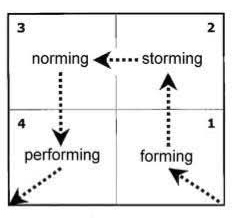
During the Forming stage, Tuckman stated that team member behavior is driven by a desire to be accepted by the others, and to avoid conflict. At the same time, team members are also gathering information and forming opinions. Leaders often need to be directive during this phase.
The Storming stage calls for the team to address issues and conflicts that have arisen, as well to determine how they deal with each other’s perspectives and ideas. This stage can be contentious and unpleasant, especially for team members who are averse to conflict. Tolerance and patience are needed for the team to successfully navigate this stage. It should be noted that some teams never develop past the storming stage. Tuckman calls for leaders to be more accessible during the storming stage, but also to remain fairly directive and decisive.
By the Norming stage Tuckman stated that team members have agreed on goals, as well as a strategic plan of action. Some team members may have modified their own ideas in order to allow the team to function. During this stage, a vast majority of team members take responsibility for their actions and work toward team success.
The Performing stage is reserved for the highest performing teams. These teams are able to function as a cohesive unit. In addition, they find ways to accomplish initiatives smoothly and effectively with minimal conflict. Team members have been given autonomy and minimum supervision is required. Leaders during the performing stage are almost always participative.
It should be noted that Tuckman also stated that even high-performing teams will revert to earlier stages under certain circumstances. Many teams go through these four cycles many times as they deal with a myriad of changes in the workplace. For example, a simple change in leadership may cause the team to revert to the storming stage as team members suddenly challenge existing norms and team dynamics.
Tuckman provides a straight-forward organizational model for leaders to consider. In order to add some additional tools and insights, I present the Modified Tuckman Model for your consideration.
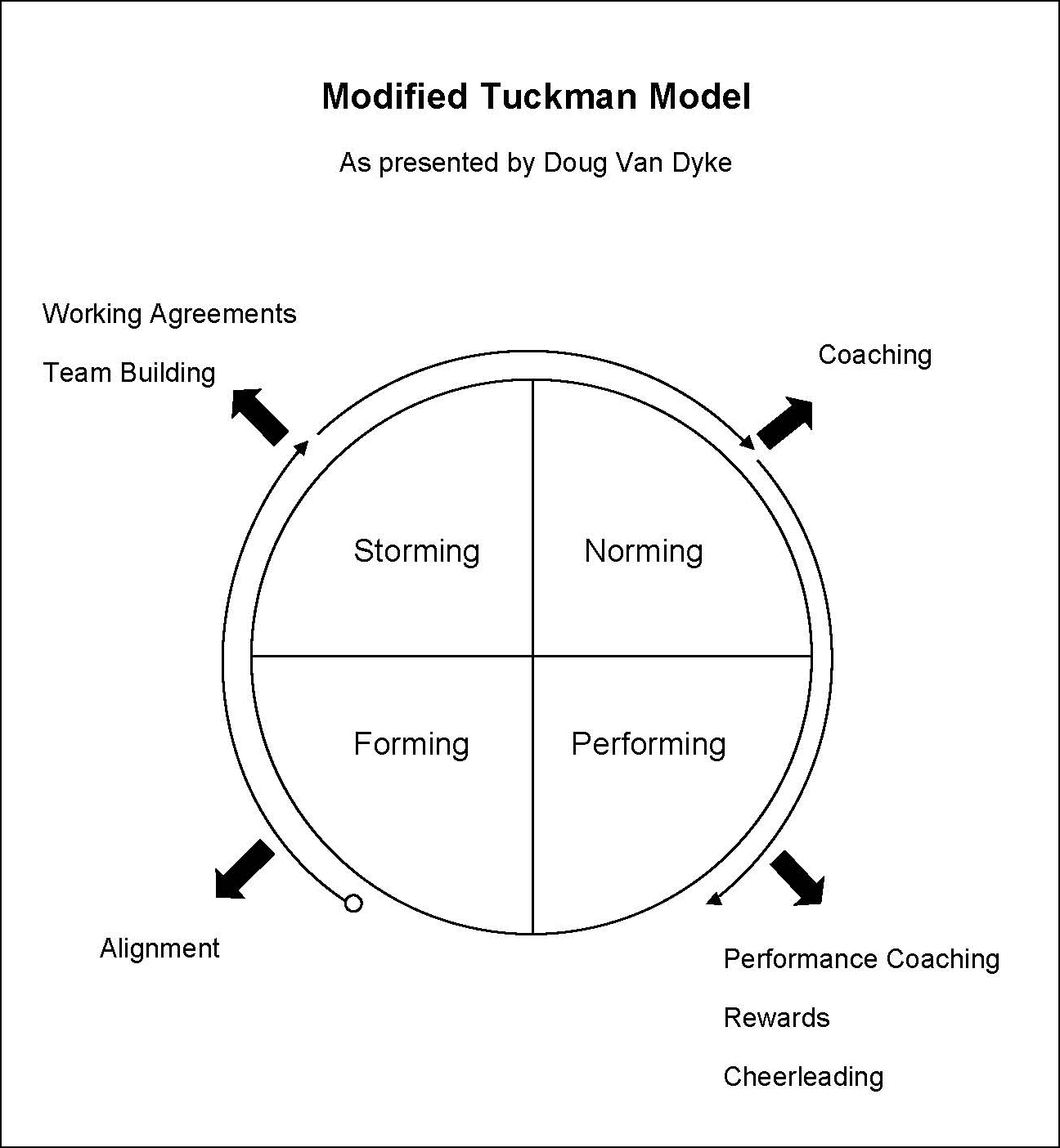
In my opinion, some thinking that should accompany the Forming stage is to strategize about the alignment of the organization. This is where leaders seek to align their organizational talent with the many needs of the business, the ebb and flow of the marketplace, and the potential that exists within the business.
During the Storming stage leaders may want to utilize constructs such as working agreements in order to add clarity to workplace expectations. In addition, they may utilize the working agreements in order to reduce or eliminate workplace conflicts. Lastly, leaders may want to engage their group in workplace team building activities that will build a better sense of team and increase morale. Many leaders in this stage embrace the mantra of company building through team building.
The Norming stage calls for leaders to function as a coach. As such, leaders need to exhibit a mixture of informal, daily coaching, as well as more formalized, structured coaching sessions.
As Tuckman stated, during the Performance stage the leader is participative. In my opinion, this calls for leaders to be very rewards-oriented as they catch their team members doing something right. In addition, the leader can function as a cheerleader by encouraging the team to continue to deliver high-level results. Also during this stage, leaders should drive coaching initiatives that challenge team members to grow and learn new and more advanced skills.
Bottom Line: While every organization possesses a unique culture and mission, the stages that each organization experiences during its group development are surprisingly similar. In order to guide an organization effectively, a leader must have their fingers on the pulse of what stage of group development their team is experiencing. Moreover, an agile leader anticipates the effects of change on group development and prepares accordingly. As such, think strategically my friends and alter your leadership style to best fit the situation in which you find yourself, and to best fit the pressing needs of your team.
Until next time, be well.
Do you want to use this newsletter in print or online?
Please do so, as long as you do not alter the content or embedded links. Also, please include the following information: Doug Van Dyke is a Tampa Bay based leadership and collaboration consultant, executive coach, and strategic planner. Doug’s book, Leadership Simplified, as well as CDs and DVDs are available at www.leadershipsimplified.com. To learn more about coaching and training services, contact Doug today at .(JavaScript must be enabled to view this email address).
© 2012 Leadership Simplified. All rights reserved.
Enjoy this post? Share it with others.
del.icio.us
Digg
Email
Facebook
Google
LinkedIn
Live
Mixx
StumbleUpon
Technorati
TwitThis
 Related Newsletters
Creating Followership
Leading in a Hybrid World
Leaders - Go With The Shot!
It could be done, it should be done, it will be done… by somebody else!
Conflict Management
Leading a Group? Keep Systems Theory in Mind
... Read More Newsletters Related Blog Posts
Seven Ways to Build Collaboration and Workplace Diversity
Workplace Bullying a Problem? Put on Your Conflict Management Hat
The Importance of Being a Team Player
Want Better Collaboration in the Workplace? Try Taking Your Dog to Work
The Magic Touch for the Dodgers
Team Synergy
... Check Out the Blog Related Newsletters
Creating Followership
Leading Through Noise: Decision Clarity in a High-Change Year
AI Literacy Leadership: Navigating and Leveraging the AI Frontier
Leadership & A.I. Policy
Leadership Resilience
Being a Transformational Organization
... Read More Newsletters Related Blog Posts
Lakewood Ranch Leadership Institute
Expectations - Hitting the Mark
Presentation Skills - How Leaders Become Better Speakers
10 Reasons to Attend Our Upcoming Leadership Boot Camp
Work-Life Balance Executive Coaching
Targeted Engagement
... Check Out the Blog Related Newsletters
AI Literacy Leadership: Navigating and Leveraging the AI Frontier
Leadership & A.I. Policy
Leadership Resilience
Dynamic Leadership During Business Disruption
Effective Leadership in a World of Artificial Intelligence | AI Part II
Leadership and Artificial Intelligence
... Read More Newsletters Related Blog Posts
Lakewood Ranch Leadership Institute
Presentation Skills - How Leaders Become Better Speakers
Work-Life Balance Executive Coaching
Targeted Engagement
Decision Fatigue & the Decision Fatigue Trap
Employee Retention Plan
... Check Out the Blog Related Newsletters
AI Literacy Leadership: Navigating and Leveraging the AI Frontier
Leadership & A.I. Policy
Leadership Resilience
Dynamic Leadership During Business Disruption
Effective Leadership in a World of Artificial Intelligence | AI Part II
Leadership and Artificial Intelligence
... Read More Newsletters Related Blog Posts
Lakewood Ranch Leadership Institute
Presentation Skills - How Leaders Become Better Speakers
Work-Life Balance Executive Coaching
Targeted Engagement
Decision Fatigue & the Decision Fatigue Trap
Employee Retention Plan
... Check Out the Blog Related Newsletters
Creating Followership
Leading Through Noise: Decision Clarity in a High-Change Year
AI Literacy Leadership: Navigating and Leveraging the AI Frontier
Leadership & A.I. Policy
Leadership Resilience
Being a Transformational Organization
... Read More Newsletters Related Blog Posts
Lakewood Ranch Leadership Institute
Expectations - Hitting the Mark
Presentation Skills - How Leaders Become Better Speakers
10 Reasons to Attend Our Upcoming Leadership Boot Camp
Work-Life Balance Executive Coaching
Targeted Engagement
... Check Out the Blog Related Newsletters
Creating Followership
Leading Through Noise: Decision Clarity in a High-Change Year
AI Literacy Leadership: Navigating and Leveraging the AI Frontier
Leadership & A.I. Policy
Leadership Resilience
Being a Transformational Organization
... Read More Newsletters Related Blog Posts
Lakewood Ranch Leadership Institute
Expectations - Hitting the Mark
Presentation Skills - How Leaders Become Better Speakers
10 Reasons to Attend Our Upcoming Leadership Boot Camp
Work-Life Balance Executive Coaching
Targeted Engagement
... Check Out the Blog Related Newsletters
Creating Followership
Leading Through Noise: Decision Clarity in a High-Change Year
AI Literacy Leadership: Navigating and Leveraging the AI Frontier
Leadership & A.I. Policy
Leadership Resilience
Being a Transformational Organization
... Read More Newsletters Related Blog Posts
Lakewood Ranch Leadership Institute
Expectations - Hitting the Mark
Presentation Skills - How Leaders Become Better Speakers
10 Reasons to Attend Our Upcoming Leadership Boot Camp
Work-Life Balance Executive Coaching
Targeted Engagement
... Check Out the Blog Related Newsletters
Creating Followership
Leading Through Noise: Decision Clarity in a High-Change Year
AI Literacy Leadership: Navigating and Leveraging the AI Frontier
Leadership & A.I. Policy
Leadership Resilience
Being a Transformational Organization
... Read More Newsletters Related Blog Posts
Lakewood Ranch Leadership Institute
Expectations - Hitting the Mark
Presentation Skills - How Leaders Become Better Speakers
10 Reasons to Attend Our Upcoming Leadership Boot Camp
Work-Life Balance Executive Coaching
Targeted Engagement
... Check Out the Blog Related Newsletters
AI Literacy Leadership: Navigating and Leveraging the AI Frontier
Leadership & A.I. Policy
Leadership Resilience
Dynamic Leadership During Business Disruption
Effective Leadership in a World of Artificial Intelligence | AI Part II
Leadership and Artificial Intelligence
... Read More Newsletters Related Blog Posts
Lakewood Ranch Leadership Institute
Presentation Skills - How Leaders Become Better Speakers
Work-Life Balance Executive Coaching
Targeted Engagement
Decision Fatigue & the Decision Fatigue Trap
Employee Retention Plan
... Check Out the Blog Related Newsletters
AI Literacy Leadership: Navigating and Leveraging the AI Frontier
Leadership & A.I. Policy
Leadership Resilience
Dynamic Leadership During Business Disruption
Effective Leadership in a World of Artificial Intelligence | AI Part II
Leadership and Artificial Intelligence
... Read More Newsletters Related Blog Posts
Lakewood Ranch Leadership Institute
Presentation Skills - How Leaders Become Better Speakers
Work-Life Balance Executive Coaching
Targeted Engagement
Decision Fatigue & the Decision Fatigue Trap
Employee Retention Plan
... Check Out the Blog Related Newsletters
AI Literacy Leadership: Navigating and Leveraging the AI Frontier
Leadership & A.I. Policy
Leadership Resilience
Dynamic Leadership During Business Disruption
Effective Leadership in a World of Artificial Intelligence | AI Part II
Leadership and Artificial Intelligence
... Read More Newsletters Related Blog Posts
Lakewood Ranch Leadership Institute
Presentation Skills - How Leaders Become Better Speakers
Work-Life Balance Executive Coaching
Targeted Engagement
Decision Fatigue & the Decision Fatigue Trap
Employee Retention Plan
... Check Out the Blog Related Newsletters
Creating Followership
Leading Through Noise: Decision Clarity in a High-Change Year
AI Literacy Leadership: Navigating and Leveraging the AI Frontier
Leadership & A.I. Policy
Leadership Resilience
Being a Transformational Organization
... Read More Newsletters Related Blog Posts
Lakewood Ranch Leadership Institute
Expectations - Hitting the Mark
Presentation Skills - How Leaders Become Better Speakers
10 Reasons to Attend Our Upcoming Leadership Boot Camp
Work-Life Balance Executive Coaching
Targeted Engagement
... Check Out the Blog Related Newsletters
Creating Followership
Leading Through Noise: Decision Clarity in a High-Change Year
AI Literacy Leadership: Navigating and Leveraging the AI Frontier
Leadership & A.I. Policy
Leadership Resilience
Being a Transformational Organization
... Read More Newsletters Related Blog Posts
Lakewood Ranch Leadership Institute
Expectations - Hitting the Mark
Presentation Skills - How Leaders Become Better Speakers
10 Reasons to Attend Our Upcoming Leadership Boot Camp
Work-Life Balance Executive Coaching
Targeted Engagement
... Check Out the Blog Related Newsletters
Creating Followership
Leading Through Noise: Decision Clarity in a High-Change Year
AI Literacy Leadership: Navigating and Leveraging the AI Frontier
Leadership & A.I. Policy
Leadership Resilience
Being a Transformational Organization
... Read More Newsletters Related Blog Posts
Lakewood Ranch Leadership Institute
Expectations - Hitting the Mark
Presentation Skills - How Leaders Become Better Speakers
10 Reasons to Attend Our Upcoming Leadership Boot Camp
Work-Life Balance Executive Coaching
Targeted Engagement
... Check Out the Blog Related Newsletters
Creating Followership
Leading Through Noise: Decision Clarity in a High-Change Year
AI Literacy Leadership: Navigating and Leveraging the AI Frontier
Leadership & A.I. Policy
Leadership Resilience
Being a Transformational Organization
... Read More Newsletters Related Blog Posts
Lakewood Ranch Leadership Institute
Expectations - Hitting the Mark
Presentation Skills - How Leaders Become Better Speakers
10 Reasons to Attend Our Upcoming Leadership Boot Camp
Work-Life Balance Executive Coaching
Targeted Engagement
... Check Out the Blog Related Newsletters
AI Literacy Leadership: Navigating and Leveraging the AI Frontier
Leadership & A.I. Policy
Leadership Resilience
Dynamic Leadership During Business Disruption
Effective Leadership in a World of Artificial Intelligence | AI Part II
Leadership and Artificial Intelligence
... Read More Newsletters Related Blog Posts
Lakewood Ranch Leadership Institute
Presentation Skills - How Leaders Become Better Speakers
Work-Life Balance Executive Coaching
Targeted Engagement
Decision Fatigue & the Decision Fatigue Trap
Employee Retention Plan
... Check Out the Blog Related Newsletters
AI Literacy Leadership: Navigating and Leveraging the AI Frontier
Leadership & A.I. Policy
Leadership Resilience
Dynamic Leadership During Business Disruption
Effective Leadership in a World of Artificial Intelligence | AI Part II
Leadership and Artificial Intelligence
... Read More Newsletters Related Blog Posts
Lakewood Ranch Leadership Institute
Presentation Skills - How Leaders Become Better Speakers
Work-Life Balance Executive Coaching
Targeted Engagement
Decision Fatigue & the Decision Fatigue Trap
Employee Retention Plan
... Check Out the Blog Related Newsletters
AI Literacy Leadership: Navigating and Leveraging the AI Frontier
Leadership & A.I. Policy
Leadership Resilience
Dynamic Leadership During Business Disruption
Effective Leadership in a World of Artificial Intelligence | AI Part II
Leadership and Artificial Intelligence
... Read More Newsletters Related Blog Posts
Lakewood Ranch Leadership Institute
Presentation Skills - How Leaders Become Better Speakers
Work-Life Balance Executive Coaching
Targeted Engagement
Decision Fatigue & the Decision Fatigue Trap
Employee Retention Plan
... Check Out the Blog Related Newsletters
AI Literacy Leadership: Navigating and Leveraging the AI Frontier
Leadership & A.I. Policy
Leadership Resilience
Dynamic Leadership During Business Disruption
Effective Leadership in a World of Artificial Intelligence | AI Part II
Leadership and Artificial Intelligence
... Read More Newsletters Related Blog Posts
Lakewood Ranch Leadership Institute
Presentation Skills - How Leaders Become Better Speakers
Work-Life Balance Executive Coaching
Targeted Engagement
Decision Fatigue & the Decision Fatigue Trap
Employee Retention Plan
... Check Out the Blog Related Newsletters
AI Literacy Leadership: Navigating and Leveraging the AI Frontier
Leadership & A.I. Policy
Leadership Resilience
Dynamic Leadership During Business Disruption
Effective Leadership in a World of Artificial Intelligence | AI Part II
Leadership and Artificial Intelligence
... Read More Newsletters Related Blog Posts
Lakewood Ranch Leadership Institute
Presentation Skills - How Leaders Become Better Speakers
Work-Life Balance Executive Coaching
Targeted Engagement
Decision Fatigue & the Decision Fatigue Trap
Employee Retention Plan
... Check Out the Blog Related Newsletters
AI Literacy Leadership: Navigating and Leveraging the AI Frontier
Leadership & A.I. Policy
Leadership Resilience
Dynamic Leadership During Business Disruption
Effective Leadership in a World of Artificial Intelligence | AI Part II
Leadership and Artificial Intelligence
... Read More Newsletters Related Blog Posts
Lakewood Ranch Leadership Institute
Presentation Skills - How Leaders Become Better Speakers
Work-Life Balance Executive Coaching
Targeted Engagement
Decision Fatigue & the Decision Fatigue Trap
Employee Retention Plan
... Check Out the Blog Related Newsletters
AI Literacy Leadership: Navigating and Leveraging the AI Frontier
Leadership & A.I. Policy
Leadership Resilience
Dynamic Leadership During Business Disruption
Effective Leadership in a World of Artificial Intelligence | AI Part II
Leadership and Artificial Intelligence
... Read More Newsletters Related Blog Posts
Lakewood Ranch Leadership Institute
Presentation Skills - How Leaders Become Better Speakers
Work-Life Balance Executive Coaching
Targeted Engagement
Decision Fatigue & the Decision Fatigue Trap
Employee Retention Plan
... Check Out the Blog Related Newsletters
AI Literacy Leadership: Navigating and Leveraging the AI Frontier
Leadership & A.I. Policy
Leadership Resilience
Dynamic Leadership During Business Disruption
Effective Leadership in a World of Artificial Intelligence | AI Part II
Leadership and Artificial Intelligence
... Read More Newsletters Related Blog Posts
Lakewood Ranch Leadership Institute
Presentation Skills - How Leaders Become Better Speakers
Work-Life Balance Executive Coaching
Targeted Engagement
Decision Fatigue & the Decision Fatigue Trap
Employee Retention Plan
... Check Out the Blog Related Newsletters
AI Literacy Leadership: Navigating and Leveraging the AI Frontier
Leadership & A.I. Policy
Leadership Resilience
Dynamic Leadership During Business Disruption
Effective Leadership in a World of Artificial Intelligence | AI Part II
Leadership and Artificial Intelligence
... Read More Newsletters Related Blog Posts
Lakewood Ranch Leadership Institute
Presentation Skills - How Leaders Become Better Speakers
Work-Life Balance Executive Coaching
Targeted Engagement
Decision Fatigue & the Decision Fatigue Trap
Employee Retention Plan
... Check Out the Blog Related Newsletters
AI Literacy Leadership: Navigating and Leveraging the AI Frontier
Leadership & A.I. Policy
Leadership Resilience
Dynamic Leadership During Business Disruption
Effective Leadership in a World of Artificial Intelligence | AI Part II
Leadership and Artificial Intelligence
... Read More Newsletters Related Blog Posts
Lakewood Ranch Leadership Institute
Presentation Skills - How Leaders Become Better Speakers
Work-Life Balance Executive Coaching
Targeted Engagement
Decision Fatigue & the Decision Fatigue Trap
Employee Retention Plan
... Check Out the Blog Related Newsletters
AI Literacy Leadership: Navigating and Leveraging the AI Frontier
Leadership & A.I. Policy
Leadership Resilience
Dynamic Leadership During Business Disruption
Effective Leadership in a World of Artificial Intelligence | AI Part II
Leadership and Artificial Intelligence
... Read More Newsletters Related Blog Posts
Lakewood Ranch Leadership Institute
Presentation Skills - How Leaders Become Better Speakers
Work-Life Balance Executive Coaching
Targeted Engagement
Decision Fatigue & the Decision Fatigue Trap
Employee Retention Plan
... Check Out the Blog Related Newsletters
AI Literacy Leadership: Navigating and Leveraging the AI Frontier
Leadership & A.I. Policy
Leadership Resilience
Dynamic Leadership During Business Disruption
Effective Leadership in a World of Artificial Intelligence | AI Part II
Leadership and Artificial Intelligence
... Read More Newsletters Related Blog Posts
Lakewood Ranch Leadership Institute
Presentation Skills - How Leaders Become Better Speakers
Work-Life Balance Executive Coaching
Targeted Engagement
Decision Fatigue & the Decision Fatigue Trap
Employee Retention Plan
... Check Out the Blog Related Newsletters
AI Literacy Leadership: Navigating and Leveraging the AI Frontier
Leadership & A.I. Policy
Leadership Resilience
Dynamic Leadership During Business Disruption
Effective Leadership in a World of Artificial Intelligence | AI Part II
Leadership and Artificial Intelligence
... Read More Newsletters Related Blog Posts
Lakewood Ranch Leadership Institute
Presentation Skills - How Leaders Become Better Speakers
Work-Life Balance Executive Coaching
Targeted Engagement
Decision Fatigue & the Decision Fatigue Trap
Employee Retention Plan
... Check Out the Blog Related Newsletters
AI Literacy Leadership: Navigating and Leveraging the AI Frontier
Leadership & A.I. Policy
Leadership Resilience
Dynamic Leadership During Business Disruption
Effective Leadership in a World of Artificial Intelligence | AI Part II
Leadership and Artificial Intelligence
... Read More Newsletters Related Blog Posts
Lakewood Ranch Leadership Institute
Presentation Skills - How Leaders Become Better Speakers
Work-Life Balance Executive Coaching
Targeted Engagement
Decision Fatigue & the Decision Fatigue Trap
Employee Retention Plan
... Check Out the Blog Related Newsletters
Creating Followership
Leading Through Noise: Decision Clarity in a High-Change Year
AI Literacy Leadership: Navigating and Leveraging the AI Frontier
Leadership & A.I. Policy
Leadership Resilience
Being a Transformational Organization
... Read More Newsletters Related Blog Posts
Lakewood Ranch Leadership Institute
Expectations - Hitting the Mark
Presentation Skills - How Leaders Become Better Speakers
10 Reasons to Attend Our Upcoming Leadership Boot Camp
Work-Life Balance Executive Coaching
Targeted Engagement
... Check Out the Blog Related Newsletters
AI Literacy Leadership: Navigating and Leveraging the AI Frontier
Leadership & A.I. Policy
Leadership Resilience
Dynamic Leadership During Business Disruption
Effective Leadership in a World of Artificial Intelligence | AI Part II
Leadership and Artificial Intelligence
... Read More Newsletters Related Blog Posts
Lakewood Ranch Leadership Institute
Presentation Skills - How Leaders Become Better Speakers
Work-Life Balance Executive Coaching
Targeted Engagement
Decision Fatigue & the Decision Fatigue Trap
Employee Retention Plan
... Check Out the Blog Related Newsletters
AI Literacy Leadership: Navigating and Leveraging the AI Frontier
Leadership & A.I. Policy
Leadership Resilience
Dynamic Leadership During Business Disruption
Effective Leadership in a World of Artificial Intelligence | AI Part II
Leadership and Artificial Intelligence
... Read More Newsletters Related Blog Posts
Lakewood Ranch Leadership Institute
Presentation Skills - How Leaders Become Better Speakers
Work-Life Balance Executive Coaching
Targeted Engagement
Decision Fatigue & the Decision Fatigue Trap
Employee Retention Plan
... Check Out the Blog Related Newsletters
AI Literacy Leadership: Navigating and Leveraging the AI Frontier
Leadership & A.I. Policy
Leadership Resilience
Dynamic Leadership During Business Disruption
Effective Leadership in a World of Artificial Intelligence | AI Part II
Leadership and Artificial Intelligence
... Read More Newsletters Related Blog Posts
Lakewood Ranch Leadership Institute
Presentation Skills - How Leaders Become Better Speakers
Work-Life Balance Executive Coaching
Targeted Engagement
Decision Fatigue & the Decision Fatigue Trap
Employee Retention Plan
... Check Out the Blog Related Newsletters
Creating Followership
Leading Through Noise: Decision Clarity in a High-Change Year
AI Literacy Leadership: Navigating and Leveraging the AI Frontier
Leadership & A.I. Policy
Leadership Resilience
Being a Transformational Organization
... Read More Newsletters Related Blog Posts
Lakewood Ranch Leadership Institute
Expectations - Hitting the Mark
Presentation Skills - How Leaders Become Better Speakers
10 Reasons to Attend Our Upcoming Leadership Boot Camp
Work-Life Balance Executive Coaching
Targeted Engagement
... Check Out the Blog Related Newsletters
AI Literacy Leadership: Navigating and Leveraging the AI Frontier
Leadership & A.I. Policy
Leadership Resilience
Dynamic Leadership During Business Disruption
Effective Leadership in a World of Artificial Intelligence | AI Part II
Leadership and Artificial Intelligence
... Read More Newsletters Related Blog Posts
Lakewood Ranch Leadership Institute
Presentation Skills - How Leaders Become Better Speakers
Work-Life Balance Executive Coaching
Targeted Engagement
Decision Fatigue & the Decision Fatigue Trap
Employee Retention Plan
... Check Out the Blog Related Newsletters
AI Literacy Leadership: Navigating and Leveraging the AI Frontier
Leadership & A.I. Policy
Leadership Resilience
Dynamic Leadership During Business Disruption
Effective Leadership in a World of Artificial Intelligence | AI Part II
Leadership and Artificial Intelligence
... Read More Newsletters Related Blog Posts
Lakewood Ranch Leadership Institute
Presentation Skills - How Leaders Become Better Speakers
Work-Life Balance Executive Coaching
Targeted Engagement
Decision Fatigue & the Decision Fatigue Trap
Employee Retention Plan
... Check Out the Blog Related Newsletters
AI Literacy Leadership: Navigating and Leveraging the AI Frontier
Leadership & A.I. Policy
Leadership Resilience
Dynamic Leadership During Business Disruption
Effective Leadership in a World of Artificial Intelligence | AI Part II
Leadership and Artificial Intelligence
... Read More Newsletters Related Blog Posts
Lakewood Ranch Leadership Institute
Presentation Skills - How Leaders Become Better Speakers
Work-Life Balance Executive Coaching
Targeted Engagement
Decision Fatigue & the Decision Fatigue Trap
Employee Retention Plan
... Check Out the Blog Related Newsletters
AI Literacy Leadership: Navigating and Leveraging the AI Frontier
Leadership & A.I. Policy
Leadership Resilience
Dynamic Leadership During Business Disruption
Effective Leadership in a World of Artificial Intelligence | AI Part II
Leadership and Artificial Intelligence
... Read More Newsletters Related Blog Posts
Lakewood Ranch Leadership Institute
Presentation Skills - How Leaders Become Better Speakers
Work-Life Balance Executive Coaching
Targeted Engagement
Decision Fatigue & the Decision Fatigue Trap
Employee Retention Plan
... Check Out the Blog Related Newsletters
AI Literacy Leadership: Navigating and Leveraging the AI Frontier
Leadership & A.I. Policy
Leadership Resilience
Dynamic Leadership During Business Disruption
Effective Leadership in a World of Artificial Intelligence | AI Part II
Leadership and Artificial Intelligence
... Read More Newsletters Related Blog Posts
Lakewood Ranch Leadership Institute
Presentation Skills - How Leaders Become Better Speakers
Work-Life Balance Executive Coaching
Targeted Engagement
Decision Fatigue & the Decision Fatigue Trap
Employee Retention Plan
... Check Out the Blog Related Newsletters
AI Literacy Leadership: Navigating and Leveraging the AI Frontier
Leadership & A.I. Policy
Leadership Resilience
Dynamic Leadership During Business Disruption
Effective Leadership in a World of Artificial Intelligence | AI Part II
Leadership and Artificial Intelligence
... Read More Newsletters Related Blog Posts
Lakewood Ranch Leadership Institute
Presentation Skills - How Leaders Become Better Speakers
Work-Life Balance Executive Coaching
Targeted Engagement
Decision Fatigue & the Decision Fatigue Trap
Employee Retention Plan
... Check Out the Blog Related Newsletters
AI Literacy Leadership: Navigating and Leveraging the AI Frontier
Leadership & A.I. Policy
Leadership Resilience
Dynamic Leadership During Business Disruption
Effective Leadership in a World of Artificial Intelligence | AI Part II
Leadership and Artificial Intelligence
... Read More Newsletters Related Blog Posts
Lakewood Ranch Leadership Institute
Presentation Skills - How Leaders Become Better Speakers
Work-Life Balance Executive Coaching
Targeted Engagement
Decision Fatigue & the Decision Fatigue Trap
Employee Retention Plan
... Check Out the Blog Related Newsletters
5 Strategies on How to Lead While in Meetings all Day
The Negatives of Negativity
Leadership Scorecard
Leaders, Be Disruptive
The Negatives of Negativity
Employee Motivation and Leadership Style
... Read More Newsletters Related Blog Posts
Public Speaking & Presentation Skills
Public Speaking Mindset
Motivational Speaker
Workplace Learning Helps Everyone Win
I Hate Selling (The Gonzo Method)
Penn State Mess Showcases Serious Lack of Ethics, Courage and Judgment
... Check Out the Blog Related Newsletters
AI Literacy Leadership: Navigating and Leveraging the AI Frontier
Leadership & A.I. Policy
Leadership Resilience
Dynamic Leadership During Business Disruption
Effective Leadership in a World of Artificial Intelligence | AI Part II
Leadership and Artificial Intelligence
... Read More Newsletters Related Blog Posts
Lakewood Ranch Leadership Institute
Presentation Skills - How Leaders Become Better Speakers
Work-Life Balance Executive Coaching
Targeted Engagement
Decision Fatigue & the Decision Fatigue Trap
Employee Retention Plan
... Check Out the Blog Related Newsletters
AI Literacy Leadership: Navigating and Leveraging the AI Frontier
Leadership & A.I. Policy
Leadership Resilience
Dynamic Leadership During Business Disruption
Effective Leadership in a World of Artificial Intelligence | AI Part II
Leadership and Artificial Intelligence
... Read More Newsletters Related Blog Posts
Lakewood Ranch Leadership Institute
Presentation Skills - How Leaders Become Better Speakers
Work-Life Balance Executive Coaching
Targeted Engagement
Decision Fatigue & the Decision Fatigue Trap
Employee Retention Plan
... Check Out the Blog Related Newsletters
AI Literacy Leadership: Navigating and Leveraging the AI Frontier
Leadership & A.I. Policy
Leadership Resilience
Dynamic Leadership During Business Disruption
Effective Leadership in a World of Artificial Intelligence | AI Part II
Leadership and Artificial Intelligence
... Read More Newsletters Related Blog Posts
Lakewood Ranch Leadership Institute
Presentation Skills - How Leaders Become Better Speakers
Work-Life Balance Executive Coaching
Targeted Engagement
Decision Fatigue & the Decision Fatigue Trap
Employee Retention Plan
... Check Out the Blog Related Newsletters
Creating Followership
Leading Through Noise: Decision Clarity in a High-Change Year
AI Literacy Leadership: Navigating and Leveraging the AI Frontier
Leadership & A.I. Policy
Leadership Resilience
Being a Transformational Organization
... Read More Newsletters Related Blog Posts
Lakewood Ranch Leadership Institute
Expectations - Hitting the Mark
Presentation Skills - How Leaders Become Better Speakers
10 Reasons to Attend Our Upcoming Leadership Boot Camp
Work-Life Balance Executive Coaching
Targeted Engagement
... Check Out the Blog Related Newsletters
AI Literacy Leadership: Navigating and Leveraging the AI Frontier
Leadership & A.I. Policy
Leadership Resilience
Dynamic Leadership During Business Disruption
Effective Leadership in a World of Artificial Intelligence | AI Part II
Leadership and Artificial Intelligence
... Read More Newsletters Related Blog Posts
Lakewood Ranch Leadership Institute
Presentation Skills - How Leaders Become Better Speakers
Work-Life Balance Executive Coaching
Targeted Engagement
Decision Fatigue & the Decision Fatigue Trap
Employee Retention Plan
... Check Out the Blog Related Newsletters
AI Literacy Leadership: Navigating and Leveraging the AI Frontier
Leadership & A.I. Policy
Leadership Resilience
Dynamic Leadership During Business Disruption
Effective Leadership in a World of Artificial Intelligence | AI Part II
Leadership and Artificial Intelligence
... Read More Newsletters Related Blog Posts
Lakewood Ranch Leadership Institute
Presentation Skills - How Leaders Become Better Speakers
Work-Life Balance Executive Coaching
Targeted Engagement
Decision Fatigue & the Decision Fatigue Trap
Employee Retention Plan
... Check Out the Blog Related Newsletters
AI Literacy Leadership: Navigating and Leveraging the AI Frontier
Leadership & A.I. Policy
Leadership Resilience
Dynamic Leadership During Business Disruption
Effective Leadership in a World of Artificial Intelligence | AI Part II
Leadership and Artificial Intelligence
... Read More Newsletters Related Blog Posts
Lakewood Ranch Leadership Institute
Presentation Skills - How Leaders Become Better Speakers
Work-Life Balance Executive Coaching
Targeted Engagement
Decision Fatigue & the Decision Fatigue Trap
Employee Retention Plan
... Check Out the Blog Related Newsletters
AI Literacy Leadership: Navigating and Leveraging the AI Frontier
Leadership & A.I. Policy
Leadership Resilience
Dynamic Leadership During Business Disruption
Effective Leadership in a World of Artificial Intelligence | AI Part II
Leadership and Artificial Intelligence
... Read More Newsletters Related Blog Posts
Lakewood Ranch Leadership Institute
Presentation Skills - How Leaders Become Better Speakers
Work-Life Balance Executive Coaching
Targeted Engagement
Decision Fatigue & the Decision Fatigue Trap
Employee Retention Plan
... Check Out the Blog Related Newsletters
Creating Followership
Leading Through Noise: Decision Clarity in a High-Change Year
AI Literacy Leadership: Navigating and Leveraging the AI Frontier
Leadership & A.I. Policy
Leadership Resilience
Being a Transformational Organization
... Read More Newsletters Related Blog Posts
Lakewood Ranch Leadership Institute
Expectations - Hitting the Mark
Presentation Skills - How Leaders Become Better Speakers
10 Reasons to Attend Our Upcoming Leadership Boot Camp
Work-Life Balance Executive Coaching
Targeted Engagement
... Check Out the Blog Related Newsletters
AI Literacy Leadership: Navigating and Leveraging the AI Frontier
Leadership & A.I. Policy
Leadership Resilience
Dynamic Leadership During Business Disruption
Effective Leadership in a World of Artificial Intelligence | AI Part II
Leadership and Artificial Intelligence
... Read More Newsletters Related Blog Posts
Lakewood Ranch Leadership Institute
Presentation Skills - How Leaders Become Better Speakers
Work-Life Balance Executive Coaching
Targeted Engagement
Decision Fatigue & the Decision Fatigue Trap
Employee Retention Plan
... Check Out the Blog Related Newsletters
Creating Followership
Leading Through Noise: Decision Clarity in a High-Change Year
AI Literacy Leadership: Navigating and Leveraging the AI Frontier
Leadership & A.I. Policy
Leadership Resilience
Being a Transformational Organization
... Read More Newsletters Related Blog Posts
Lakewood Ranch Leadership Institute
Expectations - Hitting the Mark
Presentation Skills - How Leaders Become Better Speakers
10 Reasons to Attend Our Upcoming Leadership Boot Camp
Work-Life Balance Executive Coaching
Targeted Engagement
... Check Out the Blog Related Newsletters
AI Literacy Leadership: Navigating and Leveraging the AI Frontier
Leadership & A.I. Policy
Leadership Resilience
Dynamic Leadership During Business Disruption
Effective Leadership in a World of Artificial Intelligence | AI Part II
Leadership and Artificial Intelligence
... Read More Newsletters Related Blog Posts
Lakewood Ranch Leadership Institute
Presentation Skills - How Leaders Become Better Speakers
Work-Life Balance Executive Coaching
Targeted Engagement
Decision Fatigue & the Decision Fatigue Trap
Employee Retention Plan
... Check Out the Blog Related Newsletters
AI Literacy Leadership: Navigating and Leveraging the AI Frontier
Leadership & A.I. Policy
Leadership Resilience
Dynamic Leadership During Business Disruption
Effective Leadership in a World of Artificial Intelligence | AI Part II
Leadership and Artificial Intelligence
... Read More Newsletters Related Blog Posts
Lakewood Ranch Leadership Institute
Presentation Skills - How Leaders Become Better Speakers
Work-Life Balance Executive Coaching
Targeted Engagement
Decision Fatigue & the Decision Fatigue Trap
Employee Retention Plan
... Check Out the Blog Related Newsletters
Creating Followership
Leading Through Noise: Decision Clarity in a High-Change Year
AI Literacy Leadership: Navigating and Leveraging the AI Frontier
Leadership & A.I. Policy
Leadership Resilience
Being a Transformational Organization
... Read More Newsletters Related Blog Posts
Lakewood Ranch Leadership Institute
Expectations - Hitting the Mark
Presentation Skills - How Leaders Become Better Speakers
10 Reasons to Attend Our Upcoming Leadership Boot Camp
Work-Life Balance Executive Coaching
Targeted Engagement
... Check Out the Blog Related Newsletters
AI Literacy Leadership: Navigating and Leveraging the AI Frontier
Leadership & A.I. Policy
Leadership Resilience
Dynamic Leadership During Business Disruption
Effective Leadership in a World of Artificial Intelligence | AI Part II
Leadership and Artificial Intelligence
... Read More Newsletters Related Blog Posts
Lakewood Ranch Leadership Institute
Presentation Skills - How Leaders Become Better Speakers
Work-Life Balance Executive Coaching
Targeted Engagement
Decision Fatigue & the Decision Fatigue Trap
Employee Retention Plan
... Check Out the Blog Related Newsletters
AI Literacy Leadership: Navigating and Leveraging the AI Frontier
Leadership & A.I. Policy
Leadership Resilience
Dynamic Leadership During Business Disruption
Effective Leadership in a World of Artificial Intelligence | AI Part II
Leadership and Artificial Intelligence
... Read More Newsletters Related Blog Posts
Lakewood Ranch Leadership Institute
Presentation Skills - How Leaders Become Better Speakers
Work-Life Balance Executive Coaching
Targeted Engagement
Decision Fatigue & the Decision Fatigue Trap
Employee Retention Plan
... Check Out the Blog Related Newsletters
Leadership and the Millennial Movement
Selling To Millennials
What is Leadership
Time Manage Your Social Media
... Read More Newsletters Related Blog Posts
10 Reasons to Attend Our Upcoming Leadership Boot Camp
Competencies of Excellent Leaders
Guidelines for Effective In-Person Networking
New Leader Challenges - Let Them Down Easy
New Leaders Challenges – Embrace the Employee Review
New Leader Challenges - Fear the Back Room Deals
... Check Out the Blog Related Newsletters
AI Literacy Leadership: Navigating and Leveraging the AI Frontier
Leadership & A.I. Policy
Leadership Resilience
Dynamic Leadership During Business Disruption
Effective Leadership in a World of Artificial Intelligence | AI Part II
Leadership and Artificial Intelligence
... Read More Newsletters Related Blog Posts
Lakewood Ranch Leadership Institute
Presentation Skills - How Leaders Become Better Speakers
Work-Life Balance Executive Coaching
Targeted Engagement
Decision Fatigue & the Decision Fatigue Trap
Employee Retention Plan
... Check Out the Blog Related Newsletters
AI Literacy Leadership: Navigating and Leveraging the AI Frontier
Leadership & A.I. Policy
Leadership Resilience
Dynamic Leadership During Business Disruption
Effective Leadership in a World of Artificial Intelligence | AI Part II
Leadership and Artificial Intelligence
... Read More Newsletters Related Blog Posts
Lakewood Ranch Leadership Institute
Presentation Skills - How Leaders Become Better Speakers
Work-Life Balance Executive Coaching
Targeted Engagement
Decision Fatigue & the Decision Fatigue Trap
Employee Retention Plan
... Check Out the Blog Related Newsletters
Creating Followership
Leading Through Noise: Decision Clarity in a High-Change Year
AI Literacy Leadership: Navigating and Leveraging the AI Frontier
Leadership & A.I. Policy
Leadership Resilience
Being a Transformational Organization
... Read More Newsletters Related Blog Posts
Lakewood Ranch Leadership Institute
Expectations - Hitting the Mark
Presentation Skills - How Leaders Become Better Speakers
10 Reasons to Attend Our Upcoming Leadership Boot Camp
Work-Life Balance Executive Coaching
Targeted Engagement
... Check Out the Blog Related Newsletters
AI Literacy Leadership: Navigating and Leveraging the AI Frontier
Leadership & A.I. Policy
Leadership Resilience
Dynamic Leadership During Business Disruption
Effective Leadership in a World of Artificial Intelligence | AI Part II
Leadership and Artificial Intelligence
... Read More Newsletters Related Blog Posts
Lakewood Ranch Leadership Institute
Presentation Skills - How Leaders Become Better Speakers
Work-Life Balance Executive Coaching
Targeted Engagement
Decision Fatigue & the Decision Fatigue Trap
Employee Retention Plan
... Check Out the Blog Related Newsletters
Leadership and the Millennial Movement
Selling To Millennials
What is Leadership
Time Manage Your Social Media
... Read More Newsletters Related Blog Posts
10 Reasons to Attend Our Upcoming Leadership Boot Camp
Competencies of Excellent Leaders
Guidelines for Effective In-Person Networking
New Leader Challenges - Let Them Down Easy
New Leaders Challenges – Embrace the Employee Review
New Leader Challenges - Fear the Back Room Deals
... Check Out the Blog Related Newsletters
AI Literacy Leadership: Navigating and Leveraging the AI Frontier
Leadership & A.I. Policy
Leadership Resilience
Dynamic Leadership During Business Disruption
Effective Leadership in a World of Artificial Intelligence | AI Part II
Leadership and Artificial Intelligence
... Read More Newsletters Related Blog Posts
Lakewood Ranch Leadership Institute
Presentation Skills - How Leaders Become Better Speakers
Work-Life Balance Executive Coaching
Targeted Engagement
Decision Fatigue & the Decision Fatigue Trap
Employee Retention Plan
... Check Out the Blog Related Newsletters
AI Literacy Leadership: Navigating and Leveraging the AI Frontier
Leadership & A.I. Policy
Leadership Resilience
Dynamic Leadership During Business Disruption
Effective Leadership in a World of Artificial Intelligence | AI Part II
Leadership and Artificial Intelligence
... Read More Newsletters Related Blog Posts
Lakewood Ranch Leadership Institute
Presentation Skills - How Leaders Become Better Speakers
Work-Life Balance Executive Coaching
Targeted Engagement
Decision Fatigue & the Decision Fatigue Trap
Employee Retention Plan
... Check Out the Blog Related Newsletters
AI Literacy Leadership: Navigating and Leveraging the AI Frontier
Leadership & A.I. Policy
Leadership Resilience
Dynamic Leadership During Business Disruption
Effective Leadership in a World of Artificial Intelligence | AI Part II
Leadership and Artificial Intelligence
... Read More Newsletters Related Blog Posts
Lakewood Ranch Leadership Institute
Presentation Skills - How Leaders Become Better Speakers
Work-Life Balance Executive Coaching
Targeted Engagement
Decision Fatigue & the Decision Fatigue Trap
Employee Retention Plan
... Check Out the Blog Related Newsletters
AI Literacy Leadership: Navigating and Leveraging the AI Frontier
Leadership & A.I. Policy
Leadership Resilience
Dynamic Leadership During Business Disruption
Effective Leadership in a World of Artificial Intelligence | AI Part II
Leadership and Artificial Intelligence
... Read More Newsletters Related Blog Posts
Lakewood Ranch Leadership Institute
Presentation Skills - How Leaders Become Better Speakers
Work-Life Balance Executive Coaching
Targeted Engagement
Decision Fatigue & the Decision Fatigue Trap
Employee Retention Plan
... Check Out the Blog Related Newsletters
AI Literacy Leadership: Navigating and Leveraging the AI Frontier
Leadership & A.I. Policy
Leadership Resilience
Dynamic Leadership During Business Disruption
Effective Leadership in a World of Artificial Intelligence | AI Part II
Leadership and Artificial Intelligence
... Read More Newsletters Related Blog Posts
Lakewood Ranch Leadership Institute
Presentation Skills - How Leaders Become Better Speakers
Work-Life Balance Executive Coaching
Targeted Engagement
Decision Fatigue & the Decision Fatigue Trap
Employee Retention Plan
... Check Out the Blog Related Newsletters
5 Strategies on How to Lead While in Meetings all Day
The Negatives of Negativity
Leadership Scorecard
Leaders, Be Disruptive
The Negatives of Negativity
Employee Motivation and Leadership Style
... Read More Newsletters Related Blog Posts
Public Speaking & Presentation Skills
Public Speaking Mindset
Motivational Speaker
Workplace Learning Helps Everyone Win
I Hate Selling (The Gonzo Method)
Penn State Mess Showcases Serious Lack of Ethics, Courage and Judgment
... Check Out the Blog Related Newsletters
5 Strategies on How to Lead While in Meetings all Day
The Negatives of Negativity
Leadership Scorecard
Leaders, Be Disruptive
The Negatives of Negativity
Employee Motivation and Leadership Style
... Read More Newsletters Related Blog Posts
Public Speaking & Presentation Skills
Public Speaking Mindset
Motivational Speaker
Workplace Learning Helps Everyone Win
I Hate Selling (The Gonzo Method)
Penn State Mess Showcases Serious Lack of Ethics, Courage and Judgment
... Check Out the Blog Related Newsletters
AI Literacy Leadership: Navigating and Leveraging the AI Frontier
Leadership & A.I. Policy
Leadership Resilience
Dynamic Leadership During Business Disruption
Effective Leadership in a World of Artificial Intelligence | AI Part II
Leadership and Artificial Intelligence
... Read More Newsletters Related Blog Posts
Lakewood Ranch Leadership Institute
Presentation Skills - How Leaders Become Better Speakers
Work-Life Balance Executive Coaching
Targeted Engagement
Decision Fatigue & the Decision Fatigue Trap
Employee Retention Plan
... Check Out the Blog Related Newsletters
AI Literacy Leadership: Navigating and Leveraging the AI Frontier
Leadership & A.I. Policy
Leadership Resilience
Dynamic Leadership During Business Disruption
Effective Leadership in a World of Artificial Intelligence | AI Part II
Leadership and Artificial Intelligence
... Read More Newsletters Related Blog Posts
Lakewood Ranch Leadership Institute
Presentation Skills - How Leaders Become Better Speakers
Work-Life Balance Executive Coaching
Targeted Engagement
Decision Fatigue & the Decision Fatigue Trap
Employee Retention Plan
... Check Out the Blog Related Newsletters
AI Literacy Leadership: Navigating and Leveraging the AI Frontier
Leadership & A.I. Policy
Leadership Resilience
Dynamic Leadership During Business Disruption
Effective Leadership in a World of Artificial Intelligence | AI Part II
Leadership and Artificial Intelligence
... Read More Newsletters Related Blog Posts
Lakewood Ranch Leadership Institute
Presentation Skills - How Leaders Become Better Speakers
Work-Life Balance Executive Coaching
Targeted Engagement
Decision Fatigue & the Decision Fatigue Trap
Employee Retention Plan
... Check Out the Blog Related Newsletters
AI Literacy Leadership: Navigating and Leveraging the AI Frontier
Leadership & A.I. Policy
Leadership Resilience
Dynamic Leadership During Business Disruption
Effective Leadership in a World of Artificial Intelligence | AI Part II
Leadership and Artificial Intelligence
... Read More Newsletters Related Blog Posts
Lakewood Ranch Leadership Institute
Presentation Skills - How Leaders Become Better Speakers
Work-Life Balance Executive Coaching
Targeted Engagement
Decision Fatigue & the Decision Fatigue Trap
Employee Retention Plan
... Check Out the Blog Related Newsletters
AI Literacy Leadership: Navigating and Leveraging the AI Frontier
Leadership & A.I. Policy
Leadership Resilience
Dynamic Leadership During Business Disruption
Effective Leadership in a World of Artificial Intelligence | AI Part II
Leadership and Artificial Intelligence
... Read More Newsletters Related Blog Posts
Lakewood Ranch Leadership Institute
Presentation Skills - How Leaders Become Better Speakers
Work-Life Balance Executive Coaching
Targeted Engagement
Decision Fatigue & the Decision Fatigue Trap
Employee Retention Plan
... Check Out the Blog Related Newsletters
AI Literacy Leadership: Navigating and Leveraging the AI Frontier
Leadership & A.I. Policy
Leadership Resilience
Dynamic Leadership During Business Disruption
Effective Leadership in a World of Artificial Intelligence | AI Part II
Leadership and Artificial Intelligence
... Read More Newsletters Related Blog Posts
Lakewood Ranch Leadership Institute
Presentation Skills - How Leaders Become Better Speakers
Work-Life Balance Executive Coaching
Targeted Engagement
Decision Fatigue & the Decision Fatigue Trap
Employee Retention Plan
... Check Out the Blog Related Newsletters
AI Literacy Leadership: Navigating and Leveraging the AI Frontier
Leadership & A.I. Policy
Leadership Resilience
Dynamic Leadership During Business Disruption
Effective Leadership in a World of Artificial Intelligence | AI Part II
Leadership and Artificial Intelligence
... Read More Newsletters Related Blog Posts
Lakewood Ranch Leadership Institute
Presentation Skills - How Leaders Become Better Speakers
Work-Life Balance Executive Coaching
Targeted Engagement
Decision Fatigue & the Decision Fatigue Trap
Employee Retention Plan
... Check Out the Blog Related Newsletters
AI Literacy Leadership: Navigating and Leveraging the AI Frontier
Leadership & A.I. Policy
Leadership Resilience
Dynamic Leadership During Business Disruption
Effective Leadership in a World of Artificial Intelligence | AI Part II
Leadership and Artificial Intelligence
... Read More Newsletters Related Blog Posts
Lakewood Ranch Leadership Institute
Presentation Skills - How Leaders Become Better Speakers
Work-Life Balance Executive Coaching
Targeted Engagement
Decision Fatigue & the Decision Fatigue Trap
Employee Retention Plan
... Check Out the Blog Related Newsletters
AI Literacy Leadership: Navigating and Leveraging the AI Frontier
Leadership & A.I. Policy
Leadership Resilience
Dynamic Leadership During Business Disruption
Effective Leadership in a World of Artificial Intelligence | AI Part II
Leadership and Artificial Intelligence
... Read More Newsletters Related Blog Posts
Lakewood Ranch Leadership Institute
Presentation Skills - How Leaders Become Better Speakers
Work-Life Balance Executive Coaching
Targeted Engagement
Decision Fatigue & the Decision Fatigue Trap
Employee Retention Plan
... Check Out the Blog Related Newsletters
AI Literacy Leadership: Navigating and Leveraging the AI Frontier
Leadership & A.I. Policy
Leadership Resilience
Dynamic Leadership During Business Disruption
Effective Leadership in a World of Artificial Intelligence | AI Part II
Leadership and Artificial Intelligence
... Read More Newsletters Related Blog Posts
Lakewood Ranch Leadership Institute
Presentation Skills - How Leaders Become Better Speakers
Work-Life Balance Executive Coaching
Targeted Engagement
Decision Fatigue & the Decision Fatigue Trap
Employee Retention Plan
... Check Out the Blog Related Newsletters
AI Literacy Leadership: Navigating and Leveraging the AI Frontier
Leadership & A.I. Policy
Leadership Resilience
Dynamic Leadership During Business Disruption
Effective Leadership in a World of Artificial Intelligence | AI Part II
Leadership and Artificial Intelligence
... Read More Newsletters Related Blog Posts
Lakewood Ranch Leadership Institute
Presentation Skills - How Leaders Become Better Speakers
Work-Life Balance Executive Coaching
Targeted Engagement
Decision Fatigue & the Decision Fatigue Trap
Employee Retention Plan
... Check Out the Blog Related Newsletters
AI Literacy Leadership: Navigating and Leveraging the AI Frontier
Leadership & A.I. Policy
Leadership Resilience
Dynamic Leadership During Business Disruption
Effective Leadership in a World of Artificial Intelligence | AI Part II
Leadership and Artificial Intelligence
... Read More Newsletters Related Blog Posts
Lakewood Ranch Leadership Institute
Presentation Skills - How Leaders Become Better Speakers
Work-Life Balance Executive Coaching
Targeted Engagement
Decision Fatigue & the Decision Fatigue Trap
Employee Retention Plan
... Check Out the Blog Related Newsletters
5 Strategies on How to Lead While in Meetings all Day
The Negatives of Negativity
Leadership Scorecard
Leaders, Be Disruptive
The Negatives of Negativity
Employee Motivation and Leadership Style
... Read More Newsletters Related Blog Posts
Public Speaking & Presentation Skills
Public Speaking Mindset
Motivational Speaker
Workplace Learning Helps Everyone Win
I Hate Selling (The Gonzo Method)
Penn State Mess Showcases Serious Lack of Ethics, Courage and Judgment
... Check Out the Blog Related Newsletters
AI Literacy Leadership: Navigating and Leveraging the AI Frontier
Leadership & A.I. Policy
Leadership Resilience
Dynamic Leadership During Business Disruption
Effective Leadership in a World of Artificial Intelligence | AI Part II
Leadership and Artificial Intelligence
... Read More Newsletters Related Blog Posts
Lakewood Ranch Leadership Institute
Presentation Skills - How Leaders Become Better Speakers
Work-Life Balance Executive Coaching
Targeted Engagement
Decision Fatigue & the Decision Fatigue Trap
Employee Retention Plan
... Check Out the Blog Related Newsletters
AI Literacy Leadership: Navigating and Leveraging the AI Frontier
Leadership & A.I. Policy
Leadership Resilience
Dynamic Leadership During Business Disruption
Effective Leadership in a World of Artificial Intelligence | AI Part II
Leadership and Artificial Intelligence
... Read More Newsletters Related Blog Posts
Lakewood Ranch Leadership Institute
Presentation Skills - How Leaders Become Better Speakers
Work-Life Balance Executive Coaching
Targeted Engagement
Decision Fatigue & the Decision Fatigue Trap
Employee Retention Plan
... Check Out the Blog Related Newsletters
Creating Followership
Leading in a Hybrid World
Leaders - Go With The Shot!
It could be done, it should be done, it will be done… by somebody else!
Conflict Management
Leading a Group? Keep Systems Theory in Mind
... Read More Newsletters Related Blog Posts
Seven Ways to Build Collaboration and Workplace Diversity
Workplace Bullying a Problem? Put on Your Conflict Management Hat
The Importance of Being a Team Player
Want Better Collaboration in the Workplace? Try Taking Your Dog to Work
The Magic Touch for the Dodgers
Team Synergy
... Check Out the Blog Related Newsletters
AI Literacy Leadership: Navigating and Leveraging the AI Frontier
Leadership & A.I. Policy
Leadership Resilience
Dynamic Leadership During Business Disruption
Effective Leadership in a World of Artificial Intelligence | AI Part II
Leadership and Artificial Intelligence
... Read More Newsletters Related Blog Posts
Lakewood Ranch Leadership Institute
Presentation Skills - How Leaders Become Better Speakers
Work-Life Balance Executive Coaching
Targeted Engagement
Decision Fatigue & the Decision Fatigue Trap
Employee Retention Plan
... Check Out the Blog Related Newsletters
AI Literacy Leadership: Navigating and Leveraging the AI Frontier
Leadership & A.I. Policy
Leadership Resilience
Dynamic Leadership During Business Disruption
Effective Leadership in a World of Artificial Intelligence | AI Part II
Leadership and Artificial Intelligence
... Read More Newsletters Related Blog Posts
Lakewood Ranch Leadership Institute
Presentation Skills - How Leaders Become Better Speakers
Work-Life Balance Executive Coaching
Targeted Engagement
Decision Fatigue & the Decision Fatigue Trap
Employee Retention Plan
... Check Out the Blog Related Newsletters
Creating Followership
Leading Through Noise: Decision Clarity in a High-Change Year
AI Literacy Leadership: Navigating and Leveraging the AI Frontier
Leadership & A.I. Policy
Leadership Resilience
Being a Transformational Organization
... Read More Newsletters Related Blog Posts
Lakewood Ranch Leadership Institute
Expectations - Hitting the Mark
Presentation Skills - How Leaders Become Better Speakers
10 Reasons to Attend Our Upcoming Leadership Boot Camp
Work-Life Balance Executive Coaching
Targeted Engagement
... Check Out the Blog Related Newsletters
AI Literacy Leadership: Navigating and Leveraging the AI Frontier
Leadership & A.I. Policy
Leadership Resilience
Dynamic Leadership During Business Disruption
Effective Leadership in a World of Artificial Intelligence | AI Part II
Leadership and Artificial Intelligence
... Read More Newsletters Related Blog Posts
Lakewood Ranch Leadership Institute
Presentation Skills - How Leaders Become Better Speakers
Work-Life Balance Executive Coaching
Targeted Engagement
Decision Fatigue & the Decision Fatigue Trap
Employee Retention Plan
... Check Out the Blog Related Newsletters
AI Literacy Leadership: Navigating and Leveraging the AI Frontier
Leadership & A.I. Policy
Leadership Resilience
Dynamic Leadership During Business Disruption
Effective Leadership in a World of Artificial Intelligence | AI Part II
Leadership and Artificial Intelligence
... Read More Newsletters Related Blog Posts
Lakewood Ranch Leadership Institute
Presentation Skills - How Leaders Become Better Speakers
Work-Life Balance Executive Coaching
Targeted Engagement
Decision Fatigue & the Decision Fatigue Trap
Employee Retention Plan
... Check Out the Blog Related Newsletters
AI Literacy Leadership: Navigating and Leveraging the AI Frontier
Leadership & A.I. Policy
Leadership Resilience
Dynamic Leadership During Business Disruption
Effective Leadership in a World of Artificial Intelligence | AI Part II
Leadership and Artificial Intelligence
... Read More Newsletters Related Blog Posts
Lakewood Ranch Leadership Institute
Presentation Skills - How Leaders Become Better Speakers
Work-Life Balance Executive Coaching
Targeted Engagement
Decision Fatigue & the Decision Fatigue Trap
Employee Retention Plan
... Check Out the Blog Related Newsletters
AI Literacy Leadership: Navigating and Leveraging the AI Frontier
Leadership & A.I. Policy
Leadership Resilience
Dynamic Leadership During Business Disruption
Effective Leadership in a World of Artificial Intelligence | AI Part II
Leadership and Artificial Intelligence
... Read More Newsletters Related Blog Posts
Lakewood Ranch Leadership Institute
Presentation Skills - How Leaders Become Better Speakers
Work-Life Balance Executive Coaching
Targeted Engagement
Decision Fatigue & the Decision Fatigue Trap
Employee Retention Plan
... Check Out the Blog Related Newsletters
AI Literacy Leadership: Navigating and Leveraging the AI Frontier
Leadership & A.I. Policy
Leadership Resilience
Dynamic Leadership During Business Disruption
Effective Leadership in a World of Artificial Intelligence | AI Part II
Leadership and Artificial Intelligence
... Read More Newsletters Providing service and insight to customers since 1997
Leadership Simplified
Mailing Address: P.O. Box 682 | Ellenton, FL 34222 USA
Telephone: 941.776.1121
©1997 - 2023 DVD Consulting Incorporated
Leadership Simplified. News, Ideas, Seminars, and Workshops for Management Training, Workplace Team Building, Keynote Speaker and Corporate Events